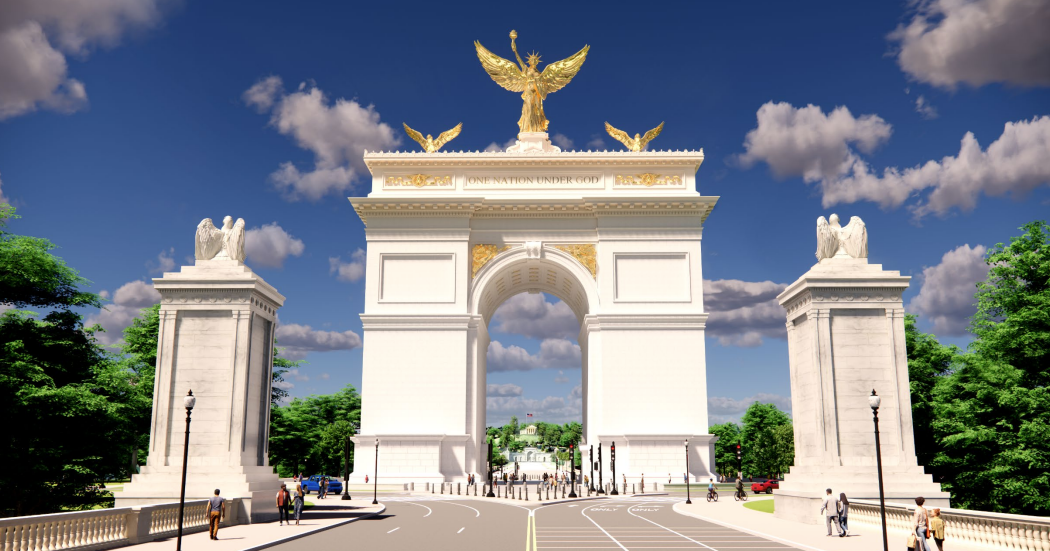
washington — The National Capital Planning Commission voted Thursday to approve President Trump’s plan for a 250-foot triumphal arch, giving final approval for building the monument between the Lincoln Memorial and Arlington National Cemetery.
The NCPC, which is the federal government’s planning agency in the region and has Trump allies, voted 8-4 to approve the project after nearly nine hours of public comment from members of Congress, veterans, architects and residents of Washington, D.C. and Virginia.
It’s unclear when construction on the arch will begin, though the Justice Department said in a court filing last month that it could begin as soon as Thursday. A court challenge in Washington could delay the Trump administration’s plans.
In a separate filing Wednesday night, the Trump administration said a construction company “may — but does not necessarily — arrange off-site preparations for construction mobilization at the site in anticipation of permit approval.”
Prior to the meeting, NCPC Executive Director Mark Paoletta recommended approval of the final site and architectural plans for the building, which will celebrate the 250th anniversary of the United States’ independence.
Paoletta, a senior attorney at the Office of Management and Budget, praised Trump’s “historic vision” for the building and said it would be “the most magnificent arch ever built by man.”
But Rep. Jared Huffman of California, the top Democrat on the House Natural Resources Committee, said at the hearing that the arch was “illegal” and would “destroy the solemn connection between the Lincoln Memorial and Arlington National Cemetery.”
“This arch would be an insult to America, our ideals and our laws,” Hoffman said in an address to the Planning Commission, adding that Congress was the appropriate body to discuss the proposed monument.
Jimi Shaughnessy, a Marine Corps veteran who opposed the proposal, said “a dominant archway of a carnival atmosphere populated by tourists, food trucks and buses is abhorrent and insulting to those who have given their all and their families.”
“Rather than focus on the issues facing military families, this administration intends to spend taxpayer dollars to site, plan and design a monument that no one requested and is content to bypass any laws or regulations that might prevent it from breaking ground,” he said.
According to documents filed with the NCPC, the arch itself is 166 feet tall and is topped by “three gilded figures” — a winged golden female figure flanked by a golden flying eagle on each side — bringing its total height to 250 feet. The building will be located near Ronald Reagan Washington National Airport, although the FAA determined it “does not pose a hazard to air navigation” and has “safety lighting conditions, including nonstandard eternal flames and continuous floodlighting.”
The arch will also feature an observation deck and the Trump administration estimates it could attract 2,000 to 22,400 visitors per day.
The arch, which is expected to take three years to build, will be at the center of what’s known as the Circle of Remembrance, across the Potomac River from the Lincoln Memorial. It’s unclear how much the project will cost and who will foot the bill.
Trump said in September that his “Arc de Triomphe” would be a “top military complex” and house drones and sniper munitions. But the NCPC document does not include military use
Justice Department lawyers declined to provide more details about the national security functions during the October hearing.
The committee said it received more than 1,300 public comments about the project, most of which were negative.
The NCPC approval comes as a federal judge weighs whether to temporarily block construction of the arch. A group of Vietnam veterans, along with the state of Virginia and Washington, D.C., have filed a lawsuit claiming the Trump administration acted without congressional authorization and failed to follow procedures required to build the monument.
In an order on Tuesday, U.S. District Judge Tanya Chutkan asked the government to provide one hour’s notice of the NCPC vote and thirty minutes’ advance notice of any preparations for construction of the arch, giving her time to make a decision on whether to block construction.
At last month’s hearing, Chatkan said the most important issue to her was whether Vietnam veterans had the legal right to sue. Earlier this year, the Supreme Court saw a group of plaintiffs file a similar lawsuit to block construction of the White House Ballroom May have no legal status Challenge this project.
In court documents, the Justice Department called the plaintiffs’ motion “suffocating” and urged Chatkan to follow supreme court The decision lies in White House Ballroom case, but attorneys for the plaintiff group argued that their legal arguments differed from those in the ballroom case and urged Chutkan to stop construction of the arch.
Two of the plaintiffs, Vietnam veterans Michael Lemmon and Shaun Byrnes, told Chutkan at a hearing last month that the arch’s construction would affect their experience visiting graves at Arlington National Cemetery, saying the arch’s size and purpose would harm them.
In a separate lawsuit filed in late October, Virginia and the District of Columbia filed the case, which was assigned to Chatkin, who had heard arguments from a Vietnam veterans group the day before. The state’s attorney general argued that “defendants will cause irreparable harm once they break ground on this project” because “the Arch Project will inevitably disrupt traffic between jurisdictions, generate pollution and stormwater runoff in the Potomac River, interfere with emergency services, and create numerous other challenges.”