Many Americans drive an Ohio-made Honda or a Kentucky-made Toyota but never consider either car to be an import. That relief began with the trade war.
In 1980, no Japanese automakers were assembling vehicles in the United States, but within a decade, all major automakers were assembling vehicles in the United States, according to America’s Compass.
President Donald Trump wants Chinese automakers to follow the same playbook. “Japan did it, but they hired our people,” he told Fox News on September 11, according to Reuters, adding that he was willing to accept a Chinese car factory here.
Ford CEO Jim Farley sent a more pointed message on September 29 in Detroit. He said it was “too late” for Europe to fend off Chinese automakers, but according to CNBC, the United States still had time to be cautious. Embarrassingly, Ford signed up in July to help Chinese rivals expand into Europe.
Also read: Volkswagen’s latest electric car uses Chinese chips, starts at nearly $19,000
Europe’s wall has a mixed-shaped gap
Europe did put up barriers. The European transport campaign group Transport and Environment said the 2024 tariffs hit China’s pure electric vehicles, but plug-in hybrids were not affected.
Chinese brands are heading straight into the chasm. Bloomberg quoted Dataforce as reporting that in August they accounted for a record share of nearly 12% of new car sales in Europe, most of which were hybrids that evaded tariffs. The lesson Farley fails to mention is that the shape of a trade barrier is more important than its height.
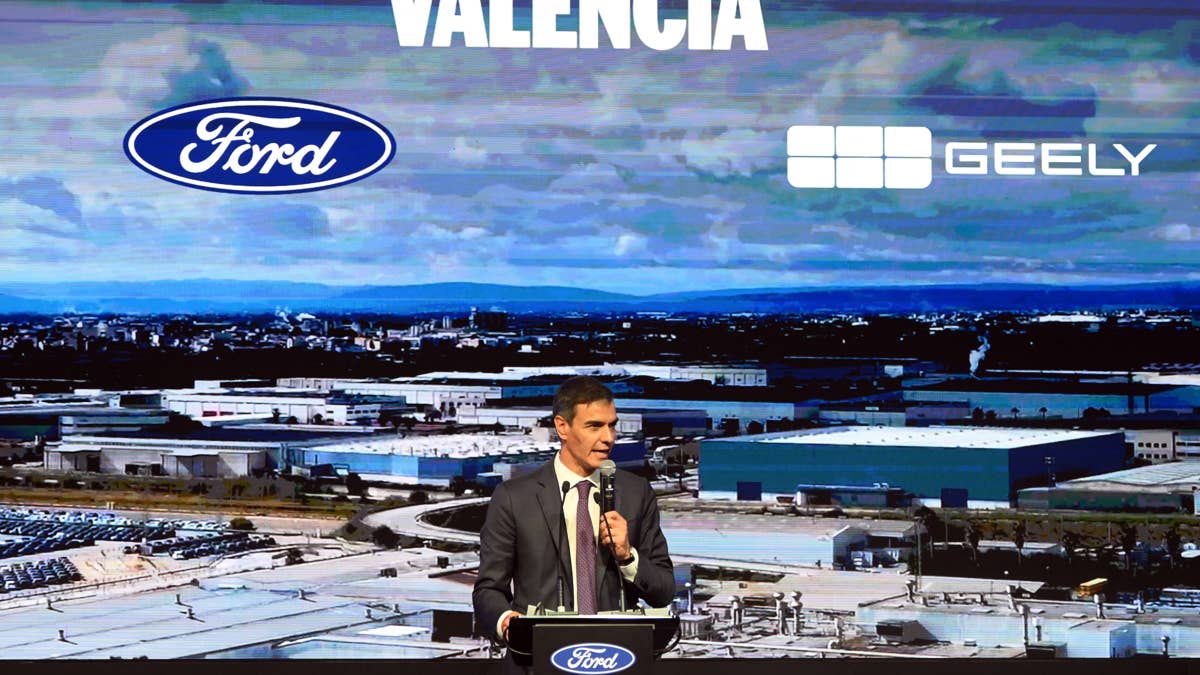
The second gap is local production. Ford said in July that Geely planned to produce two electric SUVs at Ford’s plant in Valencia, Spain, starting in 2028. One expert told The Associated Press that the deal provides Geely with a shortcut around EU tariffs.
Jose Jordan/Getty Images
Ford is already testing possible deals facing the U.S.
Ford will own two-thirds of the Valencia joint venture, according to Bloomberg. The disagreement is important because it reflects ideas Farley presented to Trump officials in January.
Under this concept, Chinese automakers can only produce cars in the United States through joint ventures controlled by U.S. partners.
A September letter from the U.S. Department of Transportation to Farley criticized the framework “to promote Chinese joint ventures in the United States.” According to CNBC, Ford called that characterization one of the letter’s factual errors.
To my surprise, Valencia turned the debate in Washington into a live experiment. If Ford’s controlling stake can keep profits and technology flowing, Farley’s cautious entry model will become important. If Geely uses the plant as a springboard for Europe, policymakers will get their answers from Spain.
For investors, Ford (NYSE: F ) is betting on whether Detroit can survive this battle.
The stock currently trades at about 6.6 times this year’s expected earnings, according to Stock Analysis, a low multiple that shows how much doubt the market has priced in.
more cars:
- Tesla Cybercab has unexpected limitations at launch
- BYD sends clear message to Toyota, Detroit about solid-state batteries
- Xiaomi starts offering SUVs to U.S. buyers that they can’t legally get
Farley is right about Europe, but time can’t save America
I think Farley’s diagnosis is correct and he has first hand knowledge of the product. According to a 2024 Fortune magazine report, he drove the Xiaomi SU7 for six months. Europe sees Chinese cars as a tariff issue, while Chinese brands see tariffs as a product planning issue.
The price gap illustrates his urgency. According to InsideEVs, the BYD Seagull sells for about $10,000 in China. It was once China’s best-selling car, and BYD said its next-generation model can charge to 70% in about five minutes, the outlet reported.
Despite European tariff barriers, the average selling price of electric vehicles in China is still 21% lower, according to data from Transport & Environment. According to CNBC, Ford’s answer is a “universal electric” pickup truck due to be launched next year, and its price will indicate whether Detroit can close the gap, not just isolate it.
His prescription is thinner. America’s real advantage is not time but obstacles constructed in different ways. A Commerce Department rule bans automakers with sufficient ties to China from selling connected cars in the United States starting in 2027, even if the cars are made in the United States, according to the Bureau of Industry and Security.
Unlike Europe’s tariffs, this rule ignores powertrains entirely, so there’s no hybrid bypass. The problem is that rules are not laws. It allows companies to seek authorization for transactions that would otherwise be prohibited, according to a recent analysis.
Trump’s “people who hire us” test also has history.
A City Journal review described the 1981 Japanese export restrictions as partially successful at best, noting that they spurred Japanese companies to build factories here. Jobs followed the factory, but the pressure in Detroit never went away.
Three markers will show whether America remains special. According to Reuters, Congress is considering a permanent ban, which the automakers hope to pass by the end of December. In Europe, Chinese brands are launching plug-in hybrids ahead of possible tariffs, and their share after any tariffs will show how much of the loophole was exploited, according to Bloomberg.
The third one is Valencia. Ford said its first Geely SUV will be launched in 2028 and provided an early look at the Farley joint venture model.
The real fight is who owns the factory
For decades, foreign automakers could only produce cars in China through joint ventures with local partners. The Farley framework was reportedly flipped for Beijing, with the Spanish factory being where the framework was first tested.
Experts told CNN that Chinese brands could be in U.S. showrooms within five to 10 years. If that is the case, the question for investors is whose balance sheets sit in their hands.
Watch Congress before the end of the year. Long before the first Geely car was built in Valencia, the law was in place.
RELATED: The robotaxi payday Tesla promised owners isn’t coming