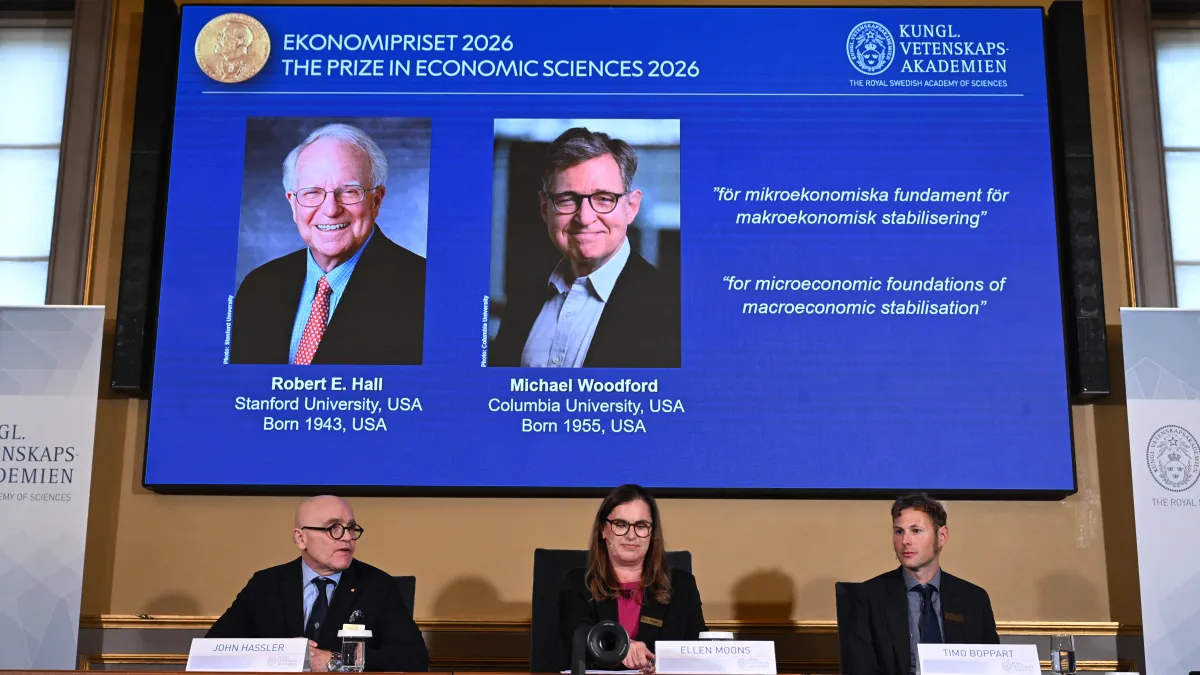
U.S.-born economists Robert E. Hall and Michael Woodford won the Nobel Prize in Economics on Monday for their work on models that help governments and central banks respond to economic shocks.
The Royal Swedish Academy of Sciences announced the winners in Stockholm and stated that the winners were awarded for “laying a microeconomic foundation for macroeconomic stability.”
“Recipients have helped us weather the peaks and valleys of the economy,” the college said in a statement.
Hall is affiliated with Stanford University in California and Woodford is affiliated with Columbia University in New York.
“This is a huge honor and a surprise,” Woodford told the committee by phone from New York on Monday.
“The laureates’ work provides a stable theoretical basis for the models we currently use for central banks and governments around the world,” John Hassler, chairman of the Economic Science Prize Committee, said in a press release.
“With them, we are better able to respond to economic shocks, such as energy crises or sudden changes in household consumption.”
For decades, governments have responded to economic shocks by following British economist John Maynard Keynes’ prescription during the Great Depression: intervening in the economy by lowering taxes and increasing government spending to encourage consumers and businesses to spend and invest on their own and help restart the economy.
“This is the secret of Keynesianism, and it works well until it doesn’t,” said Timo Boppart of the Nobel Prize Committee. Policymakers once thought that economic management involved simple trade-offs, such as unemployment staying low when inflation was high and rising when inflation fell. But the “stagflation” of the 1970s, when the world economy experienced both high inflation and high unemployment, proved this formula to be too simplistic.
Hall and Woodford set out to propose an improved model that considers how consumers and businesses actually make decisions about whether to invest and spend.
“Robert E. Hall and Michael Woodford each made contributions that helped establish a new foundation for stable policy,” Hassler said.
Last year, three researchers studying business innovation won awards for explaining how new products and inventions can boost economic growth and human well-being, even if they leave older companies in the dust.
The official name of the economics award is the Sveriges Riksbank Prize in Economic Sciences in Memory of Alfred Nobel. The central bank established it in 1968 to honor Nobel, the 19th-century Swedish businessman and chemist who invented dynamite and established five Nobel Prizes.
Nobel purists stress that the Economics Prize is not technically a Nobel Prize, but it is always awarded along with the other prizes on December 10, the anniversary of Nobel’s death in 1896.
The Nobel Prizes in Medicine, Physics, Chemistry, Literature and Peace were announced last week.
This year’s prize is SEK 12 million (approximately US$1.2 million), regardless of whether it is an individual, a group of winners or an organization.
___
Dazio reported from Berlin.