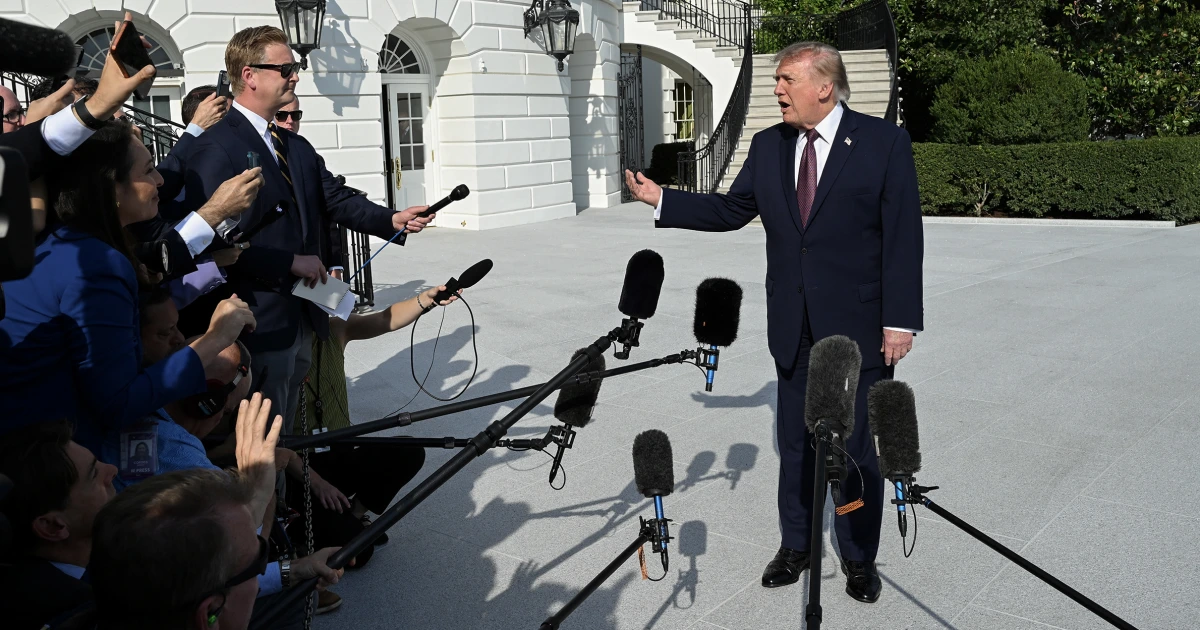
A federal judge late Tuesday issued an order blocking the Trump administration from banning CNN, Politico and MS NOW from the White House while a lawsuit filed by the groups over access continues.
U.S. District Judge Timothy Kelly in Washington, D.C., issued the preliminary injunction after a hearing on Thursday, which the government claimed was imposed in part because of national security concerns; media outlets said it was because of “viewpoint discrimination.”
Kelly sided with the news media, noting that Trump imposed the ban on national security grounds after press passes had already been revoked, ruling that it also may have violated journalists’ free speech and due process rights.
“The record contains virtually nothing relevant to national security related to the President’s decision to revoke Plaintiff’s hard order, which the Court could have delayed,” Kelly wrote in the 26-page opinion.
His order would allow those outlets access to the White House until potential lawsuits challenging the ban are resolved. But it does not require the administration to allow journalists access to the Oval Office or Air Force One, where the administration has blocked reporters from CNN and Politico in recent weeks.
Before the ruling was announced, President Trump posted on TruthSocial that he would appeal. The White House did not immediately respond to a request for comment following the ruling.
Kelly has issued a temporary restraining order lifting the ban while he weighs whether to issue an injunction.
Trump announced on September 18 that he would ban CNN, MS NOW and Politico from social media, saying this was “the result of their constant ‘reporting’ of fake news!”
“The media should not continually write or report fiction and lies when reporting on the President of the United States, the Trump Administration, or the United States of America. Other fake news outlets should follow suit,” he wrote on Truth Social.
The three news organizations said in court documents that the ban affected 78 reporters with “hard passes,” meaning they had been previously screened and qualified to work at the White House.
The media outlets sued, alleging that Trump’s actions violated their due process rights and First Amendment protections for news gathering and speech.
“This ban is a direct attack on the First Amendment and a flagrant violation of our most fundamental constitutional principles,” the lawsuit states.
Later, the White House and Trump began to argue that the ban was to address national security concerns, with Trump saying in another post that these media reports “pose a threat to our national security and must stop immediately!”
The judge was unmoved by this argument.
He said it was clear from Trump’s announcement of the ban and subsequent remarks that his motives were content.
“President Trump may have barred the plaintiffs from the White House because he believes their reporting is generally inaccurate and biased against him,” Kelly wrote. Kelly found the decision violated the reporters’ First and Fifth Amendment rights.
Ho noted, however, that his decision did not acknowledge that Trump’s concerns about accuracy and fairness were unfounded or that the government was “incompetent when its real purpose is to protect national security when classified information is unlawfully disclosed.”
Kelly cited Trump’s recent remarks to Time magazine. Trump said he didn’t like “bad story after bad story” from reporters at CNN, Politico and MS NOW. Boutrous argued before the decision that it was “an admission of viewpoint discrimination.”
“President Trump, I trust him,” Boutros said. “He didn’t hide it.”
In previous decisions, Kelly also found that the government had denied the press due process under settled law in several cases that had been brought to a federal appeals court in Washington, D.C.
The White House argued the appeals court’s decision was wrong.
“Maybe — but this court is bound by D.C. Circuit precedent, period,” Kelly wrote.
During Thursday’s hearing on the ban, Justice Department lawyer Michael Velchik, representing the White House, asked Kelly to lift his restraining order, saying the White House was a “sacred place” that should not be allowed in simply because people “claim to be journalists.”
“Being in the White House is a privilege, not a right,” Wilchik said.
Ted Boutrous, an attorney for the media organization, argued that the administration was engaging in impermissible and unconstitutional “viewpoint discrimination” because the ban was based on Trump’s aversion to media coverage and because he expressed hope that the ban would force journalists to “clean up.”
In court filings, Butrus urged Kelly to ignore the national security arguments, calling them fabrications and not the true substance of the case.
Boutrous argued that “the president himself continues to tell anyone who will listen what the ban really means, complaining at length in a recent interview with Time that he banned the plaintiffs because he felt he shouldn’t be ‘forced to endure’ what he saw as ‘constant bad stories’ because he ‘won the election’ and ‘did great things.'”
After Tuesday night’s ruling, Boutros said he and his clients were grateful to the court for re-ensuring their access.
“The President has repeatedly, candidly and consistently acknowledged publicly that he banned our client from the White House to punish coverage he did not like,” the attorney said in a statement. “This ban has caused profound harm to our client, the First Amendment, and the public at large. The court is right to bar the White House from enforcing this ‘unconstitutional ban.'”
Separately, the Justice Department said last week it was investigating five major television networks, including CNN and NBC, for possible violations of federal antitrust laws after the networks temporarily refused to provide syndicated coverage of President Donald Trump due to a ban imposed on the three news outlets.
The pool is a rotating network group that shares duties of documenting the president’s activities during public appearances and travels. The on-call network then distributes the information and media (such as video and audio) to other channels for consumption.