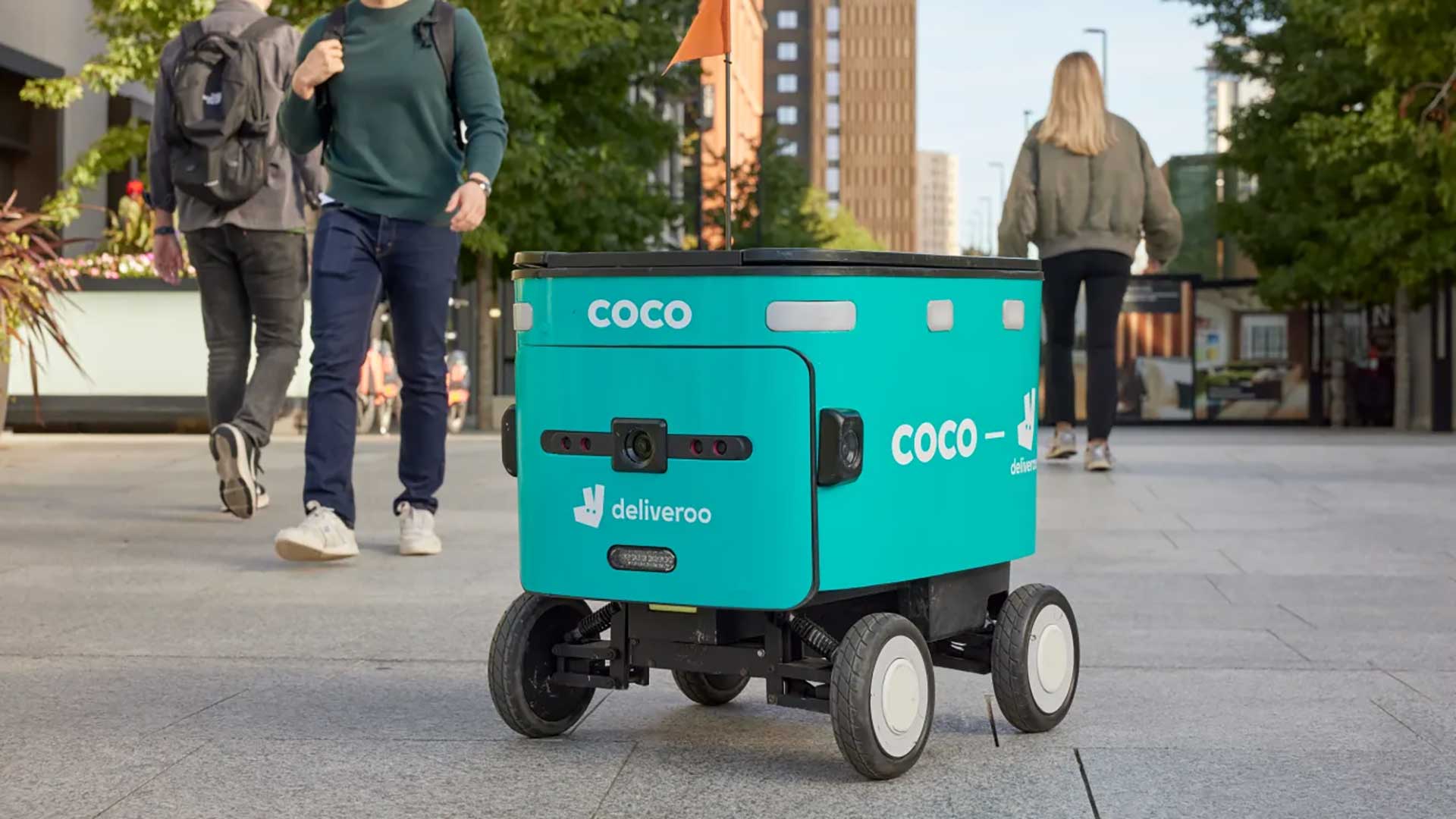
Deliveroo is to start using pavement robots to deliver takeaways and groceries in the UK, with the first robot deliveries set to take place in London in the coming weeks.
The brand’s robots will initially operate in Canary Wharf in east London, as well as in Milton Keynes, Leeds, Stockton-on-Tees and Nottingham, all areas where local councils allow robot deliveries.
Miki Kuusi, Deliveroo’s chief executive, said the move was “not about replacing” human riders. “We think of it as complementary [to human couriers]”Certain types of shipments, certain types of merchants, certain environments and places are better for autonomous delivery.”
The robot is made by Coco, a US technology company that has an exclusive deal with Deliveroo. They run at high speeds and use sensors, cameras and AI navigation systems to navigate the pavement.
Deliveroo is in talks with other councils in England and with the Department for Transport as they seek permission to use the technology more widely.
Kuusi, 37, said the number of robots will grow as technology improves, but described it as an “incremental process”. He said: “Especially in a high-density urban environment, you always need people to deliver.
Competing platforms also automate delivery. Just Eat is using robot couriers made by Starship in some parts of the UK, while Deliveroo is trialling aerial drone deliveries in Dublin.
Deliveroo was founded in 2013 by tech entrepreneur Will Shu and was bought last year by US delivery group DoorDash in a £2.9bn takeover. Kuusi, who is also the international chief executive of DoorDash, has since sought to make ordering on the platform more affordable and to expand groceries. On September 24 the company announced a partnership with Aldi.
Kuusi said robots will help reduce costs. “Plastic boxes on wheels around the city are incredibly energy-efficient, the hardware can be very low-cost, and ultimately makes the service much more affordable,” he said.
He also said that robot couriers will help local retailers and independent shops compete with international groups such as Amazon and Shein. “It is not going to some company that brings something through the airport from the other side of the world, trying to price-competition to death on the local high street,” he said.
The use of sidewalk robots has attracted controversy. In July, campaign group Living Streets argued that the Starship robots used by the Co-op for grocery deliveries presented a “danger to pedestrians”.
Kuusi said: “It is a very easy thing to solve all the concerns and fears on paper in theory. But when you see these things on the streets and how they work as part of the city, the reality is a good mix.”
Deliveroo does not consider riders who carry out orders as employees. They are independent contractors by law, and critics say the model is exploitative because riders do not receive benefits such as sick pay or pension contributions.
Concerns have also been raised that a feature that allows riders to rent accounts for surrogates could be exploited by criminals. Deliveroo has introduced new security features in response.
In France, four campaign groups have sued Deliveroo and Uber Eats, accusing them of “human trafficking” and making “significant profits by exploiting the vulnerability of these workers”. Both companies deny the claims.
Kuusi said: “If I look at the UK, we are talking about over 100,000 people who are actively delivering on Deliveroo.” He said the company “needs to come up with more sophisticated ways to try to fight malpractice on the platform”, adding: “This is not what we want on the platform.”