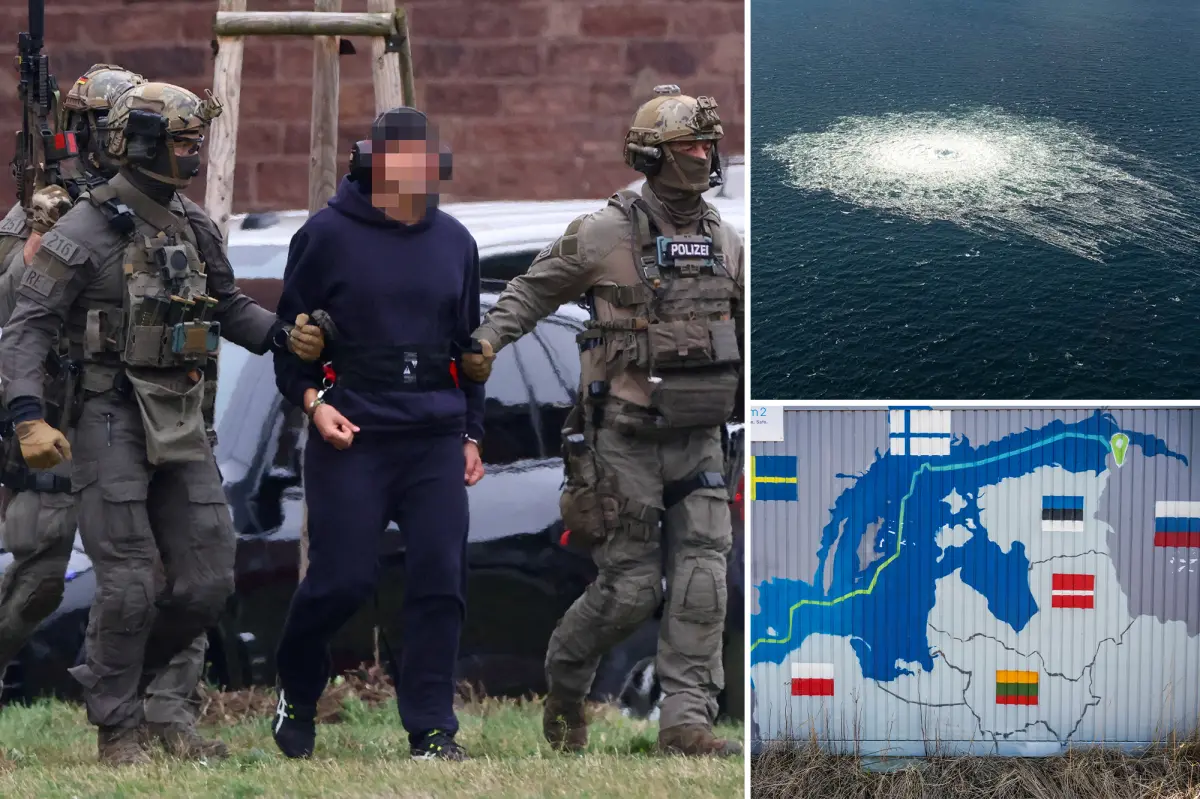
A former Ukrainian military officer went on trial in Germany on Wednesday on charges stemming from an undersea explosion four years ago at the Nord Stream gas pipeline linking Russia and Germany, considered one of Europe’s biggest acts of sabotage since World War II.
Prosecutors said the suspect faces charges of “complicity in war crimes” for causing explosions, damaging property, disrupting public services and attacking civilian infrastructure.
Under German privacy rules, the suspect will be identified in court only as Serhii K., although he has been publicly named Serhii Kuznietsov during extradition proceedings in Italy.
While international observers initially blamed Moscow, investigators are increasingly examining suggestions that Ukraine’s national security services may have been involved – even though Ukraine counts Germany as one of its closest allies.
The suspect, believed to be the mastermind of the attack, is on trial under tight security at the Hanseatic Higher Regional Court in Hamburg.
According to the charges, the defendants were involved in the September 26, 2022 explosion that damaged a pipeline carrying Russian natural gas to Germany under the Baltic Sea.
At the time, European countries were moving to wean themselves off dependence on Russian energy following the Kremlin’s full-scale invasion of Ukraine in February 2022.
Prosecutors said the plot was aimed at permanently disrupting natural gas deliveries and preventing Russia from using the revenues to fund its military operations.
The defendants and others allegedly used a yacht that sailed from the German port of Rostock. It was rented from a German company with the help of a middleman using a fake ID card.
The explosion ruptured the Nord Stream 1 pipeline, which was Russia’s main route for gas supplies to Germany until Moscow cut off supplies in August 2022.
They also damaged the Nord Stream 2, which was never put into service because Germany suspended its certification process shortly before Russia invaded Ukraine.
The suspects allegedly organized and detonated at least four bombs weighing approximately 31 to 62 pounds near the Danish island of Bornholm at a depth of 230 feet to 263 feet.
In 2025, he was detained in a village in Italy and police raided the bungalow where he lived with his family. He surrendered without resistance, police said. In November, he was extradited to Germany.
In August, a second suspect was arrested on a European arrest warrant in the northern Croatian town of Pula. He has applied for asylum in Croatia to fight extradition to Germany.
The pipelines have long been the target of criticism from the United States and some of its allies, who warn that they increase reliance on Russian gas.
Russia claimed that U.S. and British intelligence agencies were involved in the bombing and accused NATO of involvement in the attack, while some Western countries initially blamed Russia.
Ukrainian President Volodymyr Zelensky has denied accusations that Ukraine was involved in the pipeline explosion.
The German government has so far not commented on the upcoming trial, noting that no ruling has been made and that the case is being handled by an independent judicial body.
So far, as of Dec. 17, 16 court dates have been scheduled. Additional court dates are also planned for January and February 2027. It is unclear when the verdict will be announced.