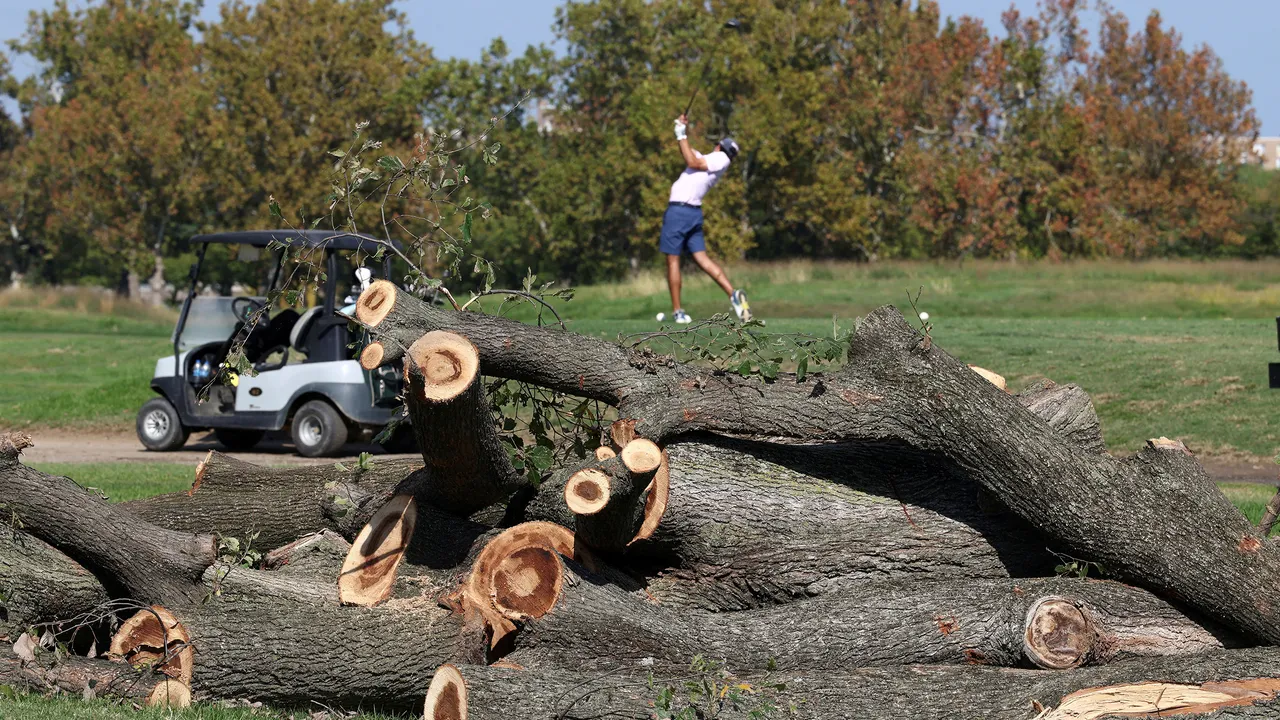
A golfer tees off near felled trees at the East Potomac Golf Course on October 14, 2026 in Washington, DC.Photograph: Kevin Lamarque/Reuters
in an era Deporting immigrants without due process, seeking to rewrite the Constitution to eliminate birthright citizenship guarantees, attacking free speech at law firms and universities—in short, during President Donald Trump’s second term—the stakes could not be lower for D.C. Conservation League v. Department of the Interior. The lawsuit involves the president’s request to close a public golf course a few miles from the White House and replace the worn-out facilities with a new course that Trump said was “designed for the highest levels of golf and capable of hosting world-class championships.” But focusing on the ostensible issue in the case — whether East Potomac Park will remain open and accessible to recreational visitors — is actually missing the forest for the trees: More specifically, earlier this month, the government cut down 430 healthy, non-invasive trees in a single day after repeatedly assuring a federal judge that basic maintenance would not be exceeded without providing adequate warning.
The Trump administration has been feuding with federal courts since the president returned to office, most acrimoniously with lower federal courts. Trump has attacked judges, including his own Supreme Court nominees. He called for the impeachment of U.S. District Judge James Boasberg, who has balked at the government’s efforts to send hundreds of Venezuelans to El Salvador’s notorious prisons. The Justice Department has filed ethics complaints against judges (none that I know of were successful) and asked them to recuse themselves from cases (again). It took the unprecedented step of suing all district judges in Maryland, accusing them of working to ensure that the complaints of people challenging deportation proceedings were heard. (That move also failed.) “This is a war, man,” then-Deputy Attorney General Todd Blanche told the Federalist Society in November 2025, attacking “rogue, radical judges.”
Yet no controversy exemplifies the administration’s unabashed disrespect for the judiciary — its willingness to ignore clear court orders to pursue Trump-ordered goals — more than the current golf course lawsuit. For months, U.S. District Judge Ana Reyes, a Biden appointee, has rejected repeated requests from plaintiffs that she order the government not to proceed with the stadium renovation plan — because, at least the government insists, there is no such plan. Then, at 4:55 p.m. on Oct. 9, the Friday before the holiday weekend, the government notified Reyes and the plaintiffs that it planned to remove “up to 529 trees” from the course and surrounding land. At eight o’clock on Saturday morning it began to cut them down. Reyes convened the parties for an emergency hearing on Columbus Day, during which she described herself as “angry” and reportedly raised her voice as she berated government lawyers. “I don’t believe you would have done what you did,” Reyes said. “In what universe do people in your office think this is acceptable?”
A normal government might express remorse. This raises the stakes. On Friday, the Justice Department asked Reyes to withdraw from the case in a motion signed by the Justice Department’s No. 3 official, Deputy Attorney General Stanley Woodward, accusing her of “histrionics” and a “deep-seated and clear antipathy toward the Trump administration.” (Reyes denied the request.) On Monday morning, before the two sides returned to court, Trump called Reyes a “crazy lunatic” in a post on Truth Social. In an astonishing feat of judicial gaslighting, the Justice Department insisted that tree removal had nothing to do with Trump’s plans to renovate golf courses, saying the plan was “still in the planning stages” and therefore had not yet been challenged. Trump immediately proved this statement wrong and announced that the old stadium would close and construction of the new stadium would begin on November 15.
I sat through a marathon seven-hour session in court on Monday, and I had never seen such a tense confrontation between the judge and government lawyers. Reyes first asked other government lawyers to say whether they would sign the recusal motion; Woodward ordered them not to answer. (Reyes eventually backed down.) “A federal judge received death threats over a golf course,” she said toward the end of the hearing. “I really don’t think that’s what the founders envisioned.”