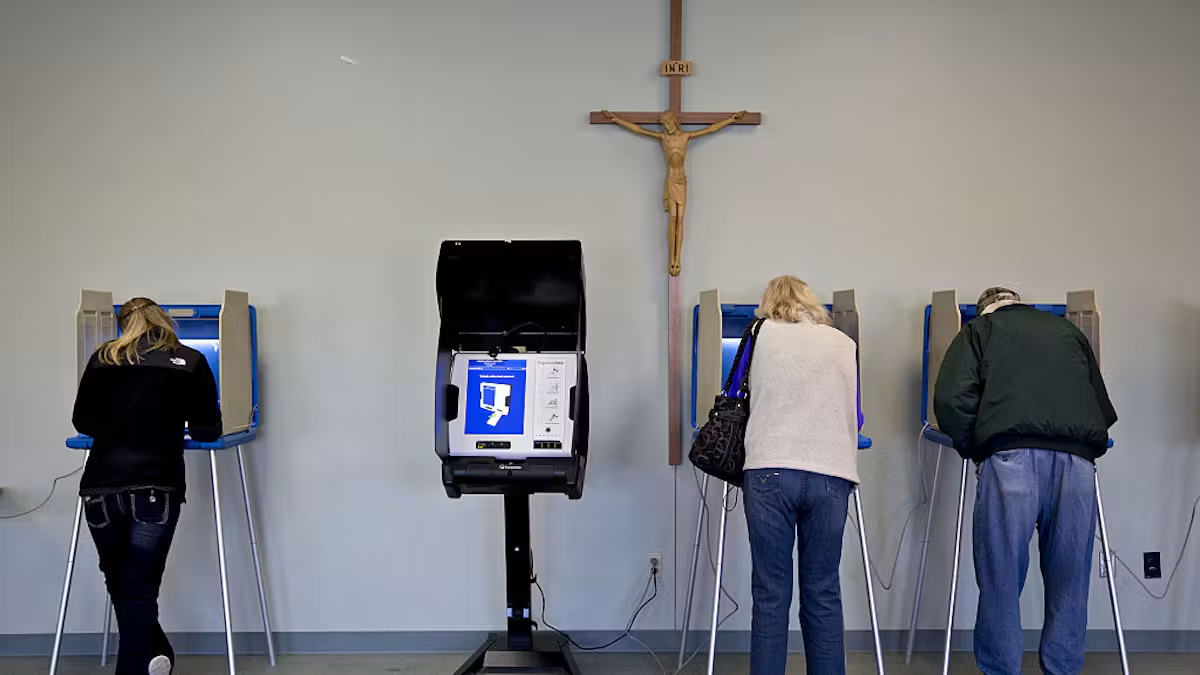
The November 3 midterm elections are currently dominating media coverage across the country. In this coverage, several religious sects emerged.
Whether it’s the Rev. Adam Hamilton running for Senate in Kansas, seminary student James Talarico running for Senate in Texas, Hindu Vivek Ramaswamy in Ohio, or Muslim Abdul Said running for Senate in Michigan, religion is inevitably at the center of this year’s midterm elections, despite the persistent narrative that America is secularizing.
As the election approaches, this raises an interesting question: Does someone’s religious beliefs influence whether you vote for or against them? Is using someone’s religion against them a form of bigotry and a constitutional evil? I argue that religion is a politically relevant category that can be weighed in one’s electoral decisions, not because we consider religion per se, but because of the moral judgments it generates. Making these necessary distinctions is important because we need to adhere to two realities: (1) the good intentions of opposing religious influences that are perceived to be harmful to society; and (2) the still widespread defense of religious freedom as a constitutional ideal.
First, remember that this problem is not new. President John F. Kennedy’s Catholic faith was a major factor in his campaign, as Protestants feared that a Catholic president would not be loyal first to the Constitution but to the Pope sitting in Rome. Evangelicals can recall some of the tensions that arose in 2012, when the only options on the ballot were either Barack Obama’s liberal Protestantism or Mitt Romney’s conservative Mormonism. Even though Barack Obama identifies as a Protestant Christian, I voted for Romney.
Now consider Abdul Said’s candidacy. He is a socialist and a progressive, which means I will never vote for him. But given the growing concern about the growth of Islam in the United States, I’m often asked whether Christians can vote be opposed to candidates simply because they are Muslims. Frankly, my answer is an absolute “yes.” When evaluating whether to vote for a candidate, a candidate’s worldview is fair game, whether that worldview is called a religion or an ideology. Excluding religion when choosing a candidate is another manifestation of Rawlsian constraints – not only do people have to give up their religion when reasoning together as ordinary citizens, but progressives now tell us that religion should be taken out of the equation when deciding whether to vote for a candidate (of course, when the candidate in question is a Christian, this is used to disqualify him or her on the grounds that one can rule according to their Christianity).
There are nuances to this equation. Whether someone is legally able to run is a different question than whether they should be voted for. Legally, Article 6 of the Constitution prohibits religious examinations for public officials. However, we need to clarify what is stipulated in the Constitution and what is not stipulated in the Constitution by distinguishing between what is stipulated in the Constitution and what is not stipulated in it. legal Office entry requirements and Morality Qualifications and considerations for election. Legally, there is nothing to prevent Muslims from joining the workforce. As long as a Muslim can take the oath of office in good faith, he or she meets the constitutional threshold for office. But legal permission does not mean there is a moral reason to do so. Of course, we all agree that obtaining legal permission to vote does not mean that someone should elected, especially if the religious worldview in question produces results that endanger the constitutional order itself – which I believe Islam does.
What exactly do I mean?
The law does not consider a candidate’s religion to be a doctrine. What do I mean by that? What I mean is that the law does not purely consider religion per se, nor does it evaluate the truth or falsity of its teachings. Government officials or courts lack the ability to judge monotheism or polytheism. Government is not a doctrinal authority. Why? As I said, because the law is a poor judge of theological accuracy. The government is not responsible for any particular religious belief and cannot ensure the means to permanently maintain or enforce a religious belief. The law is best suited to judge matters of conduct, not matters of faith (Matthew 22:21). This means that we judge the political compatibility of religion with the American experiment through its moral dimensions. We test the impact of religion by judging how its tenets apply to society. But ordinary citizens able and should Evaluate beliefs and behaviors because they are inseparable. Governments are not suited to make sweeping judgments about the relationship between religion and morality, whereas ordinary citizens are.
This is very important to me as a Baptist, a free church tradition that has historically advocated religious freedom for all.
As a member of the Southern Baptist Convention, I accept the confessional statement of my denomination, “Baptist Faith and Message 2000” Extreme urgency. it is language The point about religious freedom for all is unmistakable: “The state has no right to impose penalties for any form of religious opinion.”
In light of this statement, am I being disingenuous in my confession?
Pay attention to what it says and doesn’t say. It says “the state” has no right to impose penalties for religious views. There is nothing to prevent ordinary citizens from making such a judgment.
For individuals, as moral agents, religion does play a factor in deciding which candidates’ policies best align with a voter’s worldview. But even here more nuance is needed: in elections, what matters more is the morality generated by religion. Religion is a relevant condition but not decisive in itself.
I acknowledge that, legally speaking, Abdul Said can run for office and, if elected, he should be able to serve regardless of his religious beliefs. Therefore, legally speaking, I affirm the structure of the Constitution and my denomination’s commitment to religious freedom.
Privately, if I were in Michigan, I would undoubtedly evaluate his religion and the morality of that particular religion as grounds for disqualification. When I investigated the consequences of Islam taking power, I found that oppressive systems followed.
To be clear, this is not religion through The religion referred to here is the religion through ethics.
On the one hand, I want everyone to become a Christian. Politically, this is desirable. But really, if you are a Muslim, or if you worship flying spaghetti monsters—if your worldview is embodied in the cultural and moral practices of Islam—then I don’t want you in office. Consider Vivek Ramaswamy, a Hindu, and Amy Acton, a Jew, both running for governor. I don’t agree with their beliefs, but on the surface, the Jewish and Christian faiths have more in common. Weighing which worldview is more or less compatible with the political outcomes I want, I would choose Ramaswamy over Acton because Ramaswamy’s worldview, at least in relation to politics, is less problematic than Acton’s, even if I still find Ramaswamy’s Hinduism ultimately wrong.
The distinction I would make is that the legal permission to run for office is separate from the moral evaluation of the resulting reality. I object any The worldview assumes the cultural and moral practices of Islam, and I do not want individuals who hold these beliefs to be represented. In my opinion, El-Sayed may have had a legal reason to hold his position, but no moral reason to carry it out. Why? Because he will govern wrongly and produce bad results. The same would be true if the same practices also stemmed from secular beliefs.
Here’s where it gets tricky: James Talarico’s progressive Christianity is just as unqualified as the Muslim worldview. Talarico delivered the most obscene defense of progressive policy preferences ever against twisted appeals to Christian scripture. These false beliefs about the Christian Bible have led to worldviews and policy preferences with which I strongly disagree.
In other words: If I were asked to choose between Muslims who oppose abortion and support traditional marriage (and generally commit to governing in ways inconsistent with the requirements of Islam itself), I would have to admit that this worldview is preferable to someone like Talarico, whose bastard Christianity offends my moral sensibilities and causes clear harm to the public good.
The law is a poor arbiter of whether theology is right or wrong. However, the moral conscience of individual voters who see the products of Islam can make these decisions based on the religion and its moral implications. We must evaluate government-imposed religious coercion and religious trials in the light of justice, civil jurisdiction, and the common good—not just because the same legal requirements may one day be imposed on Christians. Religious freedom is not something to be cherished for the sake of self-preservation; This is the substantive conclusion of public theology, arising from reflections on the areas in which government is fit to judge and which areas are best left to private citizens.
While it is true that some religions are more truth-oriented than others, religion itself is not the only sufficient condition. The question is what religion to believe in produce in assessing its public significance and impact.
As a Christian, I am deeply concerned about the state banning Muslims from holding public office simply because they are Muslims. However, I do have a strong interest in convincing voters to keep toxic ideologies out of government. If that means I’m going to have to go against Islam, so be it. This is about the merits of the position taken—not the primary theology itself.
The bottom line is this: As concerns grow about Islam’s influence in the United States, it’s important not to give it any more beachhead than it already has. One way Americans can block its advance—not the only way—is to deny Islam any political footing. Michigan, it’s up to you.
***
Dr. Andrew T. Walker is dean of the School of Divinity and professor of Christian ethics and public theology at Southern Baptist Theological Seminary. He is a fellow at the Center for Ethics and Public Policy and executive editor of WORLD Opinions. You can follow him on X: @AndrewTWalker.