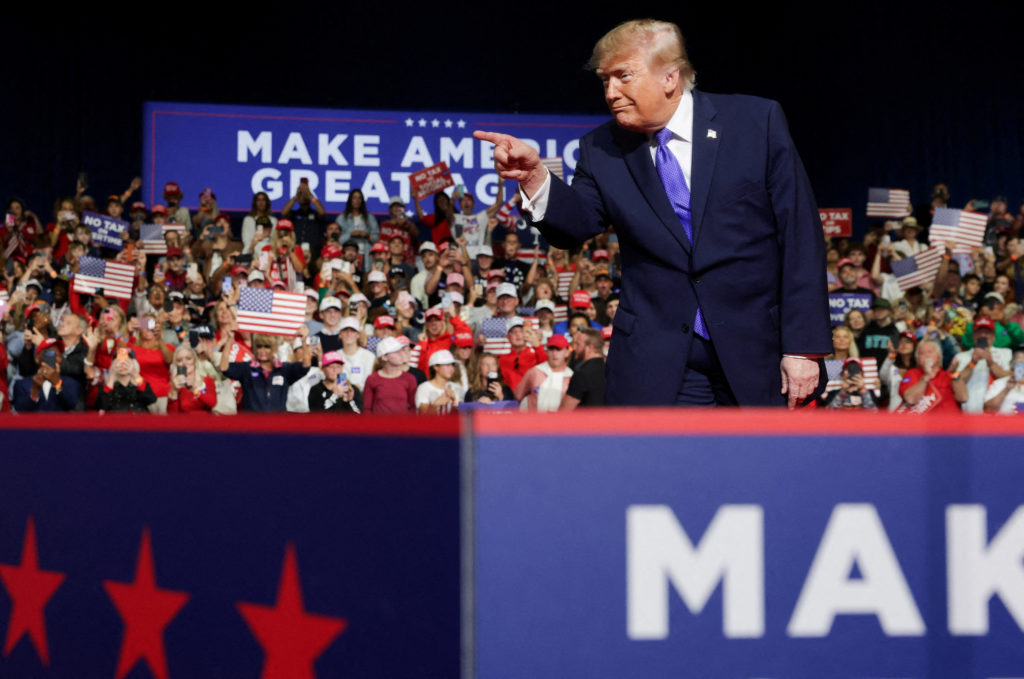
WASHINGTON (AP) — President Donald Trump is reshaping his weekend schedule to rally Republicans in two states that are crucial to Senate races as early voting surges across the country, underscoring his party’s efforts to boost turnout ahead of Election Day.
The Republican president will visit Iowa and Kansas on Sunday and attend back-to-back campaign rallies. Both events had previously been canceled due to a series of remote rallies, but Trump said he then received calls from “my friends” in those states, “and they said, ‘If you can go, that’s better than remote rallies.'”
The last-minute reversal comes as Americans actively participate in early voting. An Associated Press analysis of voting data showed that nearly 10 million more Americans voted in the five days before Election Day than during the same period in 2022. The increase was particularly pronounced in states with hotly contested Senate races, including Iowa and Kansas, where early voting increased by about 30%.
Both Democrats and Republicans hope the rally will work in their favor as they battle for control of Congress in an election that hinges largely on affordability issues and the president’s unpopularity. Earlier this month, Trump promised to hold a marathon of signature rallies in support of Republican candidates, and so far in October he has hosted 25 rallies. He plans to hold a rally in Daytona Beach, Florida, on Friday night.
Weekend rebound after Trump says ‘I don’t think I have to go’
The president angrily pushed back Thursday against the idea that his initial cancellation of a rally in Kansas, made public as he returned to Washington from a campaign trip in South Carolina, was related to fatigue or health. When a reporter asked him about changes to his plans for Kansas, where Republican Sen. Roger Marshall is seeking re-election, he lashed out.
“I’m not going to Kansas because he’s doing a great job,” Trump said, appearing to refer to Marshall. The president added, “I feel perfect.”
Watch the moment in the video player above.
Trump’s original plan was to travel to Salina, Kansas, on Saturday and Dubuque, Iowa, on Sunday. Plans then changed and he instead held a “72-hour sprint” of phone rallies, which meant the president could reach more voters across the country, according to the Republican National Committee.
The president’s schedule remained in flux Friday. His Iowa appearance was moved from Dubuque to Cedar Rapids, only to be scheduled to return to Dubuque hours later, according to a person familiar with the matter who spoke on condition of anonymity.
The Republican National Committee later confirmed that Trump would campaign in Dubuque, Iowa, and Salina, Kansas.
Both Kansas and Iowa are battlegrounds in Senate races that will help determine whether Republicans retain their slim House majority in the midterm elections.
READ MORE: Early voting moves across Senate battlegrounds as millions of Americans cast their ballots ahead of Election Day
Trump has traveled to both states this month to boost Marshall, of Kansas, and Ashley Hinson, the Republican Iowa Senate candidate currently serving in the House.
Trump told a Kansas City radio station on Friday that Marshall was “fantastic” and praised the senator for pushing his administration to enact policies that would benefit Kansas farmers, such as expanding the tax-free use of red-dyed diesel.
Trump criticized Marshall’s Democratic challenger, Methodist pastor Adam Hamilton, as a “radical” who “caused riots in churches because he was so liberal.” If Jesus stood before them now, Hamilton said, “Roger Marshall would call Him ‘woke.'”
Both sides hope the vote surge will work in their favor
The pace of early voting significantly outpaced the last midterm elections, with millions of Americans voting early.
In Texas, where voters are making decisions in the closely watched Senate, House and gubernatorial races, more than 6.3 million Texans had voted early as of Wednesday, compared with 4.2 million at the same point four years ago, a 50% increase.
In Maine, Michigan, North Carolina and Kansas, states with hotly contested Senate races, early voting is also up more than 30% from the same period four years ago. In South Carolina, where voters are electing a successor to the late Republican Sen. Lindsey Graham, early voting increased by 83%.
This year’s midterm elections saw record inflows. Republicans have expressed concern that voters are not turning out at a time when voters are unhappy with Trump and high costs, an issue that Democrats have focused on on the campaign trail.
In Michigan Senate race, wrong Democrats still make headlines
Michigan Democrats are hoping to end a bitter Senate primary race after progressive Abdul-Sayed narrowly defeated Rep. Haley Stevens in August.
As Election Day approaches, they’re not so lucky.
Stevens resurfaced in the final week before the election, reiterating on CNN that she would vote for El-Sayed while calling on him to repair relations with Jewish and black voters. Her appearance came hours after her fiancé said he would vote for El-Sayed’s Republican opponent, Mike Rogers.
WATCH: 2026 midterm election preview, plus questions about voting
Then on Friday, after agreeing to campaign alongside El-Sayed and South Carolina Rep. Jim Clyburn in Detroit on Sunday, Stevens issued a lengthy statement on social media again criticizing her former rival. She called on him to denounce an ad linking U.S. support for Israel to rising food prices and address concerns about his past comments.
“Abdel promised to get money out of politics,” Stevens wrote. “He can start by getting Israel to stop explaining what Michigan can’t afford.”
El-Sayed apologized for some of his past comments while trying to unite Democrats.
Associated Press writer Meg Kinard contributed to this report.
A free press is the cornerstone of a healthy democracy.
Support trustworthy journalism and civil dialogue.