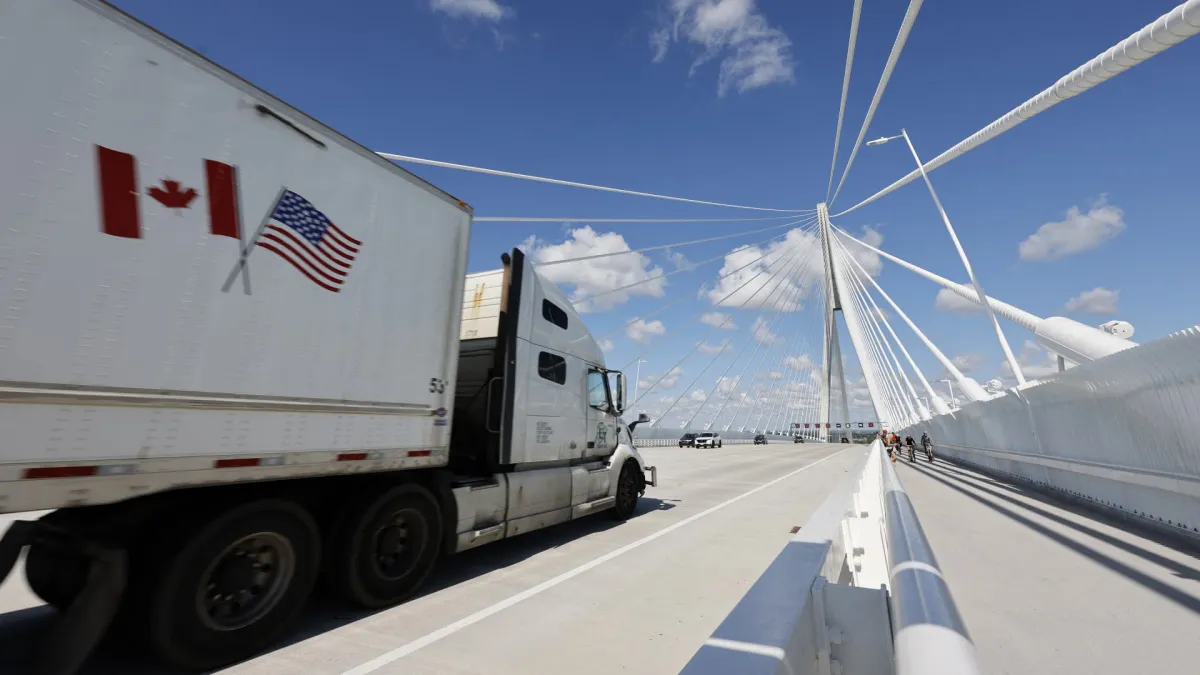
A truck crosses into the United States from Canada on the Gordie Howe International Bridge, connecting Windsor, Ontario, and Detroit, Michigan, on September 6, 2026.
Jeff Kowalski Afp | Getty Images
The White House banned imports of some Canadian vehicles, dairy products and alcohol on Tuesday, as officials sent mixed signals about the prospects for a trade deal.
The long list of goods affected includes motorcycles and mopeds with petrol engines larger than 800cc, whey and molasses products, and various alcoholic beverages – especially those packaged for immediate consumption – from beer and cider to wine, whiskey and vodka.
These products are estimated at $19.9 billion in Canadian imports by the American Action Forum.
The import ban, announced earlier this month by the Trump administration, is the latest step in a war of words – and tit-for-tat tariffs – between the US and Canada.
President Donald Trump said on Monday that he expects a “fair deal” with Canada in the coming weeks, but continued to strike an aggressive tone.
“They’re taking advantage of us, they’re feeling entitled … there’s nothing they need,” Trump told reporters in the Oval Office.
“I think what’s going to happen in the next three to four weeks is they’re going to come to us and say, ‘We’re going to get rid of all the tariffs.’ We’re going to win it all,” Trump said.
However, officials suggested little progress toward a deal.
US Trade Representative Jamieson Greer told CNBC on Friday that there is “no urgency on our part” to make an agreement and noted that the US still has “a lot more trade to do” with Canada.
“We’re still getting what we need from them in terms of oil, gas, potash, all these things … so there’s still a lot of strong trade between the countries,” Greer said.
‘We don’t wait on the phone’
Canada’s Trade Minister Dominic LeBlanc told a press conference on Friday that the US “imposed illegal and unfair tariffs on sectors of our economy that are causing great hardship to businesses and workers across the country.”
LeBlanc said the countries are “talking about trying to find an alternative to the current situation” but “will not sign a deal that is not good for Canada.”
“We’ve said we’ll sign an agreement when we think it’s in the interests of Canadian sovereignty and the Canadian economy … but we’re not waiting for the call,” LeBlanc said.
Ottawa has stopped short of unveiling fresh retaliation since its counter-tariff took effect on September 8.
Canadian Prime Minister Mark Carney meanwhile spent the month with closer ties with the European Union than with the US, suggesting in a recent speech that the White House is “weaponizing” economic policy as a form of “coercion” on other countries.
Canada has imposed tariffs of 15% to 50% on 27.6 billion Canadian dollars ($19.45 billion) worth of U.S. goods, including steel, milk, agricultural equipment, paper, household appliances, furniture, clothing and electronics.
He said it was a “dollar for dollar” response to Washington’s 50% tariffs on goods including cement, wine, hockey sticks and others, which were imposed in August.
The measures target a relatively small portion of the $715.5 billion annual trade in goods between the countries, but continued escalation or a prolonged standoff will affect sectors such as metals and automobiles, and damage small and medium businesses on both sides of the border.
The Bank of Canada warned this month that the new rates have made the country’s growth prospects more uncertain and increased inflation risks.
Correction: Ottawa has stopped short of unveiling fresh retaliation since its counter-tariff took effect on September 8. The previous version misstated the timeline.