By Manuel Nau, Lead Editor at IoT Business News.
The global installed base of connected home medical monitoring device it is expected to grow from 92.7 million in 2025 to almost 160 million in 2030, according to Berg Insight. Diabetes management, cardiac monitoring and medication adherence are helping to drive a wider shift towards data-driven health care outside the hospital.
Healthcare providers are increasingly monitoring patients beyond hospitals and clinics, using connected medical devices to track chronic conditions, assess treatment adherence and identify potential complications early. As remote care becomes more established, the challenge is changing from simply collecting patient data to integrating that information into clinical workflows and supporting timely medical interventions.
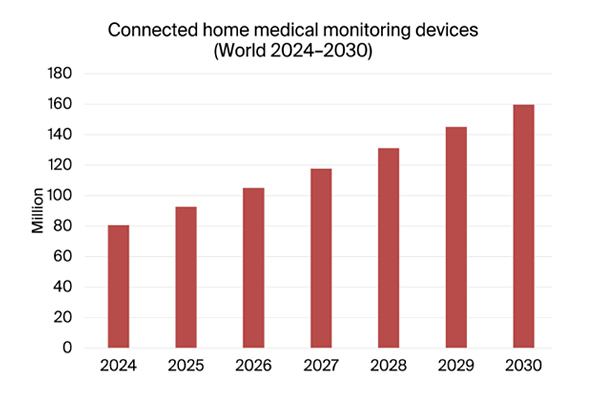 New research from Berg Insight highlights the scale of this transition. The analyst firm estimates that 92.7 million connected home medical monitoring devices will be in use worldwide by the end of 2025. This figure is expected to reach 159.7 million by 2030, representing a compound annual growth rate (CAGR) of 11.5%.
Importantly, these numbers include connected medical devices used by patients enrolled in structured health programs. Consumer fitness trackers and personal health devices used outside of prescribed treatment regimens were not collected, making the forecast a more focused indicator of clinical IoT adoption than the wearable technology market.
Sleep Therapy Dominates, While Diabetes Monitoring Gains Momentum
Three application areas comprise the majority of the connected home medical monitoring market: sleep therapy, diabetes management and cardiac rhythm management (CRM).
Sleep therapy remains the largest segment, with ResMed holding a dominant position alongside manufacturers including Philips, BMC Medical and Löwenstein Medical Technology. The number of remotely monitored sleep therapy patients has doubled since 2018, largely driven by treatment compliance monitoring requirements introduced in the US and Europe.
Diabetes management has emerged as the second largest segment, reaching 19.5 million connections worldwide by 2025. Growth is fueled by the use of continuous glucose monitoring (CGM) and connected insulin delivery systems from companies including Abbott, Dexcom, Insulet, Tandem Diabetes Care and MiniMed.
Heart rhythm management represents another established application, with manufacturers such as Medtronic, Abbott, Boston Scientific and BIOTRONIK having incorporated connectivity into implantable devices for more than two decades.
Looking ahead, Berg Insight expects diabetes management, remote electrocardiogram (ECG) monitoring and medication adherence monitoring to be among the fastest growing categories through 2030.
Connected Healthcare Goes Beyond Device Connectivity
One important development highlighted by the research is the importance of software and service platforms in the mHealth ecosystem.
While connected medical devices provide the underlying patient measurement, platforms from companies such as Huma Therapeutics, Doccla, Teladoc Health, CareSimple and Current Health support the collection, analysis and management of patient information in remote care programs.
This changes the requirements for healthcare IoT deployment. Reliable device connectivity remains important, but delivering clinical value increasingly depends on the ability to integrate information from multiple devices, provide valuable insights to medical professionals and integrate monitoring into existing care processes.
For medical device manufacturers and IoT solution providers, this makes an important difference between selling connected hardware and participating in a complete remote patient monitoring ecosystem. Device interoperability, reliable data delivery and integration with healthcare software are important considerations as deployment spreads across a wide range of medical conditions and care providers.
These trends also have implications for system integrators and connectivity providers. Medical monitoring applications must support multiple device types, patient environments and data collection requirements, making end-to-end service reliability an important operational consideration.
AI Adds Another Layer to Remote Patient Monitoring
Artificial intelligence is increasingly relevant as healthcare organizations seek to extract actionable information from volumes of patient data collected remotely.
According to Berg Insight, AI and machine learning can help identify early indications of patient deterioration, support clinical decision-making and enable more proactive interventions outside of traditional healthcare facilities.
However, the growing use of analytics also reinforces the importance of distinguishing between collecting more data and making that data clinically useful. Continuous monitoring can produce a more complete picture of the patient’s condition, but its practical value depends on how effectively health professionals can interpret and act on the information.
The direction of the broader market is not limited to reaching the larger population of medical devices. It’s towards an integrated home monitoring system that integrates medical hardware, connectivity, software and analytics as part of routine patient care.
For the IoT industry, Berg Insight’s forecast shows a market where long-term opportunities are growing beyond the connection of devices to the infrastructure and services needed to deliver reliable and clinically relevant remote monitoring.