By Manuel Nau, Lead Editor at IoT Business News.
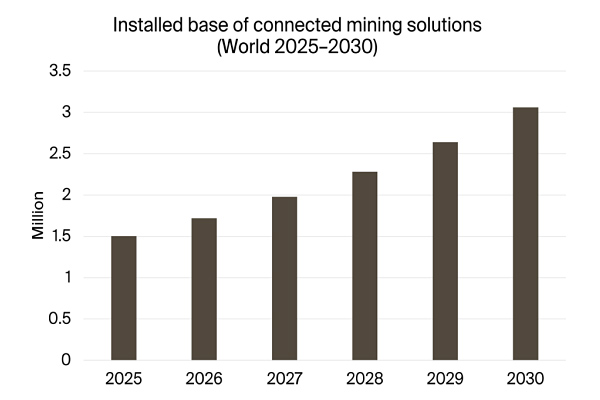
At global base installed connected mining solutions it is expected to more than double by 2030, according to Berg Insight, as mining operators expand their use of telematics equipment, worker safety systems, environmental sensors and autonomous machines.
Mining operations are growing, but the transition is beyond tracking heavy equipment. From autonomous haulage trucks operating in open pit mines to personnel monitoring and environmental sensing underground, industrial IoT technology is taking on a wider role in safety, productivity and operational management.
New research from Berg Insight puts the global connected mining solution base at 1.5 million units by 2025, with deployment forecast to reach approx. 3.1 million units in 2030. This is a compound annual growth rate (CAGR) of 15.3% over five years.
Equipment connectivity dominates, but applications are diverse
Berg Insight is divided on the mining market is connected into three parts: equipment, people and environment. Equipment is the largest segment, including OEM telematics systems installed in vehicles and mining machines as well as more advanced solutions developed by specialist technology providers.
The people segment includes technologies that support worker safety and productivity, while environmental solutions include sensors used to monitor conditions on mining sites.
The report also examines applications such as proximity detection, collision avoidance, fatigue monitoring, situational awareness and demand ventilation. Together, it illustrates how connected mining is evolving from conventional asset monitoring to a system that can directly influence operational decisions.
Asia-Pacific is the largest segment of connected mining deploymentfollowed by North America, Latin America, Europe, and the Middle East and Africa, according to Berg Insight.
Autonomous transport reaches 9,000 trucks worldwide
Autonomous mining vehicles are one of the more mature applications of industrial automation in the sector. Berg Insight estimates that around 9,000 autonomous haul trucks are operating in surface mines worldwide as of the fourth quarter of 2026.
Asia-Pacific led the deployment, with China the largest market, followed by Australia.
Among equipment manufacturers, Komatsu and Caterpillar have built large autonomous fleets, with more than 1,000 and 800 autonomous mining trucks in operation. Meanwhile, Chinese technology provider Eacon reported 4,000 active mining trucks using autonomous transportation systems by November 2026.
These figures highlight an important difference between equipment manufacturers and autonomous technology suppliers: the latter can deploy systems across fleets without having to build the base vehicle.
Although autonomous transportation is currently attracting a lot of attention, automation is also developing in drilling and, to a lesser extent, blasting and dozing operations.
Surface and underground mining present different IoT challenges
One of the defining characteristics of the connected mining market is the technological divide between surface and underground operations.
Surface mining benefits from a relatively robust fleet management ecosystem and automation platform. Key suppliers include Komatsu’s Modular Mining Systems, Hexagon Mining, Wenco International Mining Systems, Hitachi Construction Machinery and Caterpillar’s MineStar Cat suite.
Underground mining remains less mature and more fragmented, with specialist providers such as Becker Mining Systems, Komatsu-owned MST Global, Nerospec Group and Strata Worldwide targeting specific applications for underground operations.
This distinction has important implications for the design of IoT systems. Underground environments introduce different connectivity and positional constraints compared to open-pit mines, making communication infrastructure, system integration and reliable data exchange essential.
For connectivity providers and system integrators, the opportunity extends beyond providing wireless coverage. The solution must support the operational requirements of the various mining environments and the applications running between them.
Equipment manufacturers are expanding their technology portfolios
The competitive landscape is also changing as established mining equipment manufacturers develop software, connectivity and automation through acquisitions.
Berg Insight identified Epiroc Construction Machinery, Sandvik, Komatsu and Hitachi among the manufacturers that have expanded their mining technology portfolios through merger and acquisition activity.
In addition to these industry groups, independent technology specialists continue to address specific applications and deployment environments. Companies such as Micromine, GroundHog Applications and Epiroc-owned Remote Control Technology serve surface and underground mining customers.
This increasingly diverse ecosystem of suppliers creates integration challenges for mining operators managing equipment and software from multiple vendors. Interoperability and open standards are important considerationsespecially when connected systems go beyond monitoring to coordinated automation and operational control.
Personal networks and interoperability form the next phase
Beyond the installed base forecast, the Berg Insight report identifies private LTE and 5G networks, artificial intelligence and interoperability among the technological developments affecting connected mining.
For industrial IoT providers, the importance is related to increasingly sophisticated connectivity infrastructure and mining applications. Telematics, worker monitoring, environmental sensing and autonomous operations have different communication requirements, making a uniform technological approach difficult to apply in every mining environment.
The forecast expansion to 3.1 million connected units is more than additional sensors and telematics devices. This shows the need for an integrated mining technology architecture that can connect equipment, personnel and environmental information while meeting the different operational constraints of surface and underground sites.