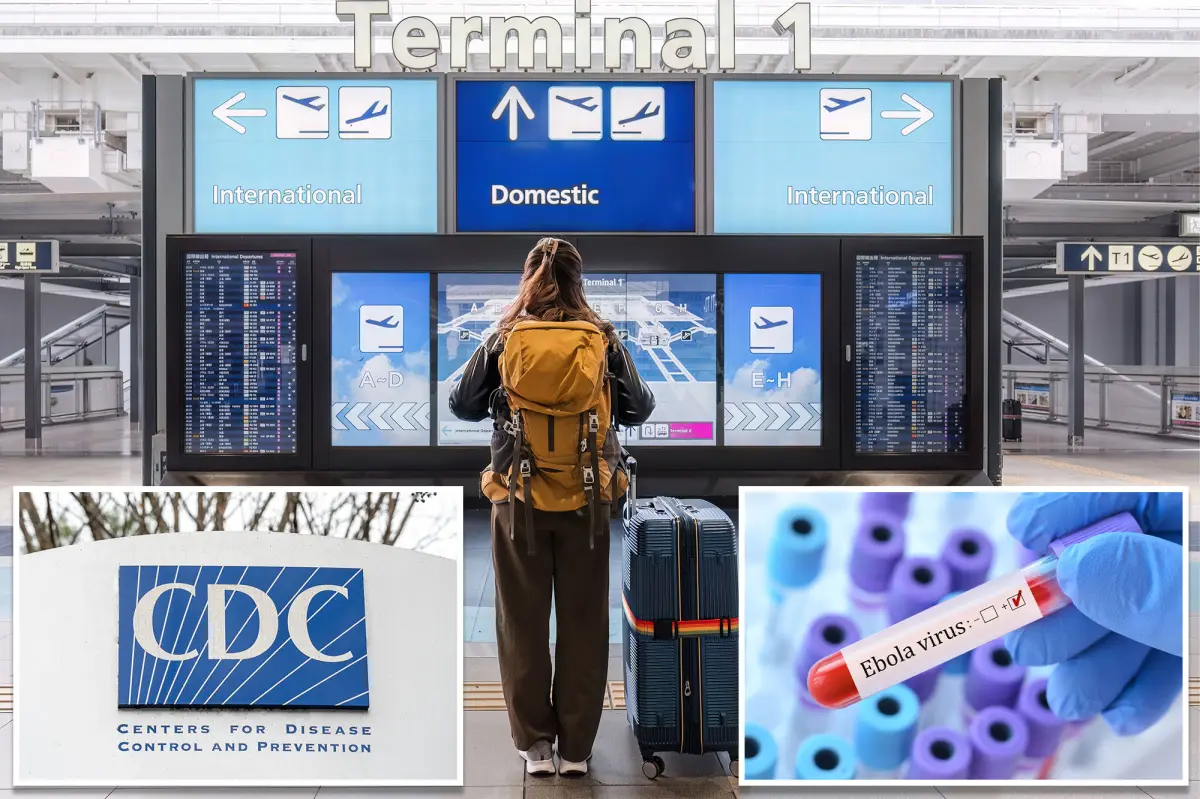
Major U.S. and international airlines are resisting new Ebola-related travel requirements that would affect millions of flights to the United States.
According to the Centers for Disease Control and Prevention (CDC), starting November 3, all passengers traveling on international flights to the United States must confirm that they have not been to the Democratic Republic of Congo (DRC) in the past 21 days.
The CDC said the requirement applies to everyone flying to or transiting through the United States, including U.S. citizens, green card holders and airline crew members.
Travelers must fill out a paper or digital declaration before boarding their flight, even if they have never visited the Democratic Republic of Congo.
The CDC says airlines must collect the forms and retain them for at least 42 days after a flight arrives in the United States.
Airlines for America (A4A), which represents major airlines including American Airlines, Delta Air Lines, Southwest Airlines, United Airlines and JetBlue Airways, is asking the CDC to reconsider the requirement and give airlines more time to prepare, according to an Oct. 26 letter provided to Fox News Digital.
The group said it supports the CDC’s public health goals but believes the new requirements are too broad and were introduced too quickly.
A4A calls for the government to adopt a “more appropriate and prudent U.S. response” that pays closer attention to affected areas and travelers who have recently been there.
The group also requested a postponement of the Nov. 3 start date.
“Changes to the sign-in system, digital signatures, station procedures and training could not easily be accomplished within the allotted time,” A4A wrote.
Dr. Tyler Evans, an infectious disease physician in California and CEO of the Health Equity Alliance, told Fox News Digital, “This is a step in the right direction considering that we really have to take this seriously. We have to make sure this doesn’t cross borders.”
He added, “This is the second largest Ebola outbreak in history. So it’s very serious.”
According to Reuters, the International Air Transport Association (IATA), which represents more than 370 airlines around the world, also asked the CDC to reconsider the requirement.
“It is unreasonable for the U.S. government to require all airlines serving the U.S. market to modify their procedures to accommodate the collection of certifications from everyone (passengers and crew) flying to the United States in less than two weeks,” the International Air Transport Association wrote in a letter, according to Reuters.
A4A also asked the CDC to exempt airline crew members, arguing that existing aviation documentation already contains information about crew members and their travels.
The group also requested exemptions for U.S. military passenger charter flights, saying the military is already tracking the health, safety and whereabouts of service members.
The CDC said the requirement is intended to reduce the risk of Ebola entering the United States through air travel.
The 21-day period reflects the maximum time it takes for symptoms to appear after exposure.
The CDC said anyone who has been to the Democratic Republic of Congo during this period, including travelers simply passing through an airport there, will not be allowed to board a flight to the United States unless they receive a government exemption.
“Some of the first symptoms are just flu-like symptoms. You’re going to have a high fever, you’re going to feel a little bit fatigued,” the doctor said.
“[For] “For those who … are asymptomatic, being able to get screened is a very effective way to reduce, prevent or mitigate further spread,” Evans said.
Evans has been involved in the Ebola response twice in the past, once in West Africa and again in the Democratic Republic of Congo, two of the worst outbreaks in history.
“The reality is that Ebola is one of the most contagious infectious diseases and has one of the highest case fatality rates,” Evans said.
But he said Americans generally don’t think Ebola is related to them. “When it comes to infectious diseases…microorganisms respect no borders.”
The Centers for Disease Control and Prevention says travelers who knowingly provide false information may face prosecution and fines.
Fox News Digital reached out to the CDC and IATA for additional information and comment.