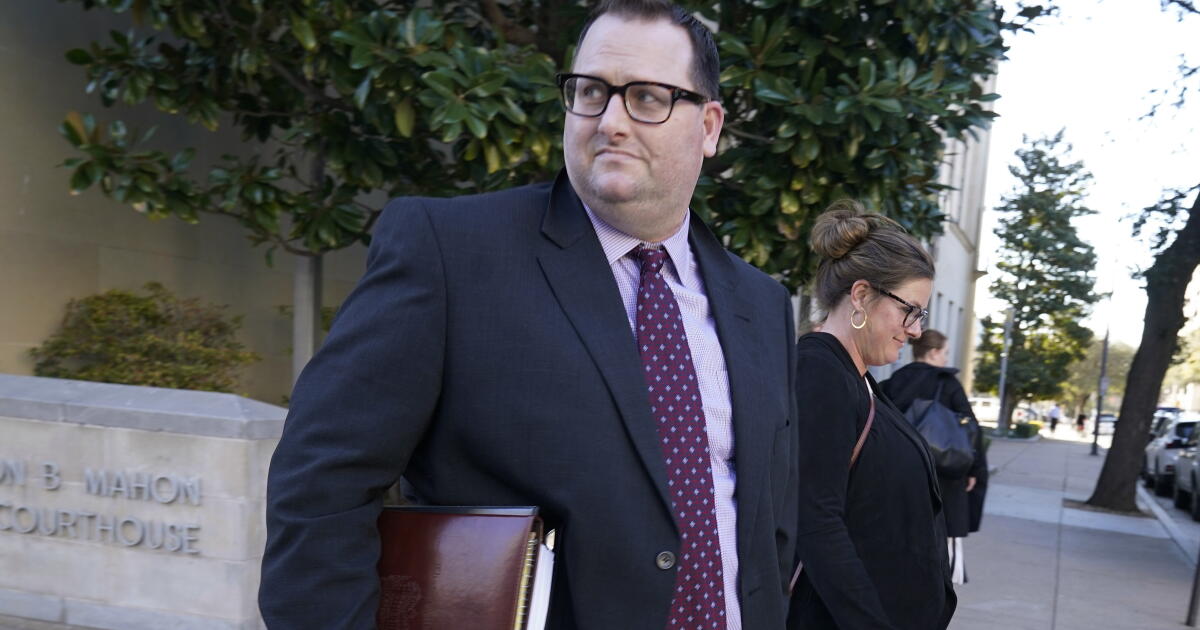
Eric Kay is scheduled to be released from federal prison on February 18, 2041, for providing fentanyl-laced pills that led to the overdose death of Angels pitcher Tyler Skaggs. The former Angels media relations director will be 67 years old.
In the latest effort to overturn or at least weaken that conviction, Kay filed a 75-page appeal in federal court in Texas on Friday asking that his conviction be vacated and that Judge Terry R. Means order a new trial. Earlier this year, Means ruled that Kay could provide new details about the evidence that led to his 2022 conviction.
The appeal, first reported by The Athletic, centers on Kay’s argument that his trial lawyer, Michael Molfetta, pressured him to reject prosecutors’ plea offer of a prison sentence of five to 10 years. Kay, 52, was sentenced to four years and eight months in prison for giving Skaggs counterfeit oxycodone pills containing fentanyl on July 1, 2019, as the Angels arrived in Texas for a three-game series against the Rangers.
The document also accuses Detective Delaney Green of lying when she testified at Kay’s criminal trial that she extracted data from Skaggs’ phone. Another detective with the Southlake (Texas) Police Department did just that. Kay claimed the phone may have been tampered with because it continued to receive messages for more than two weeks after Skaggs’ death. Additionally, when Kay attempted to obtain raw data extracted from the phone closest to the time of Mr. Skaggs’ death, he was told that the police department “no longer possesses the external hard drive containing the data.”
“The government’s case against Eric Kay rests on two key allegations,” Kay’s attorneys wrote in the appeal. “First, only Mr. Kay provided the drugs to Mr. Skaggs before his death. Second, without those drugs, which were later discovered to be fentanyl, Mr. Skaggs would not have died.
“To prove the first point, the government relied extensively on evidence obtained from Mr. Skaggs’ cell phone. But that evidence was unreliable. Records show that after Mr. Skaggs’ death and while in law enforcement custody, the phone continued to receive text messages, phone calls, and other content consistent with an Internet connection — raising the possibility that the phone’s content had been deleted or altered, something the government strenuously denied at trial.”
“As to the second issue, the advice and strategic decisions of Mr. Kay’s trial counsel were influenced by a constitutionally inadequate investigation. The traditional method of determining cause of death—an autopsy—did not and could not establish any specific substance as the sole cause of death.”
Toxicology tests showed Skaggs had alcohol, oxycodone and oxymorphone in his blood and urine in addition to fentanyl when he died.
“The impact of this unreliable evidence, both regarding the phone call and the non-cause of death, was compounded by the incompetence of Mr. Kay’s trial counsel, who failed to investigate this evidence against their client and coerced him into going to trial, which ultimately resulted in Mr. Kay’s conviction,” the appeal states.
Three years ago, Kay’s appeals of two felony convictions were rejected by the 5th U.S. Circuit Court of Appeals, which ruled that the evidence allowed a reasonable jury to conclude that Kay met with his supplier in California and obtained the pills after Skaggs asked him to do so, that Kay gave the pills to Skaggs in Texas, and that Skaggs died after taking one of the tainted pills.
Kay’s appellate attorney, David Gerger, withdrew in April, and the most recent appeal was written by a federal public defender team led by Jason D. Hawkins. The Angels paid for Kay’s defense in preparation for a civil trial brought by Skaggs’ parents, but stopped doing so after settling the lawsuit with an undisclosed monetary settlement during jury deliberations in December.
Kay is currently serving his sentence at the Federal Correctional Institution in Englewood, Colorado, a low-security prison for men. The deadline for federal prosecutors to respond to the appeal is December 31.
“This case is a sobering reminder: Fentanyl kills,” U.S. Attorney Chad Meacham said after Kay’s conviction. “Anyone who deals in fentanyl — whether on the street or outside a world-famous ballpark — puts his or her buyers at risk.”