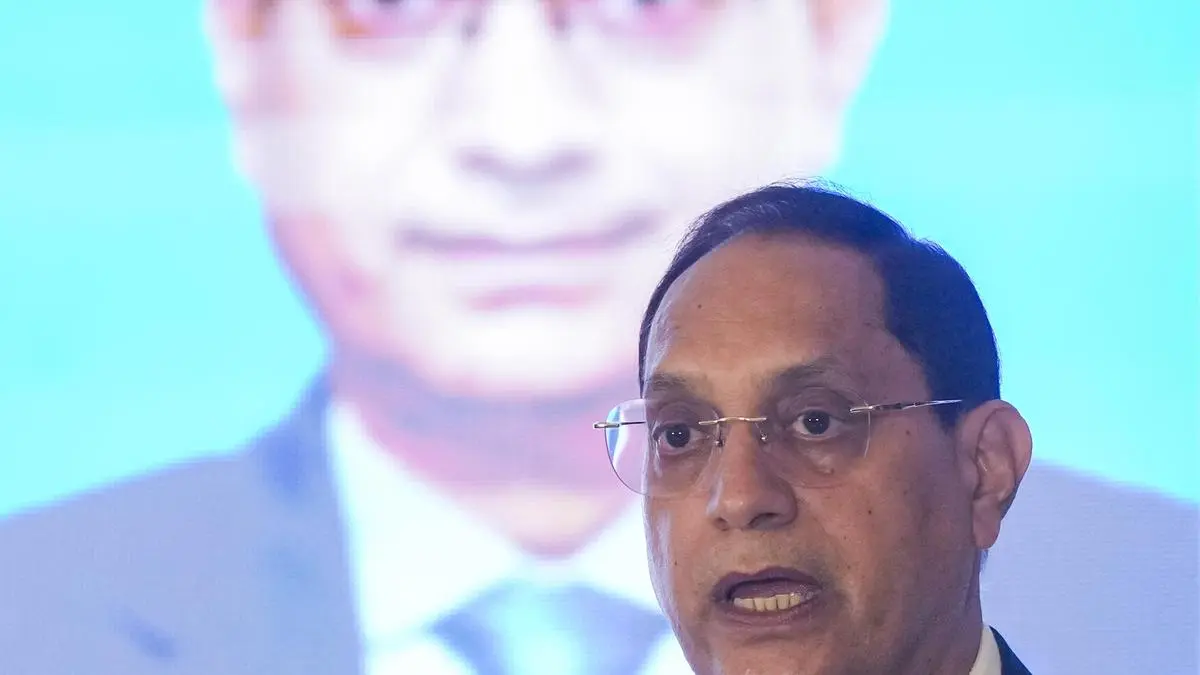
Securities and Exchange Board of India (SEBI) Chairman Tuhin Kanta Pandey addressed the gathering during a session on ‘Building India’s World Class Capital Market’, as part of the 125th anniversary celebrations of the Bharat Chamber of Commerce, in Kolkata | Photo Credit: Swapan Mahapatra
SEBI chairman Tuhin Kanta Pandey on Saturday said the infrastructure of Indian exchanges is “adequate” to handle larger volumes. Pandey stressed that it is difficult to exchange based on location, because location is less relevant now that everything has to be connected electronically.
“I think even the existing infrastructure of the exchange is sufficient to handle the larger volume,” Pandey replied to a question from the media on whether the country needs another exchange, regional or national.
To a question related to the proposed revival of the Calcutta Stock Exchange (CSE), he said that the exchange should meet conditions such as a net worth of ₹100 crore and an average annual turnover of ₹1000 crore, infrastructure for orderly trade execution, online screen-based trading system, and online security control capabilities, etc.
The SEBI chief said the CSE should clear outstanding brokerage dues and establish a separate clearing company or merge with a trading company for trade settlement before resuming operations, as trading has remained frozen since 2013. Also, a business plan should be in place.
Know the market
“All these conditions have to be done. You must understand that the institution of the market infrastructure is one of the most important institutions for the integrity of the market. Today the technology system is very high. You have to invest a lot in technology. So, any investment from the order always requires that the money can be returned in the business plan,” said Pandey, adding that the exchange must generate a sufficient turnover.
“Currently, turnover will depend on those who volunteer to come and trade (on the exchange). Traders will want liquidity, because if you don’t have adequate liquidity, then your impact costs will be very high. So, it’s a catch-22 situation,” he pointed out.
Calcutta Stock Exchange
In particular, the West Bengal government has proposed to support the revival of the 118-year-old Calcutta Stock Exchange, which was on the verge of closing due to several hurdles, to reclaim Kolkata’s place as the financial capital.
“It’s difficult for location-based exchanges. Location is less relevant now because everything has to be connected electronically. You don’t just trade within the country; there are traders who trade from outside the country. So, in a way, the new technology makes the location less relevant than before when it comes to physical trading,” SEBI Chairman said during a media interaction in Kolkata.
He said the capital markets regulator would issue a proposed consultation paper in a few weeks on compliance requirements for foreign portfolio investors (FPIs).
Fundraising process
Earlier, at a Bharat Chamber of Commerce event, Pandey said that SEBI has taken several steps to make the fundraising process easier and more efficient as businesses seeking access to capital face time, cost and regulatory certainty issues.
“We have accelerated the IPO process and shortened the time for rights issues. The listing requirements have been rationalized for companies that issue large securities. We have also solved the practical problems of the founders by allowing, under specified conditions, to retain certain employee stock options after the listing,” he said.
Pandey informed that SEBI is exploring creating a capacity building network for independent directors.
“We feel that the development of the capacity of independent directors is an important issue that we must deal with. So, now we are working, and soon we will have more consultations on this. Tentatively, we have an idea to develop a capacity building network for independent directors, where all important institutions, professional bodies, academics, and chambers and industries come together,” he said.
To a question, Pandey said SEBI is monitoring leadership and governance developments between Tata Sons and Tata Trusts.
“At the level of the holding company, there are some problems, because it is not a listed company. Other companies, which are listed, follow all LODR norms (Listing Obligations and Disclosure Requirements),” he said.
Published on October 31, 2026