A historic town hall in Gloucestershire and a Grade I listed building in Bristol dating back to the 1700s have been added to a special list of ‘at risk’ buildings in England. Historic England’s Heritage Risk Register provides an annual snapshot of the health of England’s historic buildings and places.
In the past year, 43 historic buildings and sites have been added to the register because Historic England believes they are at risk of “neglect, decay or inappropriate development”.
Among them is Dursley Town Hall, built in 1738. The building has an open market area at ground level, with the town hall above. It is now used as a hub by the community and with rooms available for rent.
The Grade II* listed building was first listed in 1952 and remains an “important landmark” in Dursley’s Market Place, according to Historic England.
It has been added to the ‘at risk’ list due to problems with the roof, dormers and rainwater system.
John Rubin, vice chairman of the City Trust Committee, said: “This status helps raise awareness, attract funding, and encourage community involvement to ensure the architectural and cultural significance of the building is protected for future generations.”
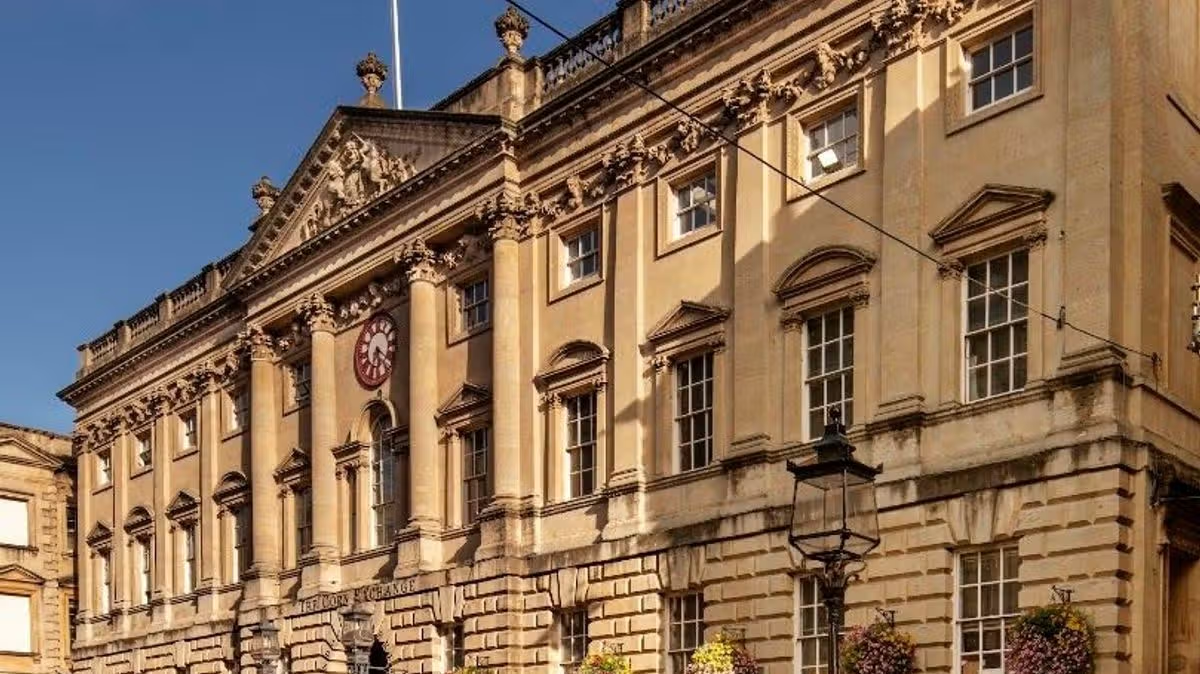
Elsewhere in the South West, Bristol’s historic Exchange building – which was the center of the city’s trade and is now part of St Nick’s Market – has also been named on the list.
Designed by architect John Wood the Elder, the Exchange was built between 1741 and 1743 as a meeting place for the city’s merchants.
The Grade I listed building, first listed in 1959, was designed around a central courtyard, where traders could meet and conduct business. In 1872, the courtyard was covered with a roof, creating the market space seen today which forms part of the wider St Nick’s Market complex.
It has been added to the heritage at risk register because repairs are needed to keep the building in good condition, according to Historic England.
Councilor Andrew Brown, chairman of the economy and skills committee, said the inclusion of the Exchange in the register is a “recognized route” to secure the investment needed to safeguard the future.
“While the designation highlights the challenges facing The Exchange, we see this as a positive step that will help strengthen the investment case to support the market and bring areas of buildings that are not regularly used, increasing their role in the heart of the Old Town,” he said.
“Through our recently developed Vision, we have set out a clear ambition to protect what makes the market special while ensuring it continues to grow and develop.”
In more positive news, there is also a West Country site that was used again last year.
Among them is the Jenner Hut in Berkeley, Gloucestershire. The historic former summer house is where Dr. Edward Jenner conducted smallpox vaccine trials in 1796.
From this hut – also known as the Temple of Vaccinia – Jenner pioneered the theory of vaccination, offering free vaccinations to local residents.
It was added to the risk register last year but thanks to funding from the National Lottery Heritage Fund, work has been completed meaning it is now saved.
James Rodliff, museum director at Dr Jenners House and Museum, said: “Seeing the Temple of Vaccinia removed from the Heritage at Risk Register is a proud moment for our small museum.
“The restoration was a collective effort, bringing together staff, volunteers and trustees with skilled craftsmen, specialist advisers and generous supporters.
“Thanks to the National Lottery Heritage Fund and the players of the National Lottery, we have renovated this incredible building, improved access and created new ways to share the Jenner story. We are grateful to everyone who has contributed their time, expertise and passion. This is an important step in our wider work to secure the museum’s future.”
The historic port of Newlyn in the heart of Cornwall’s fishing community has also been preserved.
There has been a pier or wharf at Newlyn for at least 700 years, but it became one of the most important fishing ports in Cornwall in the 19th century, mainly through the pilchard industry. The harbor was expanded with new piers in the 1880s and 1890s as the fishing industry grew, leaving the ancient docks protected but neglected.
A major restoration project, supported by Historic England’s Heritage at Risk Capital Fund, has helped preserve the harbour. Local specialists and the local community have restored the granite structure and 19th-century wrought iron railings, while the harbor will continue to provide space for historic fishing boats and a venue for artistic and maritime events.
Paul Durkin, chairman of Newlyn Pier and Harbor Commissioner, said: “We are delighted to see the Old Harbor removed from the Heritage at Risk Register.
“Historic England’s funding and expertise, together with our local and community work, led by Harbor Commissioner Nick Howell, has given the Old Harbor a future as well as a past. Historic ships and community groups are full of ideas for events, and we look forward to welcoming people back to where it all began.”
Heritage Minister Baroness Twycross said it was “fantastic” to see Newlyn Harbor removed from the list. “Every part of England is steeped in history, so it’s important to protect heritage sites at the heart of communities that help tell our nation’s story,” he said.