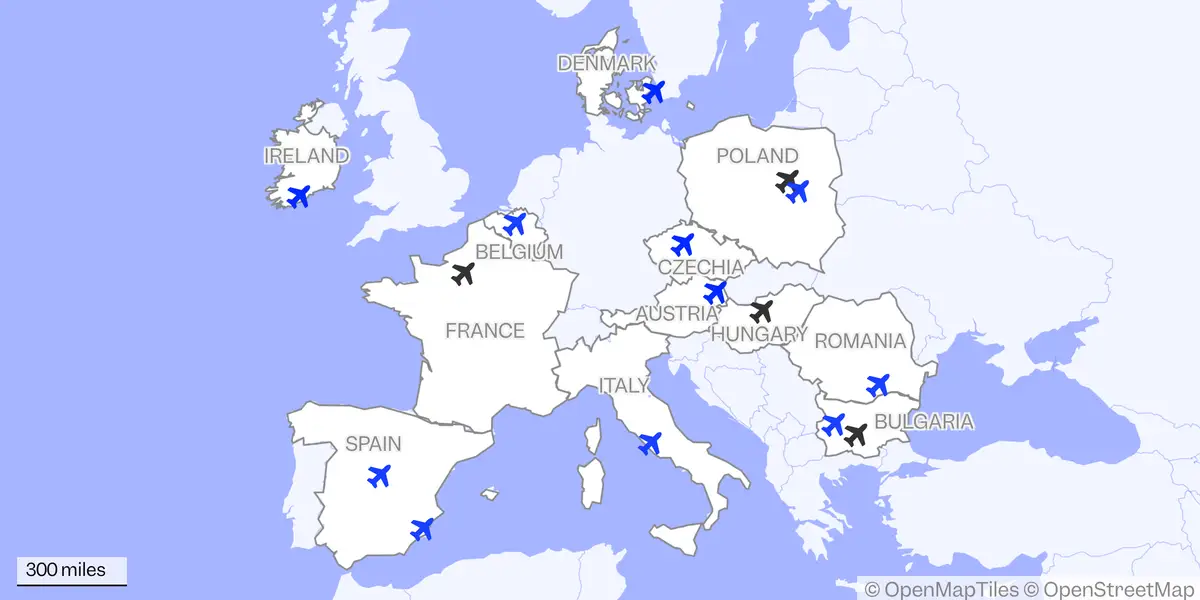
Fighter jets were scrambled as dozens of passenger flights were targeted by hoax bomb threats across Europe this week, from Ireland to Bulgaria.
Based on statements from airlines, airports, governments, and police forces, Business Insider confirmed 35 planes were threatened.
There are likely more, as some police statements mention unspecified numbers, and some reported incidents cannot be directly confirmed.
The first incident occurred on Monday, when a Wizz Air flight from London to Sofia, Bulgaria, was diverted to Budapest, Hungary. An airline spokesman said a bomb threat was received during the flight, and the plane landed safely before being searched.
On Tuesday, seven more flights were threatened. Although Wednesday then seemed quiet, at least 19 planes were targeted on Thursday.
They were among four flights that arrived in Prague, Czech police said. And in Copenhagen, Danish police said they were searching two planes, where “nothing of interest was found”.
On Friday, both police forces said they were also investigating the threat further. Madrid Airport received another threat on Friday morning, affecting four flights.
Over the course of the week, five flights were diverted, but most continued to their previous destinations. No one was reported hurt, and no bombs or other explosive devices were reported.
“We know that this is a terrible hoax threat,” Heidi Alexander, Britain’s transport minister, said on Thursday.
The severity of the threat has led some air forces to seize fighter jets.
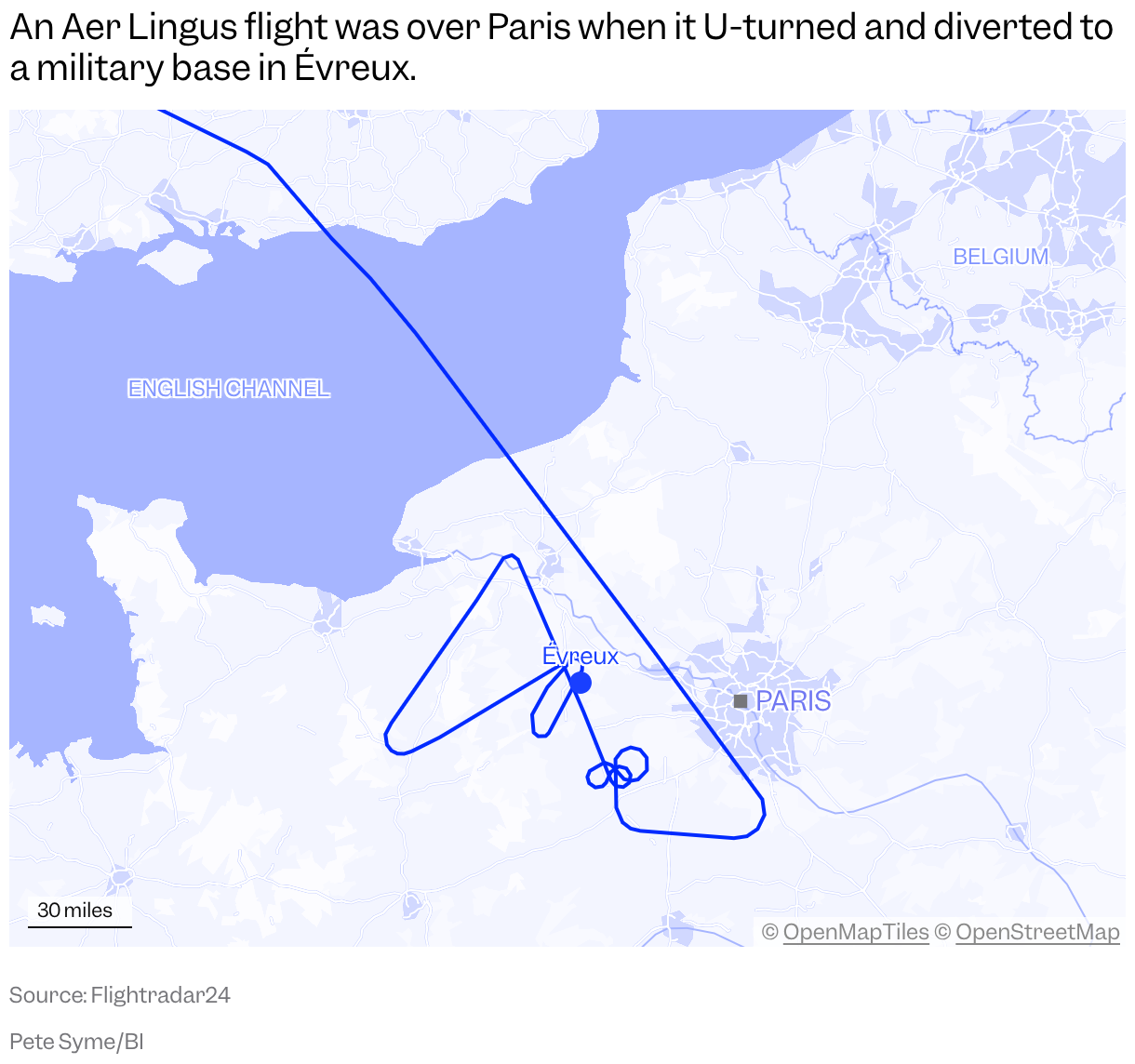
On Tuesday, French Prime Minister Sébastien Lecornu ordered fighter jets to intercept an Aer Lingus flight from Dublin that had received a bomb threat, his office said in a statement.
The plane, which had 157 people on board and was bound for Rome, was diverted to a French air base in Normandy.
Two days later, Bulgaria scrambled jets to intercept three Ryanair flights, one of which was diverted to Plovdiv, the country’s second largest city. The Italian Air Force also sent Eurofighters to escort the Finnair flight from Helsinki to Rome.
“NATO continues to monitor the situation and continues to coordinate closely with the Allies, who have responded in various ways to potential threats in the past few days, including with scrambling aircraft, some of which have been transferred to NATO,” said a senior NATO military official.
While a spokesperson for the European Commission told Business Insider on Tuesday that “it is too early to conclude that the reported incidents are related,” some analysts point to hybrid warfare – using covert methods to disrupt society and spread division.
Western officials have previously accused Russia of waging a hybrid war against Europe, blaming malicious operations including attacks, sabotage, arson, drone strikes, and other actions on the continent in recent years. The Kremlin has repeatedly denied involvement.
NATO’s leadership says the hybrid war is intended to weaken support for Ukraine and undermine allies’ resolve. NATO Secretary General Mark Rutte said last month that the campaign was escalating.
Analysts from Osprey Flight Solutions, an aviation risk management company, said in a note Tuesday that it was “likely” this week’s bomb threat was a “coordinated campaign intended to disrupt flight operations.”
“Although it is not always clear what is driving the coordinated campaign, it is possible that the new wave is related to Russian state actors, or to people sympathetic to Russia,” he said. “Demonstrating the willingness and ability to disrupt flights is considered consistent with Russia’s hybrid campaign in Europe.”
Ireland’s Cork Airport told Business Insider it received anonymous phone threats about certain flights. And the Bulgarian Border Police told the national news agency BTA that the bomb threat was received via email.
It is unclear who is behind the incident.
The International Air Transport Association, the main trade group for airlines, issued a statement on Thursday condemning the disruption.
“We are calling on the authorities to find the origin of this hoax threat,” said Nick Careen, IATA’s senior vice president for safety and security operations.