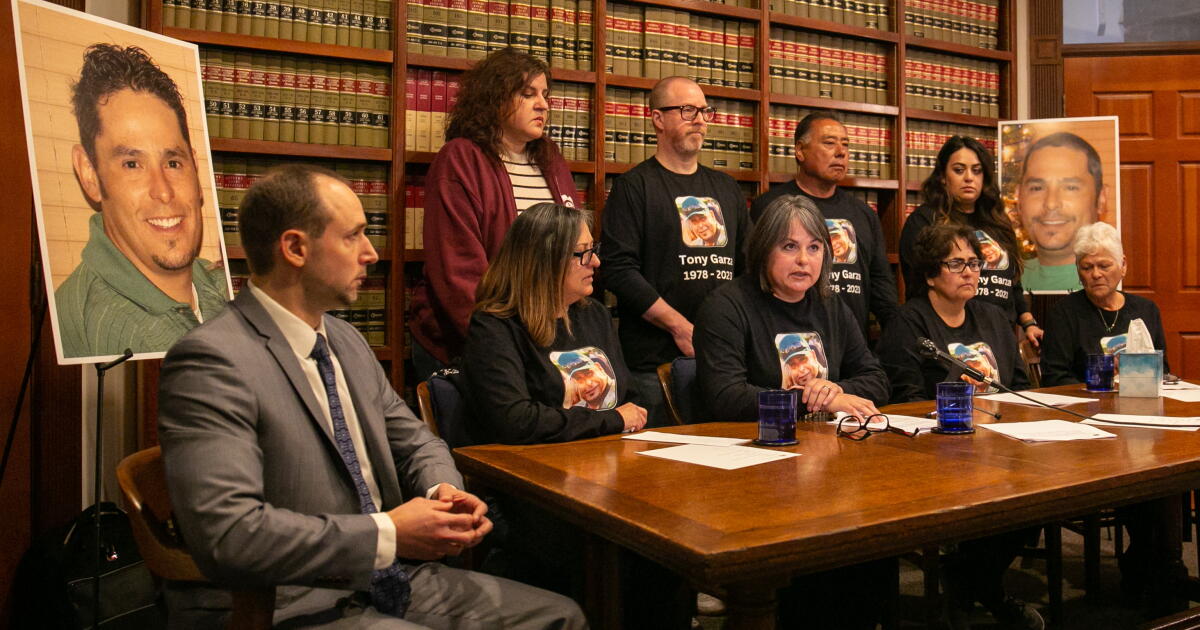
A federal jury awarded a Southern California mother $51.8 million in what is believed to be the largest verdict in a police shooting in California history after her son was killed by a San Bernardino County Sheriff’s deputy.
On February 5, 2023, Antonio Garza Jr. was chased from a fire in his Yucca Valley home to Palm Springs, where he was shot more than a dozen times during a 35-minute chase.
After a seven-day civil trial, a federal jury this week unanimously found the San Bernardino County Sheriff’s Department responsible for the actions of Deputy Nicholas Kridner and Bill Abernathy, who were charged with excessive force, violation of Garza’s civil rights and wrongful death in the incident.
“This was the execution of a mentally ill person,” Garza’s attorney Rebecca Brown said at a news conference Friday. The Sheriff’s Department did not immediately respond to a request for comment.
According to an independent autopsy report presented to jurors at the trial, officers fired 14 shots at Garza and seven more shots after he fell to the ground. Garza was hit twice in the back and twice on the ground. The deputies involved in the incident were not wearing body cameras.
But video recorded by a motorist on Interstate 10 captured part of the shooting, which occurred after a chase. The video shows four officers chasing Garza along Interstate 10 in Palm Springs, with Garza confronting officers multiple times and holding an object in his hand. At one point, Kridner ordered Garza to get on the ground with his hands up, but he ran away with a golf club.
Garza then turned around and replied, “No, you f—ing… shoot me, bro,” before starting to walk toward the officer, the video shows.
Garza was hit twice with less-lethal bean bag rounds but did not surrender. Kridner and Abernethy said Garza was holding a golf club above his head and swinging it at Kridner when he was shot. Two deputies then shot Garza.
County attorneys defending the case noted that an autopsy found large amounts of methamphetamine in Garza’s system.
Jurors also heard about Garza’s previous run-ins with law enforcement and his family’s difficulty getting help from the county for his mental health issues.
On February 5, 2021, Garza’s relatives asked deputies to perform a welfare check on him, whose mental health had begun to deteriorate. That same day, he was arrested on suspicion of assaulting a police officer with a deadly weapon.
The family said they sought assistance from several independent and government organizations, including inquiries about Garza’s custody, but were unsuccessful.
“His mental health continued to deteriorate and he became more paranoid and fearful,” his sister, Silvia Garza-Littman, said after the shooting.
Meanwhile, Garza didn’t realize he was struggling and was denied help by some programs because he didn’t seek help himself, she said.
In August 2022, Garza was ruled mentally incompetent to stand trial and sentenced to incarceration until beds became available at a state mental health treatment facility. This did not happen, however, and a lawyer eventually petitioned for his release.
Garza remained in the county jail until 12 days before the shooting. Garza was released on Jan. 24, 2023, and told he needed to seek mental health help within 48 hours. When Garza checked into a court-appointed office, he was told there was a six-month waiting list.
“No one is going to step in and help our brother,” Garza-Littman said. “Instead of helping, they made it worse.”
The jury awarded Garza’s mother $8 million for emotional pain and suffering, $10 million for loss of love, $8 million for loss of future enjoyment, $2 million for emotional anguish, $6 million for physical anguish, $2.8 million for lost earnings, and $5 million for violation of her civil rights. Additionally, the jury found the two representatives acted with reckless disregard and awarded $10 million in punitive damages. Garza’s attorney said it was the largest sentence in state history.