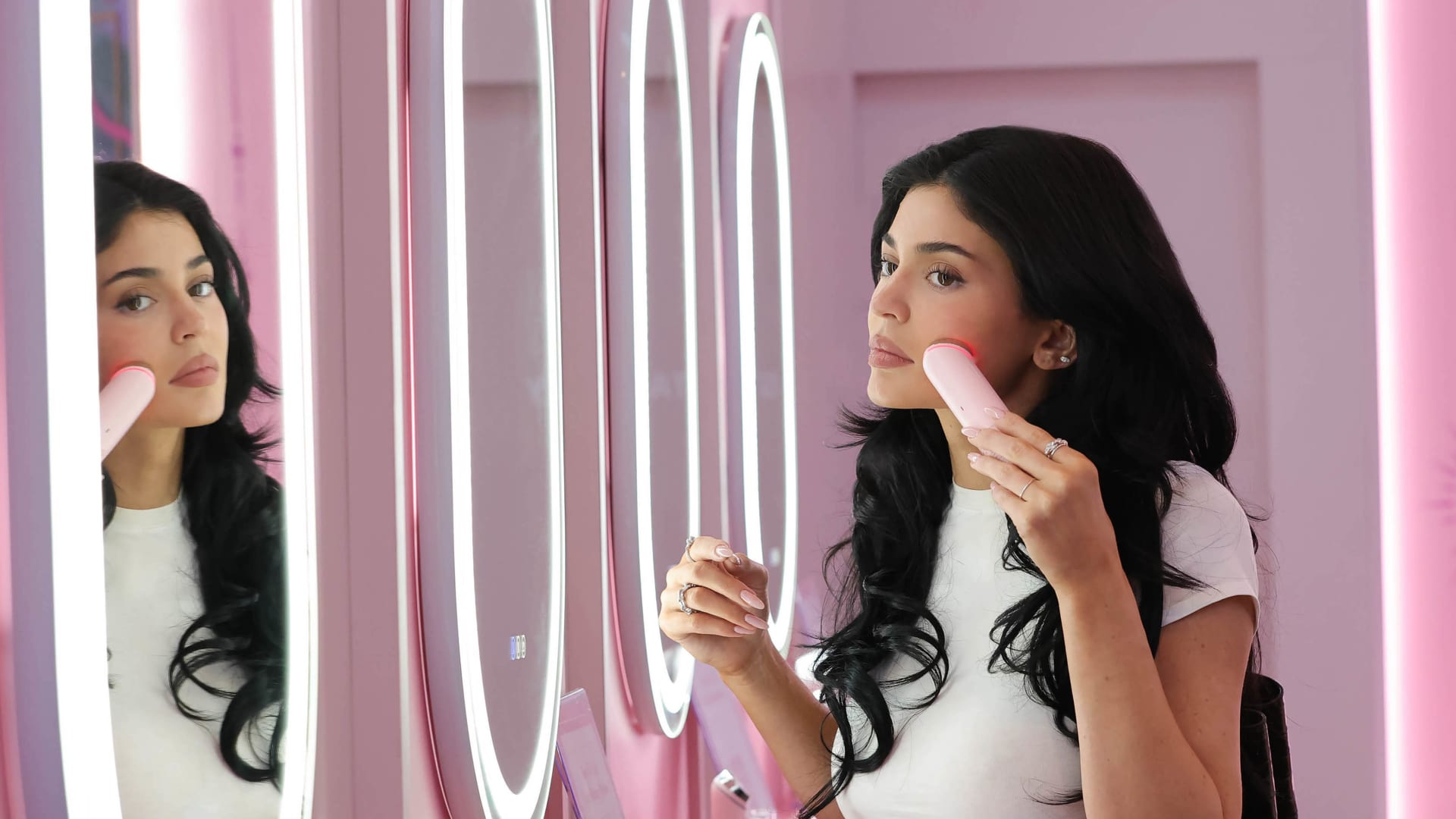
LOS ANGELES, CALIFORNIA – MARCH 25: Kylie Jenner is seen trying out Booster Pro at the Medicube Pop-Up on March 25, 2025 in Los Angeles, California. (Photo by Michael Simon/WireImage)
Michael Simon Wireimage | Getty Images
From snail mucin to salmon DNA and high-tech LED sticks, K-beauty is hitting the shelves of US stores, and investors are now testing whether the viral boom is worth paying for.
US fund manager Guinness Atkinson launched what it calls the country’s first K-beauty ETF, KBTY, in November. The fund tracks 25 companies that make up the Korean beauty ecosystem, including owners of the popular Medicube skincare brand APR, Cosmax, Kolmar Korea, Cosmecca Korea, and Amorepacific.
The K-beauty boom has helped push South Korea into the spotlight, with the country overtaking France as the top cosmetics exporter to the US by 2025, according to the US International Trade Commission.
Exports of K-beauty products to the US will increase by 197% between 2020 and 2024, according to a May report from Nielsen IQ. Globally, sales of K-beauty products are up 53% year-on-year and up 131% from two years ago.
With exports booming, brands like Medicube, Laneige, COSRX, and Dr. Jart are becoming familiar names to US shoppers.
US shoppers spent $2.8 billion on K-beauty products in the 52 weeks to March 21, with sales up 48% year over year, according to a Nielsen IQ report.
As K-beauty penetrates the US market and continues to gain global popularity in social media, investors question whether the industry will see long-term gains as rate swings and fast-moving consumer trends present potential headwinds.
“Social media has shown how quickly consumer trends can spread to financial markets,” eToro analyst Gabriel Debach told CNBC.
However, viral consumer trends don’t always translate into long-term growth for investors, Debach said. Pop Mart, The seller of collectible plushies Labubu, saw an increase in revenue of 245% to 250% year in the third quarter of 2025. However, the profit of the third quarter in 2026 fell 45% to 50% from the previous year.
“What makes K-beauty interesting in the US today is that the story has gone beyond the social media buzz,” Mintel’s chief strategist of Beauty & Personal Care, Andrew McDougall, told CNBC. “We see it appearing in trade, consumer behavior and physical retail at the same time.
“I think this is an important distinction, because viral interest can generate TikTok searches and views, but it is more difficult for a fad to generate a continuous flow of commerce and retail distribution,” he said.
Korean beauty stocks
The KBTY ETF includes beauty brands, product manufacturers, distributors, retailers, and more, according to a Guinness Atkinson research report.
“The Korean beauty industry adopts a shared industrial system, and that system is a long-lasting competitive advantage,” said Guinness Atkinson, adding that Korean beauty brands rent labs and factories rather than own them.
“Contract manufacturers store ready-made libraries, stable formulations of brands can choose and manage, handle regulatory work and packaging, and will receive orders as small as a thousand units – small enough to test an idea rather than inside the company.
The fund’s largest company, APR, has a market cap of about 11.2 trillion Korean won ($8.4 billion), and is up 30% annually. The stock surged nearly 100% earlier this year ahead of the launch of Medicube’s product in the US. Costco store. Shares gain 362% in 2025.
Cosmax, a cosmetics manufacturing company, is up 93% year-on-year and has a market cap of 3.6 trillion won. L’Orealthe world’s largest cosmetics company, announced in September that it will collaborate with Cosmax in next-generation beauty research.
Kolmar Korea, a contract manufacturer that develops and manufactures cosmetics for other brands, has a market cap of about 3 trillion won, and is up 108% year-on-year.
Meanwhile, Amorepacific, the nearly 9 trillion won company behind popular brands COSRX and Laneige, is up 19% this year.
“Guinness’ new ETF offers exposure that is difficult to obtain through traditional Korean equity funds,” Debach said.
He pointed out that cosmetics stocks are only about 1% of South Korea’s main index, ie KOSPI, which is dominated by stocks like Samsung Electronics and SK Hynix.
Meanwhile, the iShares MSCI South Korea The ETF, which manages nearly $20 billion, has only two of the 25 companies in the new fund, with a combined weight of just 1.07%, Debach added.
South Korean beauty stocks rallied ahead of Black Friday, as K-beauty products dominated Amazon’s best-selling skincare rankings across the US, UK, Germany, France, Spain, and Italy – on November 25, according to data compiled by Meritz Securities.
Shoppers at the opening of an Olive Young store in Pasadena, California, U.S., Friday, May 29, 2026.
Kyle Grillot | Bloomberg Getty Images
K-beauty products also ranked highly in the beauty and personal care category on Amazon on Friday morning.
Debach said he expects similar products to be launched in the U.S. and Europe as ETF providers are commercially linked to capitalize on new trends by launching specialized products with higher fees.
“What I’m going to see is whether investors keep putting in their funds when the stock price drops and social media attention goes elsewhere,” he said.
“US-listed K-pop ETF liquidated in 2025 despite Korean music’s worldwide popularity. Global consumer phenomenon does not necessarily make ETFs commercially successful.”
rate risk
Mintel’s McDougall warns that one risk to long-term K-beauty growth is whether the industry can offset the cost of tariffs.
“Affordability is another potential tension, part of the appeal of K-beauty is its ability to offer consumers a combination of innovation, efficacy and accessible price,” McDougall told CNBC.
“If tariffs, logistics, regulatory requirements or retail mark-ups significantly raise prices, brands risk weakening one of the reasons consumers are willing to experiment with them in the first place.”
US trade policy has been repeatedly changed since 2025, with duties on South Korean goods potentially rising to 15%, according to a proposal announced this week by the Trump administration.
Guinness Atkinson warned that the company could pass some of these costs on to consumers, potentially eroding K-beauty’s price advantage, or absorb and take a hit for margins.