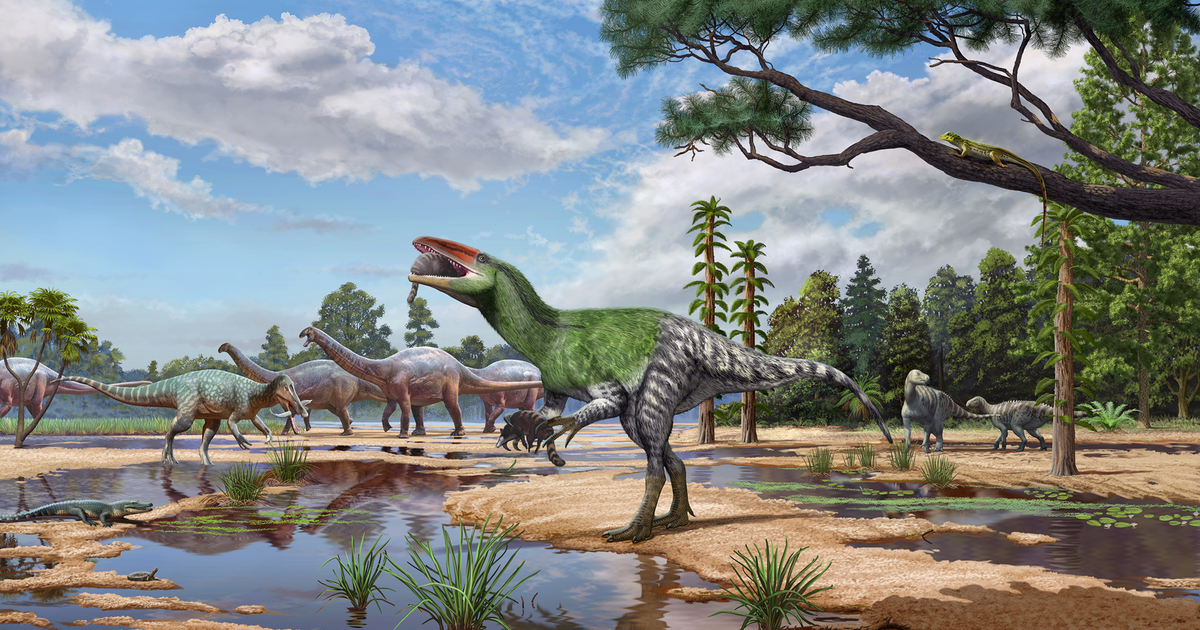
london – A previously unknown dinosaur species — A “tiger-sized, long-clawed predator” and a cousin of Tyrannosaurus rex — It was identified from a fossil discovered 100 years ago, but until recently it was hidden in a British museum.
The species, named Invictibellatrix amberina, belongs to a group of bipedal carnivores known as macroraptors According to an article published in the Royal Society Open Science Research journal.
Megaraptor is closely related to the dinosaur family of Tyrannosaurus. However, unlike Tyrannosaurus rex, scientists say Invictibellatrix attacked its prey not with its mouth, but with its long arms and huge curved claws.
Researchers believe the dinosaur was 10 to 13 feet long and nearly 5 feet tall. Its body may have been feathered, and it preyed on smaller dinosaurs, lizards, and mammals.
The fossil that led to the discovery sat in a drawer at London’s Natural History Museum for nearly 100 years, when the institution first acquired it in 1924.
Dr Cassius Morrison of University College London, lead author of the paper announcing the discovery, called it “the real mystery of this fossil that has been ignored for so long”.
Morrison writes that while Invictibellatrix “was not an apex predator of its time,” if they coexisted with the species, it would pose a huge threat to humans — even “more dangerous than Tyrannosaurus rex.”
“We would be perfect-sized prey, about a third of their body weight,” he said. “They’re definitely going to chase us. The T. rex won’t bother us because we’re so small.”
The fossil itself is a piece from the back of the skull. It was one of 1,000 specimens originally discovered by Reginald Walter Tooley on the Isle of Wight, off the south coast of England, and subsequently acquired by the Natural History Museum.
Royal Society Open Science 
Invictibellatrix lived in the early Cretaceous period, about 120 million years ago, and is one of the smallest and earliest known members of the macroraptor group.
To understand Invictibellatrix, the researchers first performed CT scans of the fossil to create a 3D model of that part of its skull. The findings were compared with skulls of other bipedal carnivorous dinosaurs, such as Tyrannosaurus rex, Spinosaurus and raptors. Many unique characteristics led the researchers to conclude they had discovered a new species.
Invictibellatrix means “invincible female warrior” in Latin, while amberina refers to the amber found in the rocks where the fossil was found. The researchers said that by naming the dinosaur “Invictibellatrix,” they hope to “bring hope and strength to all those who have been bullied, discriminated, victimized, and oppressed, letting them know that tomorrow will be theirs and not give up in the face of such difficulties.”