If President Donald Trump had his way, the Republican Party would be top-to-bottom the party of AI — or, in his preferred branding, “super intelligence.”
But down in the very state where Trump has his “winter White House,” two Republicans have put forth a very different vision for the party’s future — and have been far more eager to take on the artificial intelligence industry.
- Gov. Ron DeSantis and his attorney general, James Uthmeier, have become vocal critics of the AI industry over the past year, warning of the technology’s dangers to children and to humanity as a whole.
- This sets them apart from Trump, who has championed the industry and downplayed its dangers.
- DeSantis tried to pass an “AI bill of rights” with child safety restrictions, but his effort was foiled by other Florida Republicans with close White House ties.
- Uthmeier has filed a wide-ranging lawsuit against OpenAI and the company’s CEO, Sam Altman.
- The two are betting that public backlash against AI will grow deeper, including among Republicans — and they’re hoping they’ll be able to steer the party in a post-Trump world.
Most notable is the term-limited Gov. Ron DeSantis, who devoted much of his final year in office to a failed effort to pass an “AI bill of rights,” which would have imposed tougher restrictions regarding child safety and other topics. He’s warned that AI could “set off an age of darkness and deceit,” blasted “tech oligarchs” for putting people at risk, and called Anthropic “very creepy” for exploring whether AI could be conscious.
“He clearly understands what the risks are, and I find he’s also very good at calling bullshit on disingenuous arguments from the Silicon Valley lobby,” Max Tegmark, an MIT physicist who co-founded the Future of Life Institute, an AI safety nonprofit, told me. (DeSantis hosted Tegmark at two events in Florida this year.)
The other is DeSantis’s handpicked attorney general, James Uthmeier, a longtime close ally who is now trying to win the AG’s office in his own right — and who filed a high-profile lawsuit against OpenAI in June. Last week, Uthmeier asked the judge in the case to block OpenAI from developing new models unless they had “independent third-party guardrails and approval.”
“The danger of these AI systems is real and growing,” Forrest Saunders, a spokesperson for Uthmeier, told me. “Florida and the nation have seen case after case of violence, child exploitation, and models that operate beyond their developer’s control.” He added that Uthmeier “welcomes innovation, but Floridians will not be the test subjects.”
With AI cresting as a national anxiety — or a national opportunity, depending who you talk to — both major parties are still finding their footing on the issue. And though Trump is clearly trying to get Republicans in lockstep behind the industry, a very strong current is pulling the other way, responding to populist concerns and parents’ complaints to stake out a much more skeptical position. Florida has emerged as a bellwether for what Republican policies might look like if conservative America turns decisively against AI, especially as Trump’s political clock runs out.
DeSantis and Uthmeier aren’t unique in the GOP for having concerns about AI — a handful of House members and senators want further action, and populist opposition to data centers has bubbled up in races around the country.
But the two have gone furthest in taking on the industry directly — and they’ve done so even though it puts them on the wrong side of Trump.
In recent days, I spoke to several Florida political observers and advocates on the AI issue. Most believe that DeSantis and Uthmeier are affirmatively trying to stake out what the GOP’s position on AI should be in a post-Trump future, and to better align with an electorate that’s turning sharply against the industry, despite what the president may say.
“He’s trying to skate where the puck is going,” Jeff Brandes, a former Republican state senator, told me. (DeSantis’s office did not respond to a request for comment.)
Beyond the quest for political advantage, the stakes are very real. Will there actually be a significant and influential force on the right that takes the concerns about advanced AI’s harms seriously — and is willing to act to try and rein them in, before they do great damage?
DeSantis and Uthmeier are hoping the answer is yes — and that they will be the ones leading that charge.
Ron DeSantis’s quest for an AI bill of rights
In this case, the politics and the personal are intertwined. DeSantis occupies a unique place within the party at this particular moment that’s given him an incentive to buck the national consensus on the right, especially when it comes to Trump, and explore an independent approach.
In his first decade in politics, DeSantis had a charmed rise. In 2012, he embraced the Tea Party to win a seat in Congress; in 2017, he bear-hugged Trump to get his endorsement for governor. He then became a national conservative star for opposing pandemic-era public health restrictions and waging war on “wokeness,” winning his 2022 reelection in a nearly 20-point landslide.
“He is always out front, even ahead of other Republicans, on issues that he makes more important,” Peter Schorsch, editor of Florida Politics, told me. “I would joke with people that I didn’t know how to spell ESG or DEI before he brought these to the forefront.”
But what followed was a failed presidential primary campaign that put DeSantis on the wrong side of Trump and then sent him back to Florida with an uncertain political future.
Early last year, just weeks after a report that DeSantis’s wife Casey was considering running to succeed him as governor, Trump publicly urged Rep. Byron Donalds to enter the race, promising his “Complete and Total Endorsement.”
Also early last year, DeSantis, who had long run roughshod over Republican legislators, was faced with a new thorn in his side: an ambitious new state house speaker, Daniel Perez, who was more interested in cultivating the Trump White House than the governor. Perez took a far more assertive stance in shaping legislation and rejecting some of the governor’s demands than his predecessors; he also publicly blessed an investigation into a charity tied to Casey DeSantis. A bitterly personal feud between Perez and DeSantis ensued.
In the midst of all this, last summer, DeSantis got AI-pilled.
In July 2025, DeSantis announced that he was going to develop a state plan to deal with the rise of artificial intelligence. “We can’t just turn the reins over to a bunch of tech overlords,” he said. (DeSantis had long been a critic of major tech and social media companies on the grounds that they are too “woke” or politically hostile to conservatives and their ideas.)
At another event that month, DeSantis said: “I think this is, like, the biggest issue that’s facing our society.” He mentioned AI’s potential impacts on the economy, on jobs, on students, and on the spread of “false narratives” as troubling to him.
“I welcome technologies that will enhance the human experience. I do not welcome things that are going to supplant the human experience,” DeSantis said in September.
His interest in state action put him on the opposite side of the Trump administration, which was advocating for a 10-year moratorium on state regulation of AI — arguing that forcing the industry to abide by a patchwork of state regulations would slow its growth. (David Sacks, a key Trump adviser on AI, championed this argument.)
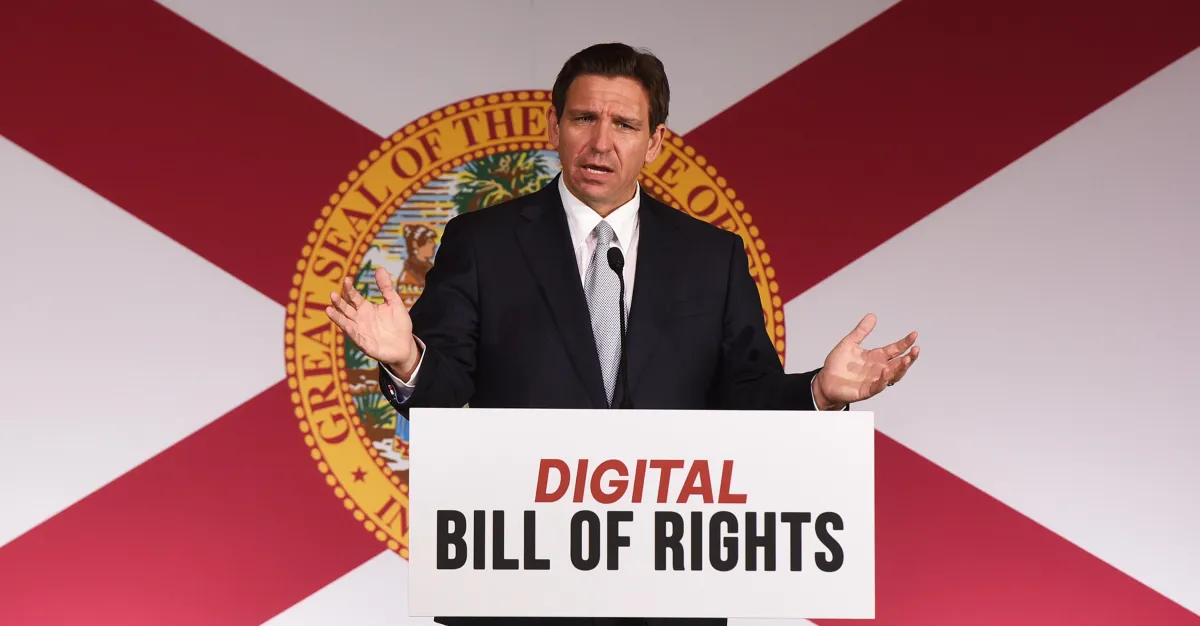
Last December, at the Florida mega-retirement community the Villages, DeSantis rolled out his proposed “AI bill of rights.” It did not focus on existential or civilizational risks, but instead more practical concerns around child safety. Megan Garcia, a Florida mother whose 14-year-old son died by suicide after conversing with a chatbot “companion,” appeared at the press conference.
As introduced in the Florida state senate, the bill would have required that parents consent to minors speaking to companion chatbots and forced companies to disclose when users weren’t speaking to a human, among other provisions. The state senate passed it in March.
But it was dead on arrival in the Florida House of Representatives — where Perez had aligned himself closely with the White House. “We do believe that the federal government should take care of AI, and whatever legislation or policy has to pass on a national level,” Perez said.
Brendan Steinhauser, who heads the AI safety advocacy group Alliance for Secure AI, told me that he saw Perez at a Mar-a-Lago fundraiser around this time, and asked him about safety risks. “He leaned to me and whispered, ‘We’re with you, but the president has made it clear not to move forward on this stuff,’” Steinhauser said. “So, the White House basically put the kibosh on that effort.”
DeSantis complained publicly that Perez was pursuing a “personal agenda” and thwarting badly needed legislation. It was to no avail — the bill didn’t move. But Perez did — Trump nominated him as ambassador to Brazil in June, and he was confirmed in August. (A request for comment from Perez, submitted to the State Department, received no response.)
James Uthmeier’s lawsuit against OpenAI
Though DeSantis hit a wall in the legislature, his attorney general was soon waging his own battle against OpenAI in court.
The attorney general is an elected position in Florida, but when Marco Rubio vacated his Senate seat to become secretary of state, DeSantis filled the seat with the state AG, Ashley Moody.
Then, to fill the newly vacant AG job, DeSantis chose one of his closest aides, who had served as his general counsel, chief of staff, presidential campaign manager, and chief of staff again — Uthmeier.
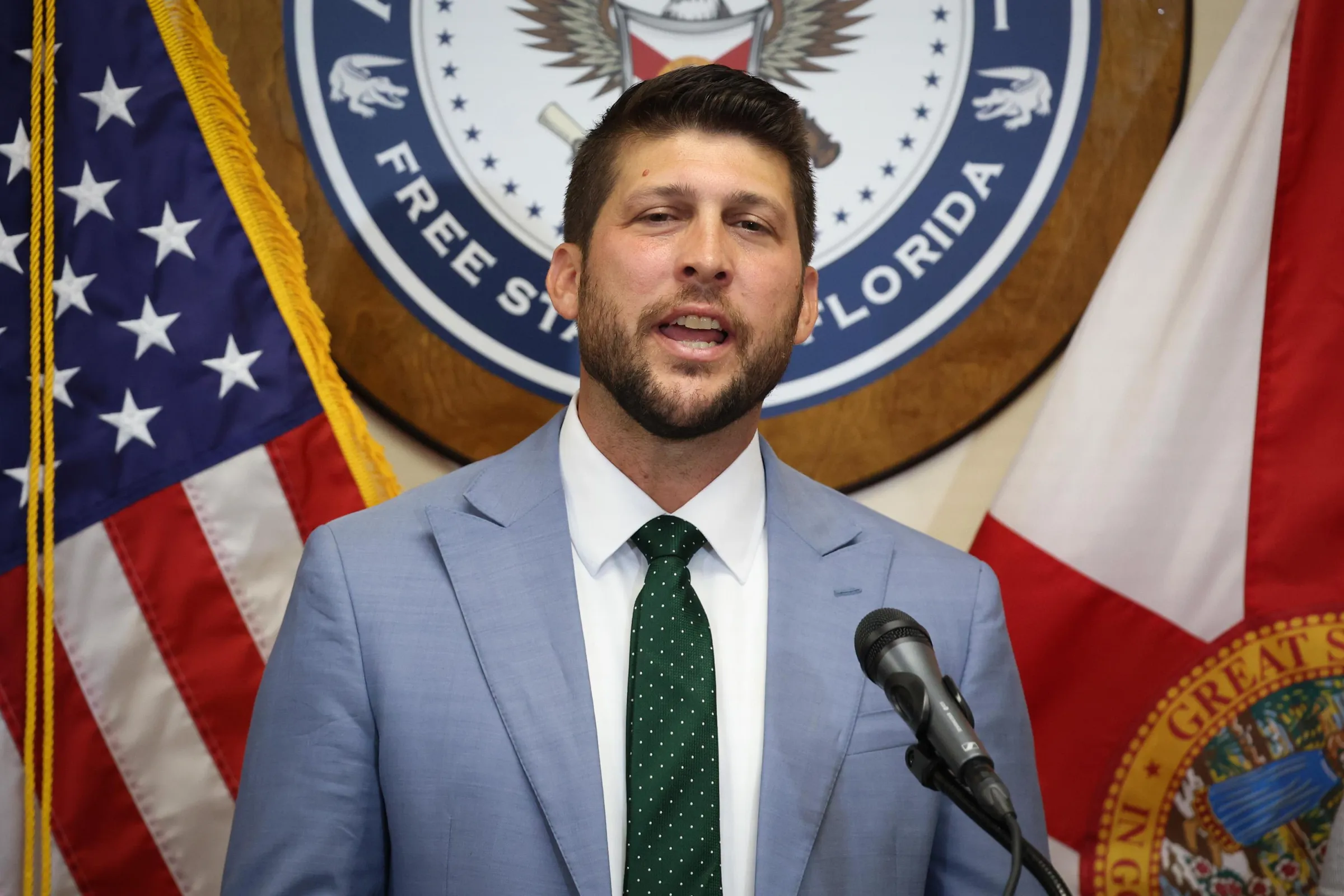
Uthmeier is a Florida native who had worked in Rubio’s senate office; he graduated from Georgetown Law School in 2014. After that he joined the firm Jones Day and worked with Don McGahn; when McGahn was named White House counsel in Trump’s first term, Uthmeier went with him to the new administration, ending up at the Commerce Department. Then, in 2019, he headed back to his home state to work for the new governor, DeSantis, and has been close by his side ever since.
Now, though, DeSantis is term-limited, and Uthmeier is trying to get Florida voters to elect him for a full term as AG on his own. (Trump’s allies had reportedly urged then-Speaker Perez to challenge Uthmeier in the GOP primary, hoping to supplant a DeSantis ally; but Perez demurred, and Uthmeier won the nomination unopposed.)
To make his mark, Uthmeier has filed several high-profile and politically charged lawsuits — for instance, he sued Starbucks over its corporate diversity politics (the company recently settled), and Pfizer about the safety of its Covid-19 vaccine. He’s also subpoenaed the NFL over its “Rooney Rule,” which requires teams to interview minority candidates for top coaching and operations jobs.
He’s also become the face of the administration’s challenge to the AI industry. In April, Uthmeier stood in front of a podium with an “Investigating OpenAI” sign, announcing he’d opened a criminal investigation into the company.
The impetus was a shooting at Florida State University last year that killed two people and injured six others; the accused shooter had consulted ChatGPT about various topics related to his plans hours before the attack.
“If ChatGPT were a person, it would be facing charges for murder,” Uthmeier said then. “This criminal investigation will determine whether OpenAI bears criminal responsibility for ChatGPT’s actions.”
There have been no criminal charges yet. But in June, Uthmeier filed a wide-ranging civil lawsuit against OpenAI, alleging deceptive business practices, negligence, fraudulent misrepresentation, and other legal violations, because the company marketed ChatGPT as safe when they knew it could be quite dangerous. The suit also named OpenAI CEO Sam Altman personally as a defendant. (Disclosure: Vox Media is one of several publishers that have signed partnership agreements with OpenAI. Our reporting remains editorially independent.)
Like DeSantis’s AI bill of rights, Uthmeier’s lawsuit originally focused on practical concerns and real-world harms that have already occurred, like the shooting. “Since its release in 2022, ChatGPT has advised teenagers on how to kill themselves, mix unsafe combinations of drugs, become anorexic, helped plan one mass shooting and one multiple homicide in Florida alone,” one filing in the lawsuit reads.
But after the summer’s ominous parade of AI headlines — such as OpenAI agents autonomously hacking the company Hugging Face, and new statements from current and former AI lab employees warning the technology could cause human extinction — Uthmeier turned up the heat, asking the judge in the suit for an injunction blocking OpenAI from developing new models without independent third-party safety evaluation.
“Defendants claim they cannot stop barreling forward with their potentially civilization-ending endeavors unless they are forced to do so by the government. They have asked the government to tie them to the mast” he wrote in a filing last week. “Plaintiff brings good news to the Defendants: The Florida Attorney General is answering your cry for help with a motion to enjoin you from harming Floridians with your reckless, unacceptably risky product.”
“Though a reasonable person would say there is no amount of money worth a 10% chance of the extinction of the human race, Defendants see it differently. They are intent on growing their $1 trillion valuation,” the filing continues. “It is only by the grace of the Almighty that one of Defendants’ AI agents hasn’t compromised a water supply or shut down a power grid — yet.”
OpenAI has not yet filed a response on the merits in this suit, but a company spokesperson has previously said that, in the case of the the Florida State University shooter, ChatGPT “provided factual responses to questions with information that could be found broadly across public sources on the internet, and it did not encourage or promote illegal or harmful activity.”
Uthmeier, age 38, is viewed in the state as a potential rising star with a talent for getting headlines, who could well have a long career in state GOP politics — if he wins in November, that is.
While DeSantis has been credited for changing Florida from a swing state to a solidly Republican one, some recent polls have raised the possibility it might swing back. A September survey by St. Pete Polls found Uthmeier ahead of his Democratic challenger, Miami attorney and former state Rep. José Javier Rodríguez, by just a single-point margin.
And though DeSantis and Uthmeier have become major AI critics, the Floridian topping this year’s GOP ticket, Rep. Byron Donalds, is currently being hammered with attacks about his statement last year that the state needs to “embrace” data centers. He’s been nicknamed “Data Center Donalds” by his Democratic opponent, former Rep. David Jolly, who has also been close in some recent polls.
As for DeSantis, few expect the 48-year old to go quietly into retirement. When asked over the spring whether he’d run for president in 2028, he told reporters, “You never know.”
Brandes, the former Florida state senator, told me that he thinks DeSantis’s AI push is about “looking for wedge issues where he can have a different opinion from Trump’s successors as he prepares for whatever future ‘28 or ‘32 provides for him.”
That is: The Republican Party of 2026 might still be too influenced by Trump to go fully anti-AI. But if Trump’s influence ebbs, if the populist backlash against AI spreads further, and especially if there are more worrying AI-related reports or incidents with real world harms, perhaps there could be an opening on the right for a leader who’s taken the problem seriously, even when it meant going against powerful figures in his party.