
The number of young people not earning or learning is described as a “moral crisis” for the nation
Listening to Alan Milburn set out his vision for youth employment this morning, Jayne Worthington – who’s spent much of her career focused on education, skills and social mobility – found plenty of reasons to be optimistic.
Now the CEO of The Progress Group, which runs a number of alternative provision education providers mostly in the North of England, she’s all too familiar with the age-old debate about getting young people earning or learning from her time at the North West Development Agency.
Former Labour Minister Mr Milburn today unveiled his long-awaited report on how to drastically reduce the numbers of young people not in education, employment or training (NEET), describing it as a “moral crisis”.
Mrs Worthington, who grew up on a deprived council estate in Birmingham before having her life turned round by a local arts worker, tells The Northern Agenda newsletter : “I completely agree with that.”
But she adds: “My disappointment is that many of the things that he’s talking about, we have done before under different names. And they’ve stopped funding them.
“So at some point, we have to see this as a cross-party, system-wide issue, as he says, genuinely and it’s slightly disappointing that more work has not been done with other parties, the opposition and Lib Dems to create this level playing field.
“I can name things like intermediate labour markets, Sure Start, Future Jobs, Kickstart, careers advice and guidance that got rolled out and rolled back. So I think many of these things have been tried and tried successfully, but the continuation of funding has ceased.”
At least a year in the making, today’s Milburn review proposes shifting Britain from a “welfare state” to a “working state” to cut the youth NEET rate from 13% to 5% by 2036.
Its main recommendations include a Youth Opportunity Service providing every NEET young person with a dedicated adviser and a route into education, training, or work, and instant, needs-based youth mental health support without requiring a diagnosis.
His suggested welfare reforms would overhaul under-25s’ benefits, replacing Personal Independence Payment and Universal Credit health elements with a standard youth allowance and narrower disability payments while investing billions upfront in job placements and training before cutting payments.
Calling for apprenticeship completions to double over a decade, he urges the Government to cut employer National Insurance for under-25s (starting with retail and hospitality) and subsidise workplace adjustments to make hiring young people cheaper and less risky.
It’s not hard to see why leaders in the North of England are so keen to see action taken, as some parts of the region have as many as one in every fourteen 16 and 17-year-olds estimated to be NEETs.
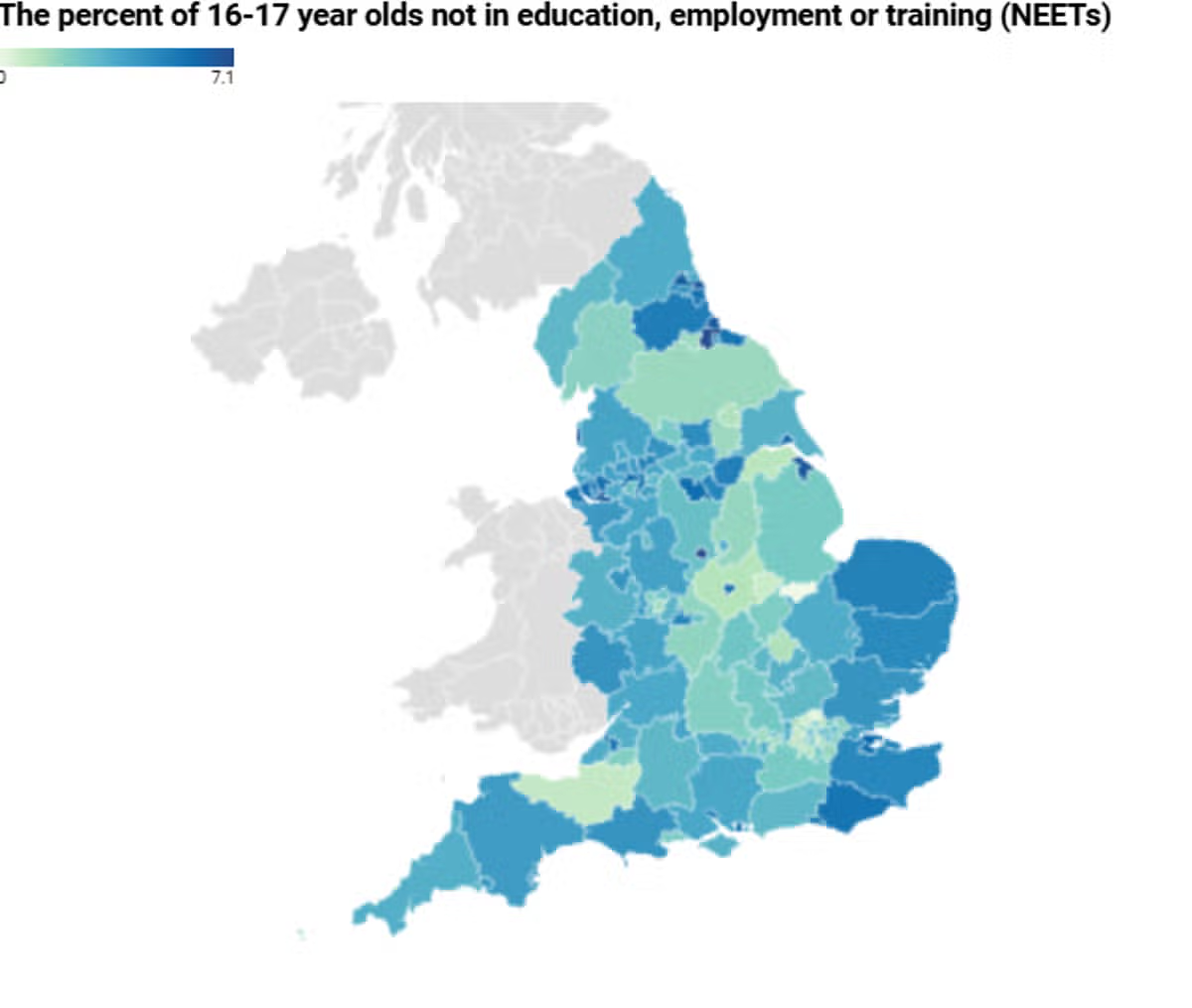
Reach Plc data unit graphic
Of the ten areas with the highest rates of NEETs, eight – Stockton-on-Tees, Blackpool, South Tyneside, North East Lincolnshire, Halton, Hartlepool, Newcastle and Hull – are in the North of England. It’s a human tragedy for the young people involved and costs the UK billions in lost productivity and extra benefits.
One of Merseyside-based The Progress Group’s family of businesses is Progress Schools, set up to deal with children who were permanently or temporarily excluded from mainstream education and with sites including Teesside, Cumbria, Manchester and the Wirral.
She describes some of the “heartbreaking” issues her teams have to deal with just to make sure young people’s basic needs are met, before even thinking about their ambitions for the future.
“For an example, just as an extreme, some of the children we work with, and it’s not that unusual, but one child came to us, and it took him 45 minutes to eat one strawberry because he’d been starved at home.
“He’d been taken into care, put into foster care, and his foster family had also starved him. That’s an extreme case, but you have to deal with that and everything that brings that trauma before you can start to help the child learn.”
Mrs Worthington says the way schools are regulated and assessed is a major factor on whether young people are ready for the world of work, with over-stressed teachers incentivised to focus on academic achievement rather than a child’s ability to thrive in adult life.
“We should be preparing our young people to be good citizens and thrive in life in their chosen profession, career, or if they have really significant needs, have meaningful activity they can do that adds back to society.
“What gets measured gets done, that’s the saying. And [watchdog] Ofsted has gradually been turned into this ‘you count the academics, you count the GCSEs, you count the A*s, you count the number of kids that go on to university’, and but you don’t think about little Johnny, who at one point may have come in and been able to do motor mechanics, who actually got an apprenticeship at 16 in Bob’s garage down the road.”
Despite the challenges, she says she feels “quite optimistic” about the prospects of success, having worked in Greater Manchester when Prime Minister Andy Burnham was mayor and seen his track record for getting different groups to collaborate to meet a common goal.
She adds: “I think the pace that they talk about is really important. You had pushback from the media this morning about [Alan Milburn’s vision] is going to take 10 years to pay back. But I’ll tell you now, if you don’t do it, you’re going to be paying a lot more in 10 years than if you don’t tackle it now, so I do feel optimistic. I think the pace is really important.”

Jayne Worthington of The Progress Group
And summing up the central issue, she says: “What Milburn is talking about is work readiness, and he’s talking about being able to thrive in society as an adult and give back. That’s really what it all boils down to. Can we get our children school-ready to be work-ready to thrive in society when they leave school.”
In Manchester, 30-year-old Roman Dibden knows better than most the reasons why young people might find themselves unable or unwilling to enter the world of work, education or training.
Growing up in south Manchester, where his mum was diagnosed with leukaemia just before his 13th birthday, he struggled with school and was eventually excluded with his attendance below 25%.
His mum died around the time of his GCSEs and he became “disinterested” in life, spending around eight months doing nothing before his school careers adviser emailed him to tell him about a local social housing apprenticeship.
“I remember going to the interview in Salford and I was absolutely bricking it to be honest with you. I hid in a Subway sandwich shop and I was going to lie to my older sister that I failed the interview because I was so nervous. But then, something came over me and I went in, I managed to connect with the hiring manager.”
Since then his career’s been on an upward trajectory, becoming a charity chief executive aged 27 and earlier this year founding Breakout, a youth employment charity for 16-25-year-olds. Launched in March, it’s already supported 240 young people.
He tells me: “The common thread over the years, what peed me off, is that we’re still not asking why. I felt massively let down by systems. I felt that nobody really took the time to understand what was going on [with me].
“[With the Milburn review], I worry that a lot of the resource is going to go to big providers putting on grassroots badges that are driven by money rather than having those relationships with the young people.”
Breakout’s way of working is specifically designed with this worry in mind, always “starting with having a natter” with any young person referred to them and bringing together employers and communities to help find solutions.
“And then we try and create a culture by leveraging volunteer mentors from industry that everybody has someone in their corner. So to us, it’s not just about ‘oh we’re going to tick a box and we’re going to get an employment outcome and then our job’s done’.”
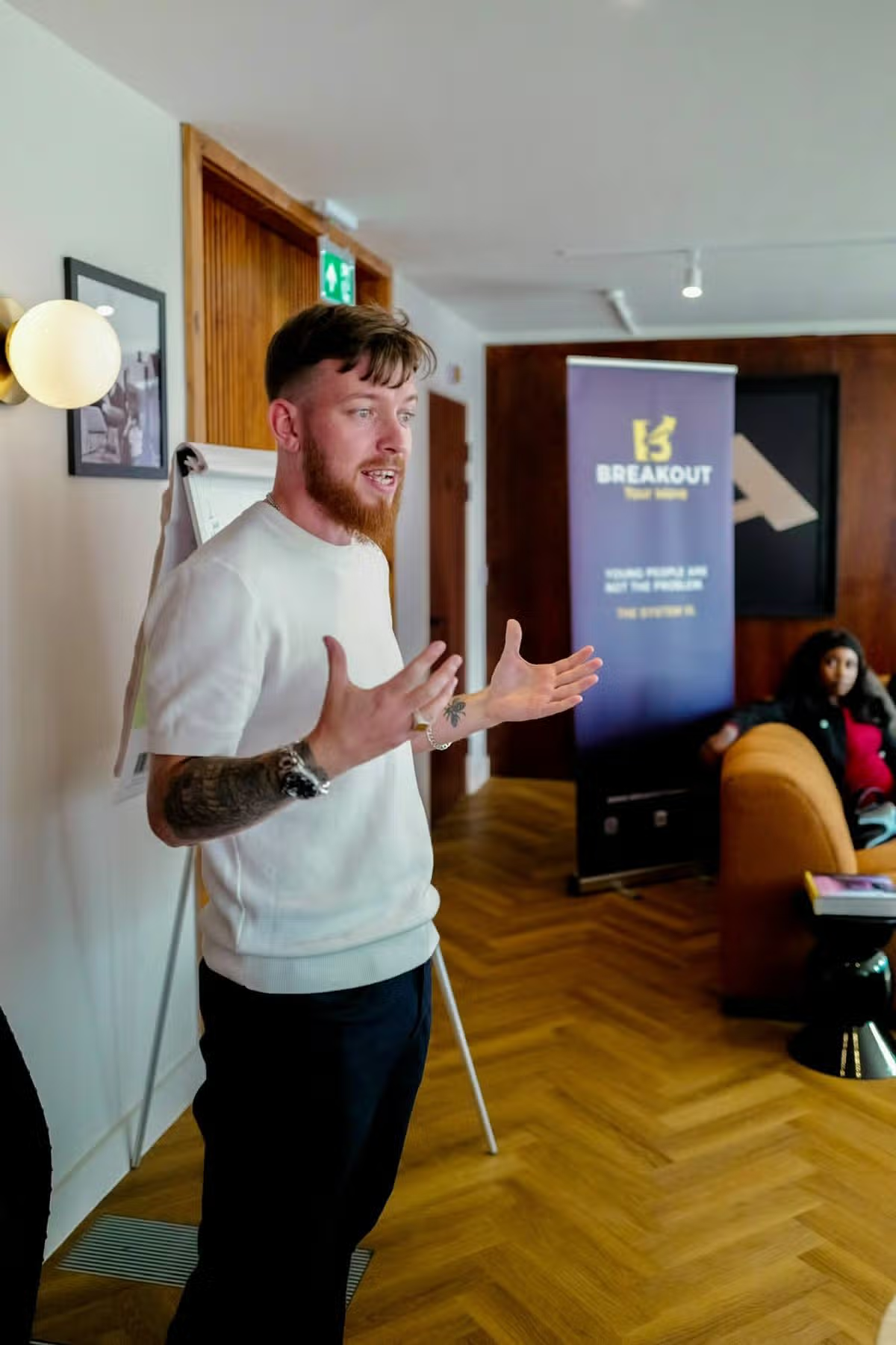
Roman Dibden of the Breakout charity
He suggests there’s a “series of contradictions” in the Milburn review as some of the suggestions are already in place, and says: “There’s a lot to be optimistic about, but these are just recommendations.”
And a key point for him is making sure that young people with lived experience are involved in the process so they can help shape provision.
“Devolution promises to be part of that, and I know obviously we’re in Greater Manchester and they’ve already announced around the creation of a deputy mayor role [devoted to this topic], and they want us to be the first on the Youth Opportunity Service.
“It’s all well and good saying that, but then process has to catch up, and all the red tape and the bureaucracy has to catch up, so I think we’re at a really interesting point.
“It needs providers that are willing to roll their sleeves up and just get this done, rather than resting on their laurels and getting dragged into the media hype.”
Labour metro mayors like Bev Craig in Greater Manchester and Kim McGuinness in the North East are hugely keen to use the powers given to them under Andy Burnham’s devolution agenda to tackle youth unemployment in their regions.
Ms McGuinness said: “The North East has by some margin the highest rates of so-called NEETs in the country and the figures are stark: Nearly one in four of our young people are being denied the opportunities they deserve. These are young people wanting work and looking for work who feel let down. We need to radically change the way we back these young people and give them hope.”
She adds: “Until now we have been given money but also told what the spend it on by distant civil servants. Now we have a chance to make the decisions that matter for ourselves, making every pound go much further. We can get in there on the ground, work with communities, and make sure young people are linked directly to the work that’s available, and begin to see a better future.”
But in the world of business, there are many who believe years of government policy on issues like National Insurance contributions and red tape for employers has made it harder to offer work to young people.

Kiran Fothergill(Image: Handout from Kiran Fothergill’s office)
Among them is Kiran Fothergill, Chairman of the The Jobs Foundation’s North East Business Council but also a director at Stockton-on-Tees-based Pickerings Lifts. The former Conservative candidate on Teesside told the BBC’s Today show the Milburn review recommendations sounded like “robbing Peter to pay Paul”.
“Our employers’ costs for hiring young people have gone up by about £4,000 in the last two years. So giving us subsidies might address this problem in the short term, but it does nothing for the labour market long term.
“I would suggest that most of these jobs will be gone again once the subsidies are withdrawn. It’s not the way to go about creating growth in the economy and to create jobs for young people.”
Citing his company’s “proud record” of hiring young people, he said: “The way to address this problem is to get off the backs of business and to let them do what they do best, which is creating opportunities for people and employing people.”
He praised Milburn’s call to end employers’ National Insurance contributions for hiring people under 25, but said it should be extended to anyone who is long-term unemployed or sick coming back into the workplace.
He adds: “But generally speaking, I think if we reduce the minimum wage increases, which have gone up 25% in the last two years, another inflation-busting minimum wage increase in the last non-Budget, I would say, and also reduce employers’ National Insurance contributions, which have gone up, and the threshold having gone down, I think we’ve gone a long way to solving these self-created issues.”
On the same programme, Radio 4 host Nick Robinson went to visit young people being helped by Career Connect in Manchester’s Moss Side, whose Manchester Pathways programme supports young people with career guidance and connects them with work experience.
Teenagers Demi, Issa and Georgia all have similar tales to tell of looking for work without success for months. Demi, 16, who wants to work in medicine, has been job-hunting since the summer.
“I applied for loads of different colleges, and I’ve also been applying for retail jobs, and they just don’t accept me because they said that you need like strict qualifications…The school didn’t help at all. They just said just ‘go and do it yourself’, basically.
“[My Career Connect adviser] keeps sending me links to different NHS things I can do, volunteering things, different courses I can look at if I don’t like the one I’m on now, and just like giving me like different options to pick from.”
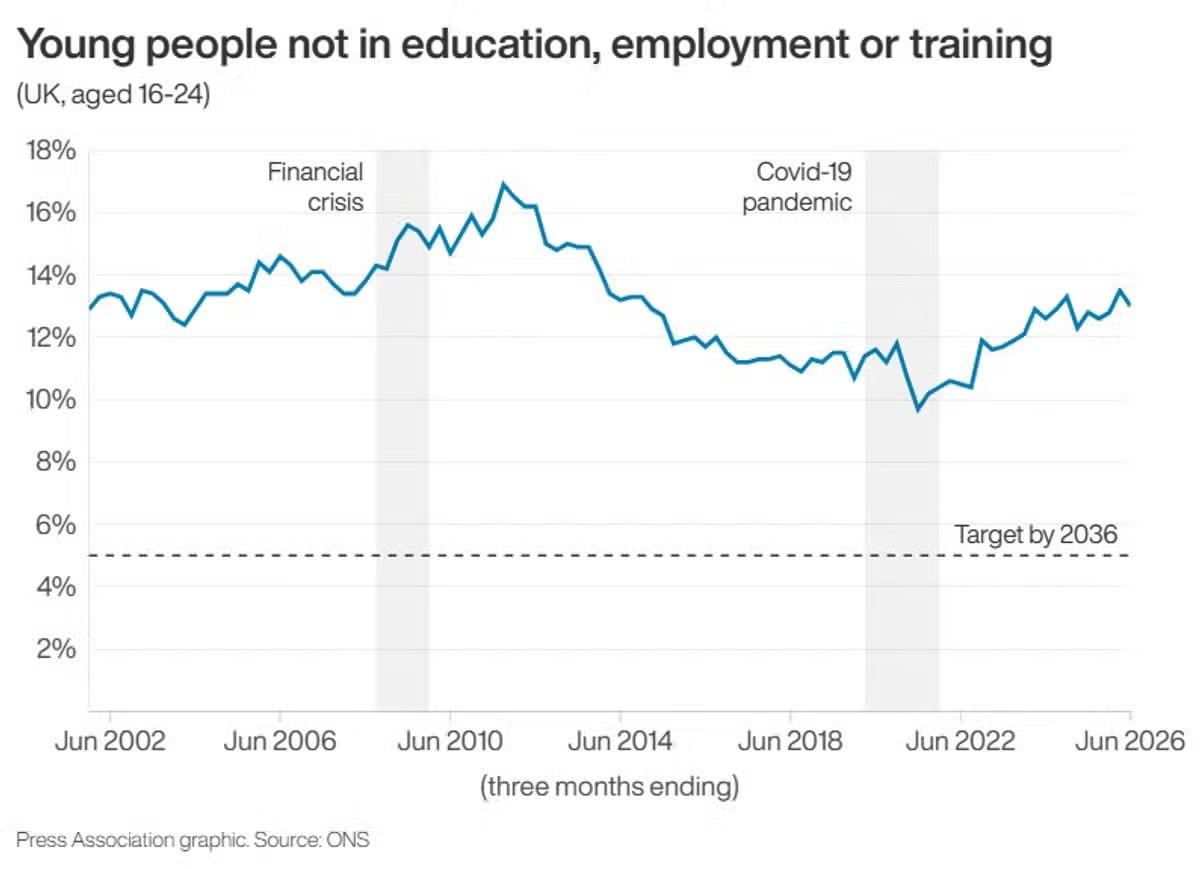
Press Association graphic
Issa has just started an apprenticeship but spent seven months hunting for a job – often applying for four or five a day. “There wasn’t that many options,” he says. “So it was really hard looking for work.”
Georgia, who’s also 16, was home educated and said most of the opportunities found came from her following her own passions rather than something an educational facility provided.
Asked for a message to send to decision-makers in London, she says: “Companies aren’t necessarily accommodating jobs to appeal to young people, rather than it being something that young people have to constantly seek out companies and large kind of employers.
“So employers need to kind of do better with seeking out opportunities for young people and actually giving opportunities that only young people can apply for, which will include training, things like that, rather than it being something that young people have to seek out themselves, it shouldn’t just be up to them.”