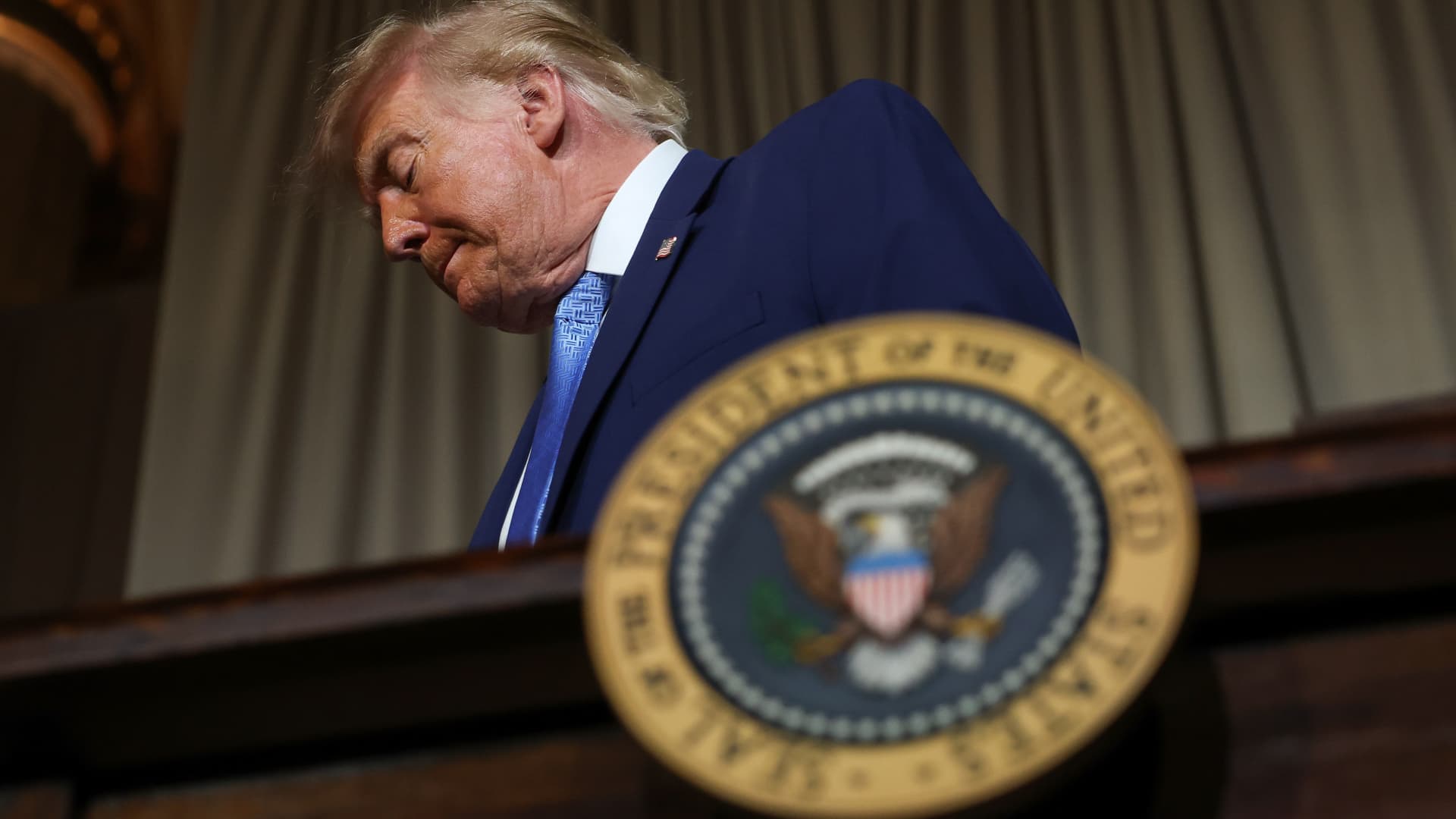
Less than two weeks before congressional elections, Americans are nearly as gloomy about the economy as they were when the country emerged from the pandemic, and President Donald Trump’s economic approval rating hit an all-time low, according to the latest CNBC All-America Economic Survey.
Eight out of 10 Americans rate the economy as fair or poor, the highest number since December 2023 and one of the ominous signs for Republicans in new polling data released Thursday that shows why their candidates face a tough battle in the midterms.
The poor view of the economy is strongest among Democrats and independents, but there has been a strong move toward economic pessimism even among Republicans in recent months. Overall, 63% of the public is pessimistic about the current economic situation and prospects, up 1 percentage point from the July survey. But that percentage now includes 35% of Republicans, up 6 points from July and the highest level of Republican pessimism in either of Trump’s two terms.
“We’re getting there not because independents or Democrats have soured — because Republicans have,” said Micah Roberts, a partner at Public Opinion Strategies, the Republican pollster for the survey. “Since Trump has become president, [Republicans] has been held in a small margin saying that the current economy is either very good or good. And now it’s broken and changed.”
The survey of 1,000 registered voters nationwide, with a margin of error of plus or minus 3.1%, found Americans favor Democratic control of Congress by a margin of 52% to 45%. The 7 percentage point Democratic edge represents a 3 percentage point gain for Democrats from the July survey.
The poll also contained other signs for Republicans. It shows 72% of Democrats are very interested in the midterm elections on November 3, compared to only 62% of Republicans. Women are 10 percentage points more interested in voting than men, and favor Democratic control of Congress by 22 points. Independents favor Democratic control by a margin of 49% to 33%. And a majority of survey respondents said Democrats would do a better job than Republicans on many of the issues they see as key issues, including corruption and the cost of food and gas.
Read the full survey results here.
In eight states with competitive Senate races, respondents favored Democratic congressional control by 4 percentage points. Trump carried those eight states by a combined 10 points in the 2024 presidential election.
The survey shows “things are far from Republican or Democratic, depending on how you want to look at it, in a way that would make me very nervous if I was leading the Republican campaign until two weeks ago,” said Jay Campbell, a partner at Hart Associates, a Democratic pollster for the poll.
Despite the economic gloom, Trump’s overall approval rating has remained stable, though only 40% approve and 59% disapprove. Net approval is now -19 percentage points compared to -8 a year ago.
Even more surprising is the 9-point drop in the president’s net economic approval rating from just the last survey in July. The president’s economic approval fell to 34% from 38% in three months and his disapproval rose to 65% from 60%. The -31 net economic approval is the lowest of Trump’s two terms. The 65% disapproval rating is 1 percentage point higher than former President Joe Biden’s worst showing and the highest for a president surveyed by CNBC going back to President Barack Obama.
Government corruption was identified as the biggest concern by 36% of respondents, and Democrats had a 4-point lead on the issue. In the cost of food and groceries, the second-most important issue, the Democratic lead widened to +16 from +7 in the July survey. Democrats also top Republicans to protect democracy as well as dealing with the high price of gas.
Among those most interested in the election are respondents who identify corruption and protecting democracy as the main issues, and prefer Democratic congressional control by a wide margin.
Republicans continue to have strong advantages on border security and immigration, but their lead on immigration drops to +9 from +15. Democrats, meanwhile, appear to be doing better in handling jobs and unemployment issues and Iran, which dropped from +2 for Republicans to +5 for Democrats.
The public continues to be skeptical about the value of the Iran war. The survey found that only 46% of the public believed that such military action would be useful in disrupting Iran’s development of nuclear capabilities, down from a majority of 53% in April. And only 35% said the military action was justified because gasoline prices were rising.
While the survey shows continued deep division by party, there is near unity on the issue of corruption. Ninety-three percent said elected officials, including the president and members of Congress, should not be allowed to own or trade stock in individual companies that have contracts with the federal government. And 89% said companies owned or invested in by immediate family members of the sitting president should not be allowed to receive contracts from the federal government.
While corruption is at the top of the list, price is clearly a concern for registered voters. Taken together, concerns about the cost of food, gas and housing were the top concerns for 57% of respondents. Eighty percent said prices increased, up 5 percentage points from a year ago, with 55% saying they rose faster than usual, also up 5 points. Food costs actually eclipsed gas as the bigger concern in the survey 34% to 23%. This is the biggest concern among key demographic groups but highest among those making $30,000 or less and supporters of America’s Democratic Socialist agenda. But it’s also a major problem for Republicans who don’t consider themselves MAGA supporters.
Both pollsters were cautious about how the Democratic advantage would turn out. POS’s Roberts says the battle is between “map and momentum.”
“There are some national indications that voters are leaning more toward the Democrats…
Campbell did not see the election “realignment” as in 1994 and 2008, he said, “This looks like a return to mean-young voters and Voters of color return to join the Democrats, bolstered by independents tired of Trumpenomics.” He added, “Nobody expected that the Democratic candidate would pull 15% of the Republican vote.”