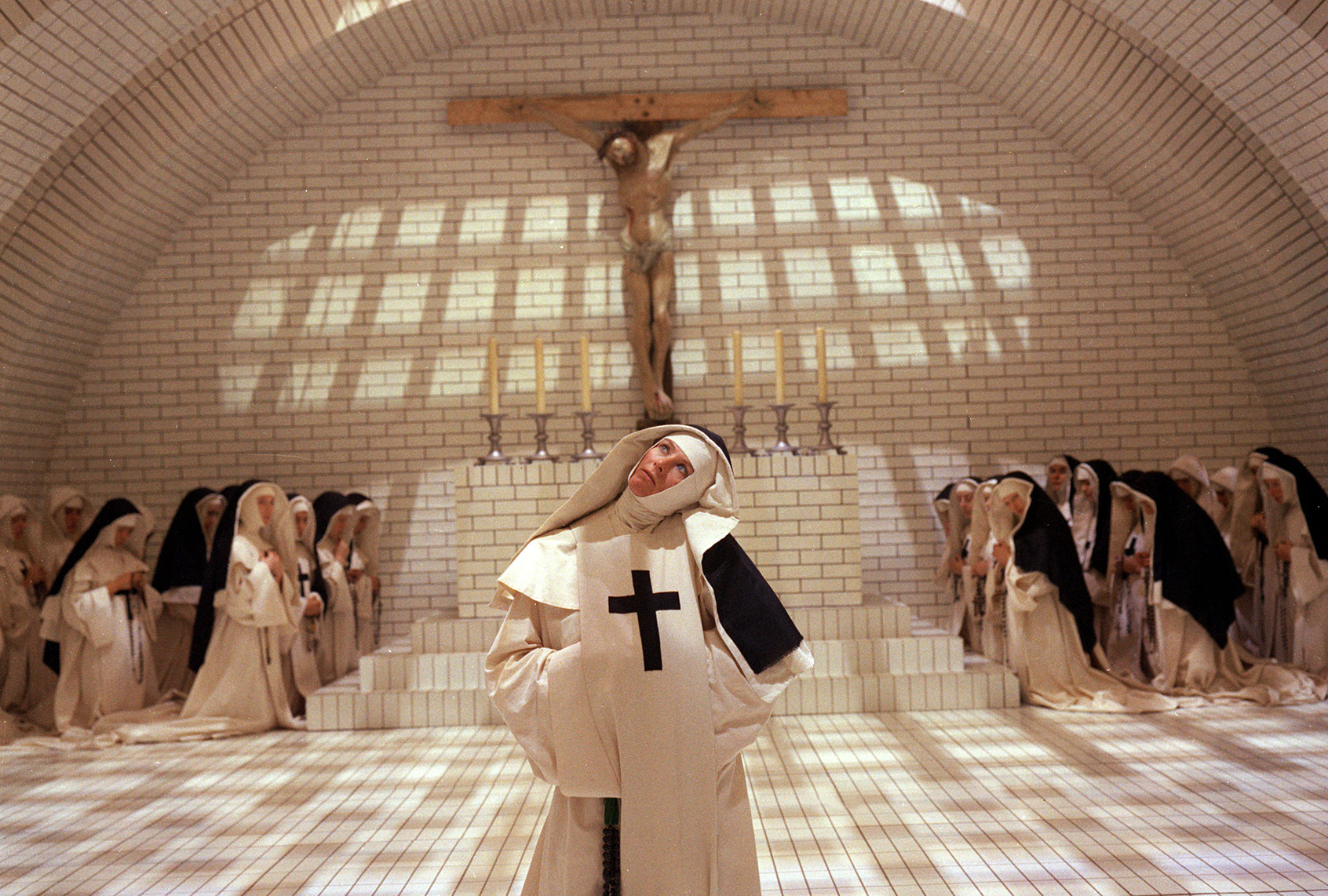
You’re no one in this business until the Vatican has condemned you. For British filmmaker Ken Russell, that denunciation from the Catholic Church’s highest post came swiftly and relatively early, just a handful of feature films into his storied, controversial career. Known and loved for his sweeping, ostentatious romanticism and flair for dramatics of every kind, Russell’s films weave artistry into the human experience, making the two inextricable. In his eyes, beauty takes all forms, morphing into the grotesque and outrageous before transforming again into a light, airy meringue, generously portioned atop life’s dense realities. Russell’s filmography has something for everyone — and, until this year, something for no one: his controversial 1971 religious epic “The Devils,” a film as heavily censored as it was widely banned.
Part historical horror, part holy sacrament, all tragically delicious blasphemy, “The Devils” revisits the downfall of 17th-century Catholic priest, Urbain Grandier (Oliver Reed), in the provincial French city of Loudun. Grandier’s sexual exploits result in accusations of sorcery when a convent of nuns, led by Sister Agnes (Vanessa Redgrave), shed their habits — both the religious garb and the daily formalities — in fits of sexually repressed obsession.
The restoration of “The Devils” and its massively effusive response point to a robust new era in moviegoing. At a moment when the art of film and the film business are so at odds, “The Devils” — that banned, blasphemous frolic through Hell — might just be cinema’s salvation.
In Russell’s typically flamboyant manner, the film features extended sequences of nudity, sacrilege, lust and bloody violence, often all rolled into one. Warner Bros. demanded Russell pare down the film’s most intense scenes yet still slapped it with an X rating in the U.S. and U.K., while other countries banned it outright. Though an uncensored director’s cut premiered in 2002, it was never formally released on home media, and “The Devils” remained difficult to find outside of low-quality, choppily edited releases and torrents for decades.
(Warner Bros. ) Ken Russell’s “The Devils”
But such a notorious reputation could do nothing but persist. After long denying “The Devils” a proper release based on the film’s “distasteful tonality,” Warner Bros. did something right (for once), commissioning a restoration and theatrical rerelease of Russell’s original director’s cut under its new boutique imprint, Clockwork, for one week only. (A limited second-week run was announced at the time of writing.) Like the nuns in Sister Agnes’ convent, the once-sheltered public responded with animalistic haste, selling out screenings nationwide. Far from the average word-of-mouth excitement, the restoration of “The Devils” and its massively effusive response point to a robust new era in moviegoing, one that looks different than anything this century has seen so far. At a moment when the art of film and the film business are so at odds, “The Devils” — that banned, blasphemous frolic through Hell — might just be cinema’s salvation.
At Chicago’s Music Box Theater, one of metropolitan America’s premier destinations for arthouse cinema, screenings sold out in a flash, accounting for the second largest share of the restoration’s opening-weekend box office. Kyle Cubr, the Music Box’s senior operations manager and assistant general manager, likens the excitement to mischief. “Patrons were abuzz around me waiting for it to start,” he says. “It’s almost like when you’re a kid, and you know you’re getting away with doing something bad — you shouldn’t be watching this, but it feels so good.”
As fellow Chicago resident Max Newfield exited the Music Box after his own sold-out screening, chatting with a friend who went in blind and listening to a crowd that was “alive with excitement,” he saw the line for the 9:30 p.m. show snaking down the block. “At one point,” Newfield says, “a woman from my screening walked down the line and yelled: ‘It’s worth the wait!’”
Cubr’s experience echoes countless others who made their way to “The Devils” in its first week. When I started looking for people to chat with for this piece, I expected to find only a handful interested. After all, finding time to answer even a few questions can be difficult these days. And with cinema more ephemeral than ever, and “The Devils” stacked against new theatrical heavy-hitters, there was no guarantee that anyone who had seen the film would actually want to talk about it.
Within hours, my inbox was flooded with people from across the country, eager to talk about the film and their experiences seeing the film. Really, “flooded” doesn’t begin to quantify the deluge. While I spoke with 20 people for this piece, I received 178 individual responses of all kinds, ranging from shock and awe to relative disappointment to distinctly modern moviegoing gripes. But overall, the prevailing narrative was that seeing “The Devils,” in this format and with a full crowd of fervent patrons, was a once-in-a-lifetime experience. As New York’s Ben Sundwall tells me: “A guy started snoring halfway through. A girl was ripping her vape. It was magical.”
Despite the polite crowd at my screening, I wondered if questionable theater etiquette came into play elsewhere. Bafflingly, repertory screenings are where I’ve run into some of the worst offenders. But for an intentionally outrageous film like “The Devils,” where Reed hurls a plastic crocodile out of a window, rules can be relaxed. Naima Warsame, a program manager and chief of staff in New York, told me she thoroughly enjoyed the film but that her screening “wasn’t without its drama.”
“As the credits were rolling, a man in the middle of the fourth row stood up, pointed at a woman in the second row, and yelled, ‘Lady, yeah, you: F*ck you. You had your phone out the whole time!”’ Warsame recalls. “We thought it would end there, but he kept going . . . the movie was already intense, and before we could catch our breath, this conflict made the whole experience overwhelming.” But Warsame isn’t deterred, seeing “at least two movies a week” and hoping for more rereleases of studio films and midnight movies of all kinds. “Nothing beats the theatrical experience,” she says.
Want more from culture than just the latest trend? The Swell highlights art made to last.
Sign up here
Josh Svetz, a Los Angeles writer and music consultant, shared a similar experience, noting laughter during both the film’s intentionally humorous moments and chuckles that drowned out moments of discomfort. But Svetz relishes the chance to see the film nonetheless, and views the enthusiasm for the rerelease as evidence that moviegoing is becoming more intentionally experiential.
“People want to time travel and experience works of art as they were intended,” Svetz says about the restoration. “I don’t think the theater experience will ever completely die because there’s this singularity, this feeling in your chest, this speechlessness that comes over you when you see something great. It’s rare, but chasing that dragon? It’s worth it.”
More than the extraordinary experience of seeing “The Devils” on the silver screen, the most moving throughline I encountered in talking with people about their screenings — one that seemed to be present in some form across every person I talked to — was the sense of community. It’s not only the chance to see something rare, well-made and lovingly preserved that’s driving people to the movies; it’s the opportunity to make a memory.
Stephen, a New Yorker who works in financial services, savored the chance to see the film at the AMC in Manhattan’s Kips Bay neighborhood, which is scheduled to close by the end of the year. “Every single seat was filled,” he says. “Seeing that for a film released in 1971 is pretty special.” So special, in fact, that he went a second time. And for those who didn’t go alone, finding a buddy was half the fun. Several people shared stories about convincing their spouses, friends, or family to come along — some more successfully than others. For many, seeing “The Devils” was a unique chance to close a loop or strengthen family ties, the kind of event that reminds us of all the small things that make cinema such a large part of our lives.
That people recognize the value in patronizing a faithfully restored work like this — when studios like Warner Bros., having just succumbed to an unholy monopolistic merger with Paramount, need to know that audiences crave great art, old and new — is critically important. It’s also a great relief.
For Bay Area journalist Bojana Cvijic, “The Devils” began as grainy screenshots on her Tumblr dashboard and a low-quality “yet still awe-inspiring” torrent sent over by a friend. Keen to catch the rerelease, she bought tickets with her AMC A-List membership and roped in two friends for a screening that boasted a mixture of laughs, shock, and dead silence. “I realized there are people here who have no idea what this movie is,” Cvijic said, laughing. Making a full-circle jump from her laptop screen to the multiplex, Cvijic waxes poetic. “We don’t get to experience movies like this on big theater screens anymore.”
Cvijic’s first encounter mirrors so many others, notably Nikhil, a 31-year-old SEO specialist who tells me he first saw “The Devils” after building a PC with his dad as a teenager and using it to foster his love of movies. When Nikhil first heard about the restoration, he says it was a “no-brainer,” and that his dad needed no convincing to come along. “I feel quite lucky to have a father who is equipped to respond to and appreciate films as he does,” Nikhil says, “because watching and discussing films together has blossomed into a shared experience that has helped both of us chart our tastes toward art — but more importantly, deepened our relationship with one another . . . Due to my excellent company and my personal relationship with [‘The Devils’], it’s a theatrical experience I will remember forever.”
When I hop on the phone with Juanchi Roca-Paisley, a member of a Miami non-profit financing affordable housing, he excitedly regales me with his experience seeing the movie with his mom, who walked out of “The Devils” when she saw it at a screening in the ’80s. This time, however, his mom stuck around — though she did warn him that she’d give him a tap if she wanted to leave. “I think she found the imagery very cool,” Roca-Paisley says. “To share it with her was so great. But my other mom also said, ‘I kind of want to see that.’ Now I’m like, ‘Oh my gosh, am I going to repeat this?’”
With the film entering its second week, don’t be surprised if you head to the movies in the coming days and see moms, dads, teenagers, or grandparents waiting for their chance to witness what no one could for so many years. It’s easy to dismiss “The Devils” as a rerelease geared toward older cinephiles. But that’s far from the truth. Part of what’s so remarkable about the gushing response to Clockwork’s restoration is that it had no guarantee of doing so well. Josh Svetz puts it perfectly in our conversation, saying, “The theatrical experience is a choice now rather than a necessity.”
Svetz cites camrips and microscopic theatrical windows as factors that have both hindered cinema and strengthened its unique selling points, and he’s completely right. In an era when anyone can watch just about anything with a few clicks of a trackpad or taps of a finger, moviegoing has become more intentional than ever, especially with rising ticket prices. That people recognize the value in patronizing a faithfully restored work like this — when studios like Warner Bros., having just succumbed to an unholy monopolistic merger with Paramount, need to know that audiences crave great art, old and new — is critically important. It’s also a great relief.
But it’s not only that people of all ages are turning out for “The Devils” that I find heartening; it’s their passion for the entire shebang — for moviegoing, and for all its wonderful, absurd and timeless rituals. There’s no question that we live in a uniquely difficult age, where reprieve is a hot commodity. But as sensational as it is, “The Devils” doesn’t exactly offer ease. The film’s historical context holds as many parallels to today as it did in 1971, arguably even more: suppression of all kinds, brutality in the name of politics and religion, innocence tainted by unnerving sights no one should ever witness.
“It’s brutal, but necessary,” says Taylor Owen, a Chicago-based artist who caught the film at an AMC after the Music Box sold out. “Our world is unfortunately not so different from the world the nuns of Loudon were living in. I have never seen a film like this before. I don’t think I ever will again. ‘The Devils,’ in the way it was meant to be seen, is one of the most important pieces of art ever created.”
Read more
about cinema’s changing landscapes