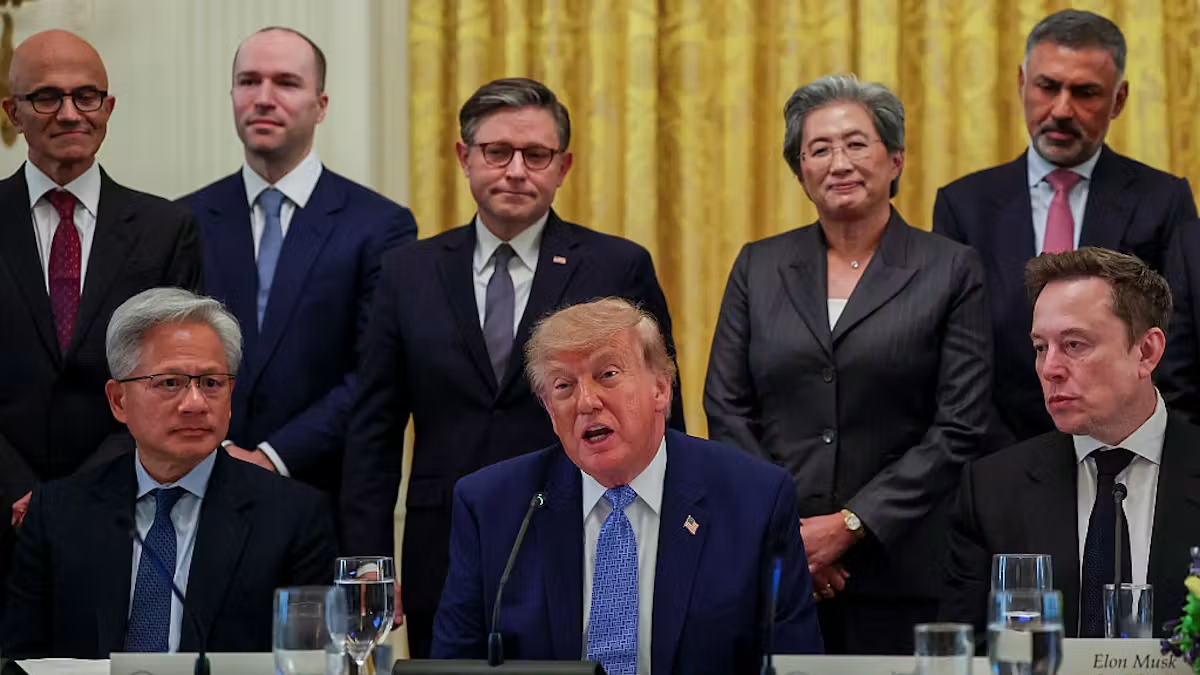
President Donald Trump renames landmarks out of national pride, but he says his latest change, from “artificial intelligence” to “superintelligence,” is about accuracy.
“So we named it SI, Super Intelligence, because we don’t want to hear artificial, because it’s not artificial,” Trump said. “It’s very powerful, it’s very good, it’s mostly going to be put to good uses and we’re going to stop the bad uses. But we’re changing the name to superintelligence and everyone loves it.”
Trump formally announced changes to the executive branch through executive orders.
Artificial intelligence industry leaders have signed on to what Trump and House Speaker Mike Johnson (R-LA) have called the “White House Superintelligence Agreement,” which Trump has called a set of “morally binding” voluntary security commitments.
The government is betting heavily on the technology to accelerate economic growth and help the U.S. escape its growing debt burden. But the measure faces skepticism from the American public.
A new CNN poll established Nearly 9 in 10 Americans are more worried than excited about the possibility that artificial intelligence could surpass human intelligence, while about 7 in 10 say the federal government is not doing enough to regulate it. Trump’s new brand emphasizes the technology’s capabilities as his administration makes the case for its expansion. “I will not kill a development greater than the Industrial Revolution,” Trump said at Tuesday’s event.
The administration also views U.S. leadership in artificial intelligence as critical to national security, especially as China races to develop the technology. “This technological revolution is taking place against the backdrop of intense security competition between the United States and China,” Trump’s former artificial intelligence czar David Sacks said previously explain. “If the United States loses the artificial intelligence competition, it will change the balance of power in the world in a very detrimental way. So this is something that needs to be taken very seriously.”
In China, surveys show that public acceptance is relatively high. A recent poll found that 69% of Chinese respondents believe The benefits of artificial intelligence outweigh the risks. another discovery 72% Trust artificial intelligence, compared with 32% of Americans. Trump and Chinese President Xi Jinping agreed last week to establish a safe lane for artificial intelligence between the two countries.
Some of the loudest warnings have come from the industry’s own executives. Anthropic CEO Dario Amodei published an article earlier this month arguing that artificial intelligence labs should deliberately slow down the progress of their system capabilities so that security efforts can keep pace. He also said that there is a 25% chance that artificial intelligence will do “very, very bad” things to humans.
OpenAI CEO Sam Altman and Elon Musk publicly agreed with Amodei’s call to slow down.
Trump responded to Amodei’s article on “Social Truth,” writing: “The only controls or ‘guardrails’ that AI needs are a strong and smart (high IQ!) president, and America does have one!”
He added that his administration “has stopped AI ‘people’ from doing bad things or ‘things’ that could do bad things, like Dario (the human!) who now pretends to be a ‘perfect little angel’ – and we will continue to do that!”
Earlier this year, the Pentagon labeled Anthropic a supply chain risk after the company said its technology should not be used for mass surveillance of Americans or fully autonomous weapons.
On Sunday night, two days before the deal was signed, Amodai and Trump had dinner together.
One of the attendees Tuesday was Palantir CEO Alex Karp, an outspoken advocate for the development of artificial intelligence in the United States. Karp believes that if the United States has no rivals advancing the technology, it may make sense to slow down. With China vying for leadership, he sees no such option.