Ukraine’s unjamable fiber-optic drones are flying farther and farther as companies continue to innovate, but one company is questioning whether it’s worth continuing to expand its range.
These drones can transmit commands and video through physical cables and are not affected by enemy electronic warfare, especially traditional radio frequency interference. Providing a clearer video feed than other FPV drones, they are useful for both surveillance and attack, Ukrainian officials and companies celebrated the expanded range.
But TechEx, a major Ukrainian manufacturer of fiber optics and interceptor drones, told Business Insider that pushing the restrictions further may not be worth the trade-off.
The company produces models with a cruising range of 35 kilometers and 40 kilometers. “We are currently considering whether it is still necessary to enable the next generation of fiber-optic drones to fly 45 or 50 kilometers,” said TechEx executive Oleg, who asked only to be identified by his first name for security reasons.
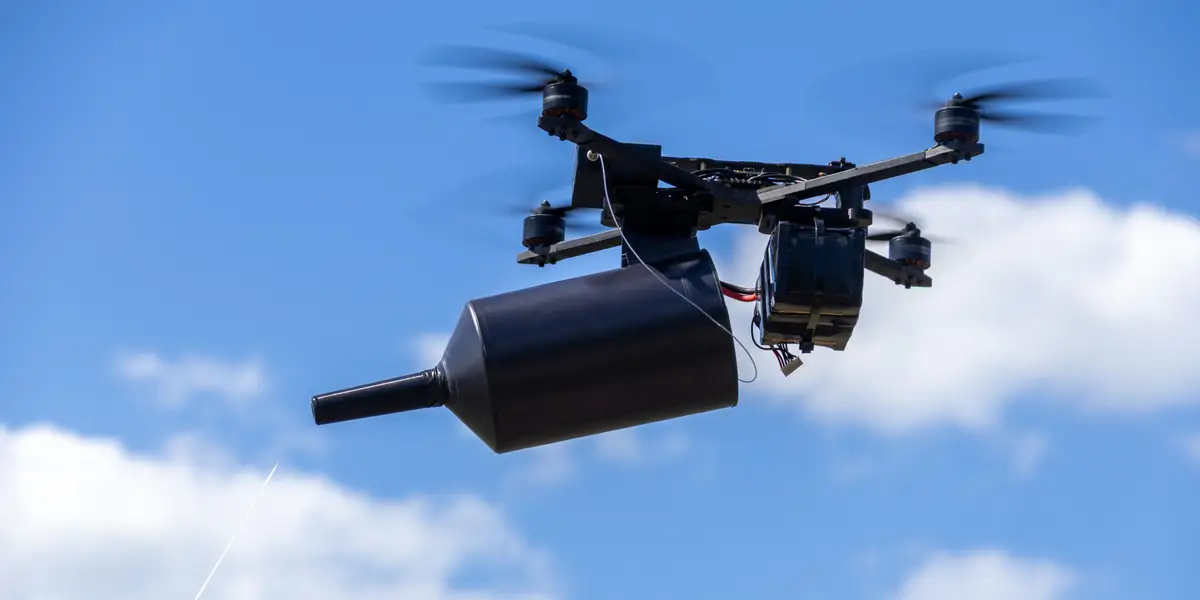
The reason behind the hesitation, Oleg said, is that flying farther requires a heavier spool, as well as larger batteries to keep the added spool weight in the air. “This could impact the amount of payload a drone can carry.”
“So we’re still figuring out whether it’s going to be actually used on the front line for long-range FPV, or whether we’re going to stick to, say, 40 or 45 kilometers.”
Drone companies often need to balance the weight of cameras, explosives, weapons accessories, communications equipment and other equipment. For fiber-optic drone manufacturers, maintaining this balance is even more difficult because their drones also carry a spool of cable.
Fiber optic cables and their spools add weight to fiber optic drones, and units and manufacturers need to consider this. Jose Colon/Anadolu, Getty Images
Some Ukrainian drone manufacturers also say that for fiber-optic drones, shorter ranges are more effective anyway, as longer distances increase the risk of cable breakage.
Describing TechEx’s Stalker XO-10 and Stalker XO-15 drones, Ukrainian state-backed innovation platform Brave1 said, “Fiber optic drones have some limitations, including the need to carry a roll of cable that gradually unrolls during flight and provides communications with the operator.”
“Since the coil itself has a certain weight, this will limit the payload of the drone,” it said, referring to the unmanned aerial vehicle.
Brave1 said TechEx has so far been able to “relieve cable weight constraints” “through good engineering solutions” and assesses its work to “enable these drones to achieve high payloads while maintaining the other advantages of fiber optics.”
Whether this will continue to be the case at longer distances is a question mark.
TechEx representative Olha told Business Insider that the company developed the technology to make the spool lighter, making “minor tweaks and changes” to how it is made and how the fiber is wound around it. The Ukrainian Ministry of Defense said last year that the Tracker series of drones “reached a record low spool weight among Ukrainian fiber-optic drones.”
Not all companies view weight vs. range returns the same way, which could work to Ukraine’s advantage. Troops use a large number of drones from different companies to perform different missions, and soldiers say they like the flexibility to choose the equipment best suited for each mission. Some missions may require long-range drones carrying smaller payloads, while others require more firepower at shorter ranges.

Fiber-optic drones have huge advantages, but they also have limitations. Jose Colon/Anadolu, Getty Images
Assault missions are not the only ones where blast weight needs to be considered. Soldiers described using fiber-optic drones to conduct intelligence gathering through airborne cameras. There are trade-offs though, and some higher quality cameras are heavier.
The fiber-optic drones are just one example of Ukraine’s growing arsenal, which includes long-range attack drones, medium-range attack drones, and even heavy bombers. Many of these are capable of carrying heavier payloads than small FPV drones. Each system has advantages and disadvantages, forcing manufacturers and soldiers to weigh which features are most important for a specific mission.
TechEx continues to receive feedback and requests from units using its drones to determine what to build.
It has a technical support department, which Oleg said works with more than 100 units. It results in weekly changes to the product, ranging from small updates to major changes.
Feedback and field testing with military pilots and operators have been critical to the work the company does and has led to the company taking counterintuitive approaches away from what was originally thought to be most effective and what units wanted.
For example, the company’s Striker interceptor drone prototype was originally much larger, with a payload of 1.5 kilograms, but testing and feedback showed it needed to be smaller and more agile and didn’t require such a large payload.
“We were able to completely redesign it so that it ended up looking completely different than the original prototype,” Olha said. Developing new weapons of war is a process of constant re-evaluation, rethinking and development.