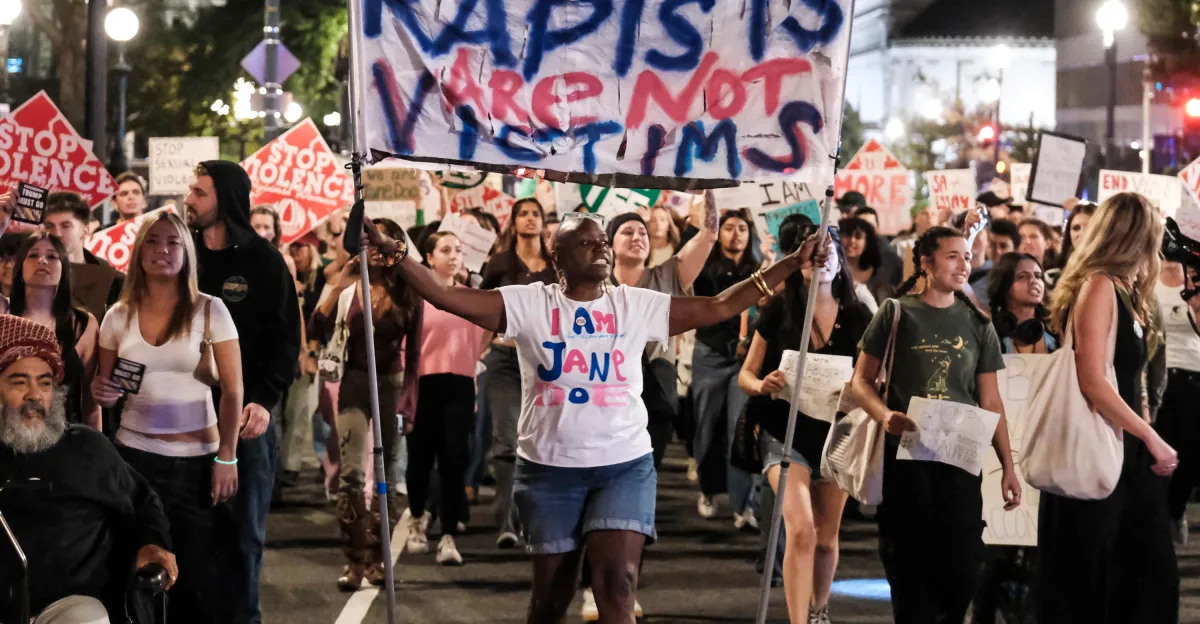
Last month, a former Cornell University student identified in court papers as “Jane Doe” sued her university and seven members of the Chi Phi fraternity, alleging they raped her at the group’s house in October 2024. Cornell’s own disciplinary process for the incident had ended with two of the men expelled, two suspended and put on probation, one (who had already graduated) barred from campus, and two found not responsible but ordered to complete trainings and write reflection papers. The local district attorney declined to press charges.
Since the lawsuit was filed, the DA has reopened the case and New York state officials have launched an investigation. Students have also held sit-ins, and some are calling for university President Michael Kotlikoff to resign. Cornell has suspended fraternity parties for the rest of the year.
But this kind of case — and the issues it raises about campus life — are not new. Educators, students, activists, and politicians have spent decades debating how to prevent sexual assault, how to protect victims, how to balance the rights of the accused, and what to do about Greek life. At times, those conversations have resulted in significant changes to policy — which in turn have also generated backlash and brought more changes in response.
Elizabeth Armstrong, a sociologist at the University of Michigan, began researching campus sexual assault in the early 2000s, embedding at a Midwestern university to understand how fraternities, alcohol, and the lack of anywhere else to go put students at risk. She has seen attention to the issue come and go in the public discourse across generations of students, often spurred by high-profile incidents like a Time magazine cover in 1991 spotlighting a first-year William & Mary student who was date raped, and a Stanford swimmer in 2016 who was sentenced to six months in jail for assaulting an unconscious woman after a frat party.
I wanted to know what Armstrong makes of Cornell, and if she thinks anything is different this time. Has anything actually gotten better since the Title IX fights of the 2010s? What do people who haven’t been on a campus in a while misunderstand about how students socialize? And what could a school like Cornell do right now, without waiting on the courts or Washington, DC?
I talked to Armstrong about Greek life, what survivors of sexual assault actually want from their schools, and the reforms she thinks colleges need to be paying attention to. Our conversation has been lightly edited and condensed for clarity.
Could you start by sharing briefly the kind of research you’ve done on campus sexual assault?
I did ethnographic and interview work at a Midwestern university, starting in 2003, and published a paper in 2006 on the organizational conditions that lead to sexual risk on campus. I later co-authored Paying for the Party: How College Maintains Inequality, a 2013 book based on that research.
Were there many people talking about this back in the early 2000s?
It was in something of a hiatus period. Interest in this issue essentially goes in waves. There was interest in the seventies, then again in the late ’80s, and then there was a hiatus. My research and writing happened right before things started to build back up again with interest.
So before we get into Cornell specifically, could you paint a bit of a picture of how campus social life tends to work? Where students gather, who hosts parties, and where Greek life fits in?
So the basic gist is that at four-year American residential universities, students often live in residence halls or they live off campus, or if there’s residential Greek life, they live in fraternities and sororities.
Young people like to congregate, and they like to party, to have fun, and drink, and figure out opportunities to hook up. One of the things that has emerged, particularly on campuses with fraternities that have their own houses, is that these organizations control the party resources — like the space and alcohol, and time and energy to host.
So it’s hard to avoid them if you are someone who wants to party.
Yes, and one of the things that’s been coming out of the discussion related to Cornell is that the pandemic really flattened the number of bars, restaurants, and cafes in Ithaca — places where people might have otherwise had opportunities to hang out. So it gave an already really dominant Greek scene even more centrality and power over the way students socialize.
My next question was going to be what do people who haven’t been on a college campus in a while tend to misunderstand about the party scene, and that pandemic shift seems like an answer to that.
Yes, and people often don’t understand that for a lot of first-year students, who are generally under 21 but still wanting to drink, figuring out how to get alcohol, where the parties are, where the fun is going to be, is a challenge for them. Students entering college often don’t have good resources to know what’s safe and not safe.
Yeah, and it seems like colleges just cover their eyes and deploy a don’t-ask-don’t-tell policy on underage drinking.
Yes. Years ago, when I was doing more traveling and speaking on college campuses, cab drivers would be telling me how they’d deposit students drunk all the time. And if a school was religiously affiliated or anything, they would just deny that their own students were partying with alcohol at all. And so the students were just vastly more at risk than even at campuses where officials were willing to admit what actually goes on.
Based on your research of party rape, what parts of campus life do you think we should be paying attention to with Cornell and other colleges?
Here I’d bring up a book, Sexual Citizens by Jennifer Hirsch and Shamus Khan. They did ethnography at Columbia University, and they pointed out some concepts like “sexual geography” — which is this idea that you can go onto any campus and see the ways things are organized to be more risky.
They point out, for example, that if students have nowhere to socialize except in dorm rooms with beds, that’s more risky than if they had lounges or other kinds of non-sexual spaces to congregate. And like, are there fun things to do that are substance-free if people want that? Are there spaces for queer students or students of color to hang out? What are the social options, and who controls where the fun happens?
That makes so much sense. If there’s no alternative, then people will go to whatever option is available, even if it’s less safe.
Yeah, and I mean it’s tricky because sometimes it’s not considered hip or cool to do that. When we were doing our observation research way back in the early 2000s, the university we were studying was trying to create some non-frat party options, and the women that we studied thought those were just hopelessly nerdy and uncool, and they didn’t want to go because they were not seen as being high-status things to do.
What do you think colleges could be doing differently when it comes to parties?
One thing I think that colleges could do — like now that we do have Uber and Lyft — they could get a Lyft subscription where students can call up 24/7 to get home safely from wherever they happen to be, no questions asked. That could be expensive, but it’s a lot more expensive when serious harm happens. So ensuring people can get home safely could be one measure.
And Michael Roth, the president of Wesleyan, had an op-ed this week in the New York Times suggesting that universities consider making these organizations co-ed. That’s another option. Not abolishing them completely, but transforming them.
I’ve been really struck by the dissonance of having this conversation around male loneliness and male bonding on one hand, and this separate conversation about fraternities and whether they’re good or bad on the other.
I have a student, Anna Wood, who’s done interviews with fraternity men. She’s very interested in young men’s mental health, and loneliness, and friendship, and she’s finding that men get a kind of brotherhood more than friendship in fraternities. In other words, the fraternities aren’t really solving the male loneliness problem.
Are there any campuses today that you think are modeling something that is safer or better? Are there any other schools you think we should be paying attention to?
Well, there’s Wesleyan and Swarthmore; the students a few years ago organized to abolish Greek life on their campus. And I think in a lot of universities there are these “learning-living” communities that are organized around various kinds of themes or interests, like it could be organized around being interested in business or interested in international relations or STEM. But something where universities take on the project of helping young people form friendships.
I know we’ve been talking a lot about Greek life, but there’s sexual assault on campus outside of Greek life, too.
Yes, it happens everywhere from honors dorms to sporting teams to residence halls. And it’s not just sexual assault; it’s also intimate partner violence in more committed relationships. I mean there are undergraduate students who are murdered by their boyfriends. So just addressing Greek life would not solve the problem across the board.
So I was in college between 2010 and 2014, when the Obama administration’s 2011 Title IX letter reminding colleges to address sexual assault complaints helped ignite a national debate over campus investigations and discipline.
Ah, you were right in the Dear Colleague letter era.
Exactly. It was a big issue on my campus and across the country. I understand those guidelines were loosened under Trump. As I’ve been following Cornell, I’ve seen a number of people respond by saying, “Well, nothing has changed or improved, and Title IX doesn’t work.” I would love your thoughts on all of this, on where things stand. Do you see progress as just a ping-pong back and forth, or do you feel like things have improved at all from when you first started studying this?
One thing that seems to me that is better over time is that every single time this issue rises to the level of public awareness, there’s more people who get it. Like in each wave, more people understand that women don’t report sexual assault because they’re afraid of retaliation, because of trauma. More people understand this.
Like this time, as soon as the facts of the case became widely public, there was just sheer horror on the part of so many people. When I was in college in the ’80s, that would not have been true at all. I mean, there was a case here at the University of Michigan when I was an undergraduate where it felt like just four feminists on campus understood what was going on. So there’s really been a gradual sort of cultural awareness over time
Even just talking to you, the composition of journalists writing on this is very different now.
What do you mean?
You’re a woman who graduated from an elite college around the time when the Dear Colleague letter was introduced. Not that long ago in the ’70s, ’80s, and ’90s, where anyone who had a position to have any kind of way of impacting the public conversation, it was all men. There weren’t women who had access to that kind of public conversation. So I think that’s also a really, really important piece of what’s changed. The journalists are changing and helping the public get it.
Can you talk about what happened beginning with the Trump administration?
So on the Title IX front, and after the Dear Colleague letter from 2011, and the whole campus anti-rape movement that happened around that time — well, on the heels of that there was a really major backlash. And that’s something my colleagues and I are studying, like the men’s rights activists and people who are more middle of the road, like civil libertarians, who felt things had gone too far.
And then the Dear Colleague letter was revoked under Trump, and in 2020 new Title IX regulations were put forward as a result of the Department of Education’s work during the first Trump administration. Those regulations made it very, very, very, very difficult to find somebody on campus responsible for sexual misconduct. Those are still in effect, so from that perspective, the fact that Cornell actually managed to expel a couple of those men and hold all of them, you know, responsible in some way, shows just how compelling the evidence against them was because it’s actually really, really hard now.
And this was all wrapped up in the backlash to Me Too?
The backlash to the campus sexual assault stuff was already well underway when Me Too was getting started, but yes, there was this wave of stuff, and then we get the 2020 regulations, and the Biden administration tried and failed to undo them.
Well, it took a really long time because they went through this notice-and-comment period, and they got everything redrafted, and then as soon as Trump was elected again, it was legally challenged.
So it took too long, and then they ran out of time?
It’s not even clear that the regs the Biden administration wanted would have fixed anything because we also have these processes where there’s just so much legalization and complexity. I mean, what survivors want is they want this to stop. They want people to believe them. Survivors want different things, but often they don’t want some year-long process where everyone’s asking them what happened again and again and again. They want to just do school.
We still don’t have a good process in place for survivors on campus through either Title IX or the criminal justice route.
No, and one of the things I think that is most straightforward that could be improved is on the notion of what’s known as supportive measures. So those are the things that are very consistent with Title IX, because the point of Title IX is for people to not be deprived of their access to education. So if you think about it from the point of view of the survivor, what do they need to be well, healthy, and stay in school?
They may need their tuition refunded for a semester. They might need mental health services. They may need somebody to contact all of their professors and tell them that they can’t get their work in. They may need some sort of immigration support. At Michigan State, after the Larry Nassar scandal, they built something called the Center for Survivors, which is supposed to operate as a kind of one-stop shop where a survivor can go and get all of their various needs met. You can imagine more schools building those out.
Hopefully not every school needs a Larry Nasser type figure to get them to step up.
Yeah, hopefully not. I don’t know if that’s come up in any of the Cornell conversations, but one of the things they could do is use this as an opportunity to really, really massively build out their supportive measures.