KYIV, Ukraine (AP) — Ukrainian and Russian authorities say their Emergency Alert mobile apps have been targeted by cyberattacks, with Ukrainian users receiving false warnings about an imminent nuclear threat.
It was unclear whether Sunday night’s attacks were related. Ukraine said its services were back up and running after being suspended due to the attacks. Residents rely on the service to seek safety from daily Russian missile and drone attacks.
watch: During Starlink outage, a Ukrainian city was attacked by Russian drones
Russian authorities said on Monday that hackers sent false emergency alerts after accessing Russia’s emergencies ministry’s mobile app and were working to restore functionality to the app.
The Russian Telegram channel stated that the hacker group Hitcore claimed responsibility for the intrusion into the Ukrainian system, but this news could not be independently confirmed. Any affiliations or other details about the identity or motivations of the alleged hackers are unclear.
Ukrainians received alerts that falsely claimed high radiation levels, chemical threats and public disturbances in Kiev, and were written in English, containing spelling and grammatical errors, and in a mix of Russian and Ukrainian.
One of the messages, written in Russian, said: “Hi! The whole of Ukraine will face a nuclear threat. Don’t worry, the Oreshnik is coming,” referring to Russia’s medium-range ballistic missiles.
In a Telegram post on Sunday night following the leak, the Ukrainian Air Raid Alert channel said that “unauthorized parties” had interfered with the operation of the app and warned users not to click on links in “suspicious notifications.”
Ukraine’s state-run Anti-Disinformation Center urged users to monitor other emergency channels on social media and rely on physical alerts when cyberattacks are resolved.
Yurii Ihnat, spokesman for the Ukrainian Air Force Command, told Ukraine’s private 1+1 TV station that the cyber attack had no impact on Ukraine’s security and defense operations because the application was separate from the military command system.
Russia’s Emergencies Ministry said in a statement that hackers used its mobile app to send false alerts to 33 of Russia’s 89 regions at around 2:45 a.m. Moscow time (11:45 p.m. GMT). It did not reveal who it believed carried out the attack.
The ministry said the digital vulnerability exploited by the attackers had been discovered and “necessary measures” were being taken to prevent similar breaches. It also assured Russians that the wider public warning system was functioning normally through text messages, media broadcasts and municipal sirens and loudspeakers.
Kremlin spokesman Dmitry Peskov said that all Russian state institutions continue to be threatened by cyberattacks, including an increasing number of institutions using artificial intelligence.
“All government agencies must take measures to improve the cybersecurity of our digital resources,” Peskov said.
Limited ceasefire ends in Kherson region
Earlier on Monday, authorities in Ukraine’s war-torn Kherson region reported multiple Russian drone attacks, hours after a humanitarian ceasefire expired.
The regional government said a 62-year-old woman and a 73-year-old man were hospitalized for injuries sustained in the blast in the city of Kherson, across the Dnieper River from the Russian-occupied zone.
A partial ceasefire that began on October 27 ended early Monday morning. The brief pause in fighting, part of a humanitarian aid and evacuation mission in the Russian-occupied city of Oreshki, marked the most significant truce between Kiev and Moscow since Russia began its full-scale invasion nearly five years ago.
Read more: Oreshki aid operations and evacuation operations as Russia and Ukraine agree to brief truce
The oldest person evacuated to Ukraine during the mission was 94, Ukrainian ombudsman Dmytro Lubinets told reporters in Kyiv on Monday, adding that 104 pets, including four parrots, were also rescued.
Lubinets, Ukraine’s chief civilian negotiator for the mission, said he hoped the local ceasefire and withdrawal would serve as a “pilot model” for other missions and could “increase momentum” for trilateral talks expected this month between Ukrainian, Russian and U.S. officials.
He said that Ukraine hopes to provide aid to residents who choose to stay in Oreshki in the future, and the delivery mechanism is still being developed. He called the involvement of US first lady Melania Trump, who helped broker a limited truce, crucial.
“We cannot even imagine such cooperation without American representation, as many agencies, including the military and intelligence agencies, are involved in this joint effort,” he said.
Rubinets described the mission as exhausting and “very complex.”
“We entered the territory of the Russian Federation and must be constantly vigilant,” he said. “We are exhausted.”
An estimated 2,000 civilians were in Oreshki when the temporary truce came into effect. They can evacuate to Ukrainian or Russian-controlled areas, or stay in cities with replenishment of food and medical supplies. The exact evacuation totals were withheld to protect those who remained.
Ukraine’s General Staff said on Monday that the Russian military had strengthened drone defenses and replenished ammunition supplies in the region during the ceasefire.
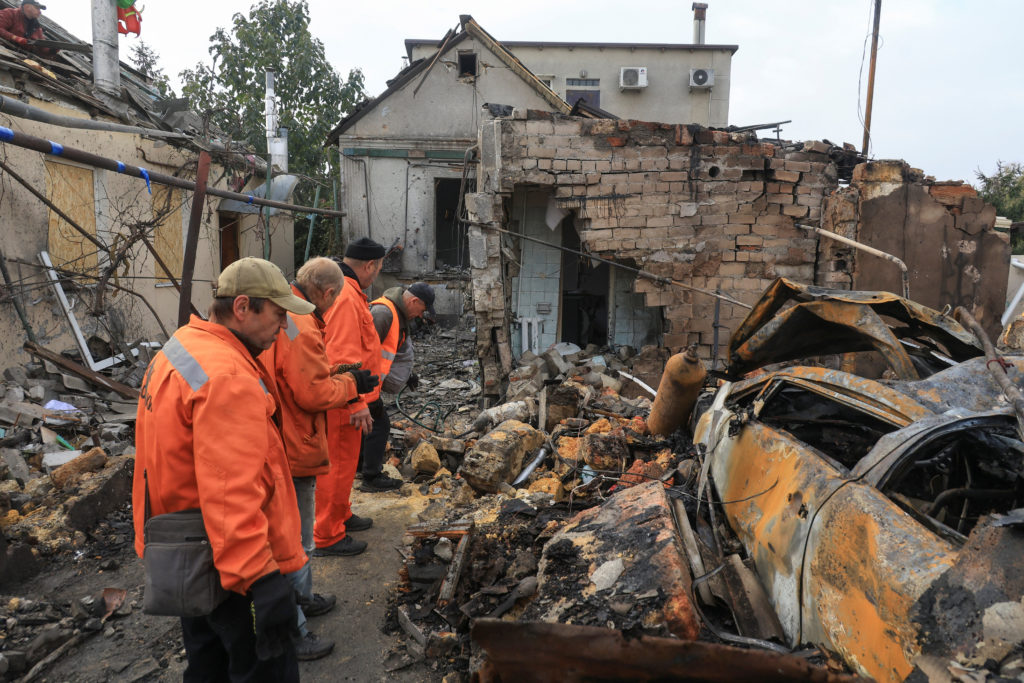
Elsewhere in Ukraine, emergency services reported that a drone strike injured 12 people in the eastern region of Kharkiv and damaged freezing facilities, greenhouses and residential buildings.
Five people were also reported injured in the Black Sea port city of Odessa, where a warehouse was attacked and homes damaged.
Russia’s Defense Ministry said on Monday it had shot down 212 Ukrainian drones overnight, while Vyacheslav Fedorishchev, the governor of Russia’s Samara region, said in a statement that local air defenses were repelling the strikes, without providing further details.
Independent Russian media later reported that Ukrainian drones struck one of Europe’s largest oil shipping hubs in Samara.
Katie Marie Davies contributed to this report in Manchester, England.
A free press is the cornerstone of a healthy democracy.
Support trustworthy journalism and civil dialogue.