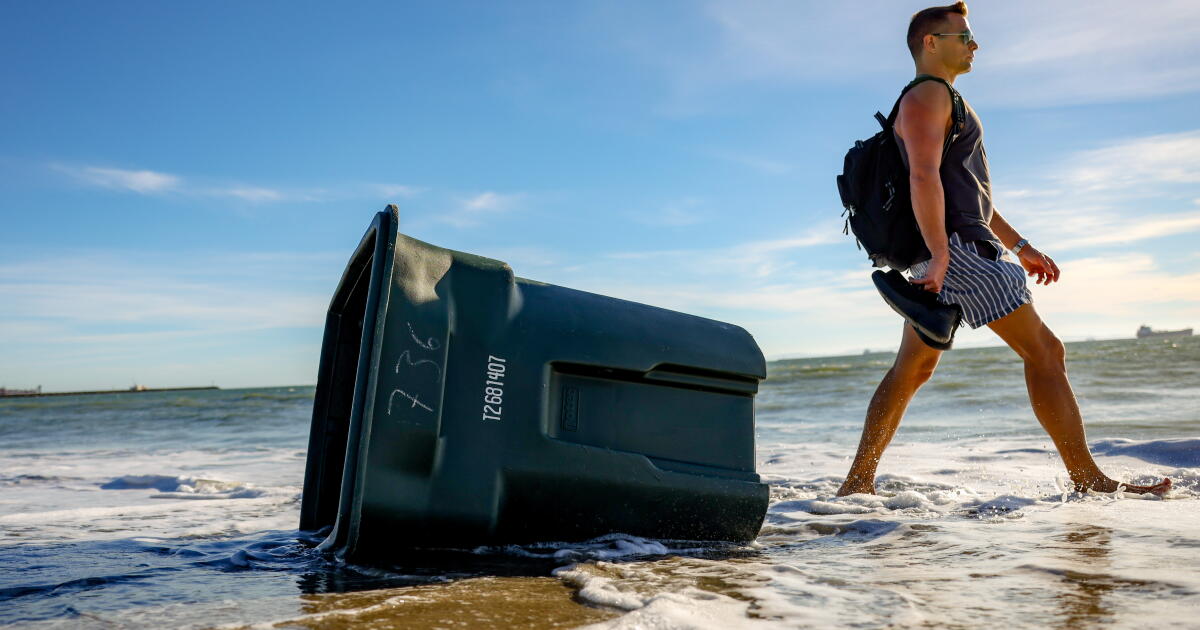
Near- or record-high sea levels are expected to bring days of flooding to the Southern California coast this week, with flooding set to begin with high tide Monday morning.
Officials in Newport Beach and Long Beach have been busy preparing, with crews hauling sand to shore up beaches, installing sandbags and otherwise working to protect areas that have been hard-hit in recent months, including the Balboa and Long Beach peninsulas. Officials urged residents in flood-prone areas to “take immediate precautions,” including moving cars to higher ground and protecting property with sandbags.
The National Weather Service warned that ocean water levels in Southern California could reach near-record or record-high levels. The highest tides are expected to occur on Monday, Tuesday and Wednesday morning.
The highest risk for coastal flooding this week is in Orange and San Diego counties, where the National Weather Service has issued a coastal flood warning that will last until Thursday afternoon.
“Significant flooding is expected along the coast,” the weather service said. “Low-lying properties including homes, businesses and some critical infrastructure will be inundated. Some shoreline erosion will occur in the morning.”
Further north, in Los Angeles, Ventura, Santa Barbara and San Luis Obispo counties, a coastal flood warning was issued, “with isolated damage to structures from salt water inundation possible in the most vulnerable areas.”
This year, a rare combination of threats brought damaging waves to the Southern California coastline—El Niño fueling an active eastern Pacific hurricane season; a marine heat wave; and an astronomical alignment that occurs only once every 20 years.
Total water levels in Los Angeles, Orange and San Diego counties this week could be more than 8 feet above the baseline, which is the average daily minimum observed between 1983 and 2001.
The highest water level ever recorded in La Jolla was 7.81 feet, set during the last “very strong” El Niño on Nov. 25, 2015, according to the weather service’s San Diego office. On Sunday, the water level reached 7.66 feet.
The highest sea level ever recorded in the Port of Los Angeles was 7.92 feet, recorded on January 10, 2005, when the El Niño was weak. The Oxnard weather service office said it expected harbor sea levels could reach 8.1 feet on Tuesday and 8 feet on Monday and Wednesday. On Sunday, sea levels initially reached a high of 7.71 feet.
City officials said water reached 8 feet in Newport Beach on Sunday. This is 1.8 feet higher than expected at high tide. Potential sea levels along the city’s shoreline could reach 8.3 feet at 9:15 a.m. Monday and 8.5 feet at 9:50 a.m. Tuesday and 10:28 a.m. Wednesday
Scientists say record-high sea temperatures off California are causing sea levels to be 1.25 to 1.8 feet higher than would be caused by the movements of the moon, Earth and sun alone. Ocean temperatures are affected not only by man-made climate change, but also by Kelvin waves caused by El Niño and months-long marine heat waves that are not related to El Niño.
Sea surface temperatures at Scripps Pier near La Jolla, San Diego, reached a yearly high of around 77 degrees in early August; the average maximum is around 70 degrees. Surface temperatures there were about 73 degrees on Thursday, well above the average temperature of 66 degrees for this time of year.
Coastal flooding is expected to become increasingly severe later this year and into next year, scientists warn. Higher tides are expected around the Thanksgiving, Christmas and Martin Luther King Jr. Day holidays — the so-called “King Tide” that Californians look forward to every year.
However, these spring tides will be extremely extreme, producing some of the highest tides for astronomical reasons alone. That’s because we’re approaching the peak of the 18.6-year lunar nodal tidal cycle and the 4.4-year lunar perigee tidal cycle, which are caused by small changes in the moon’s orbit that affect tidal forces, said Reinhard Frick, a researcher at the Scripps Institution of Oceanography at the University of California, San Diego.
Scientists warn that coastal flooding risks will be further heightened if major storms occur during king tides around the Thanksgiving, Christmas and Martin Luther King Day holidays.