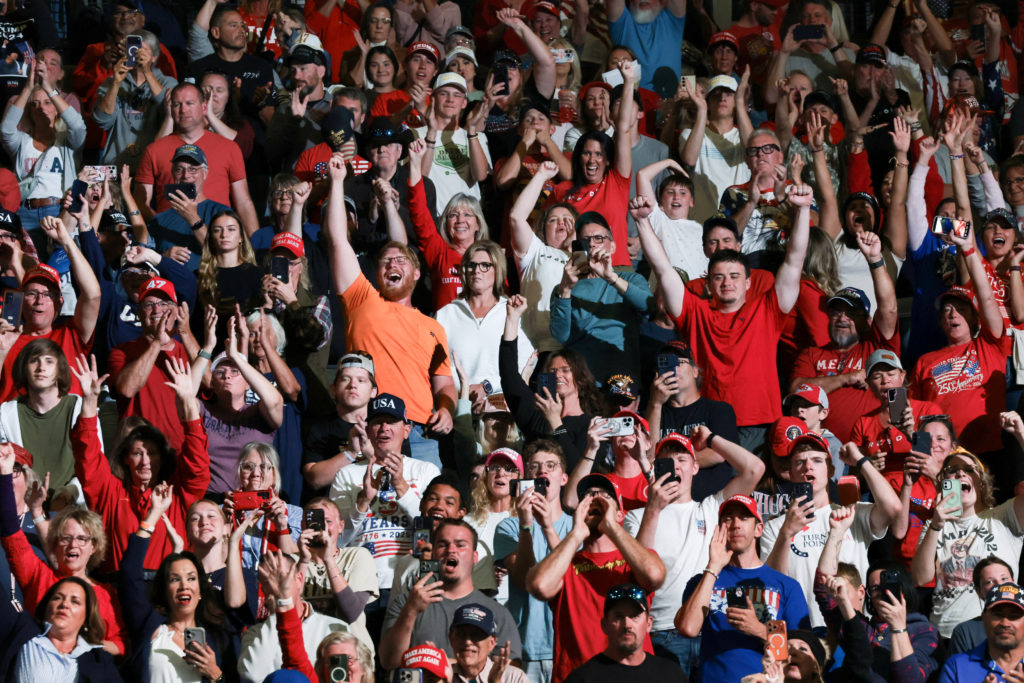
WASHINGTON (AP) — President Donald Trump hopes $5,000 checks will boost Republican turnout in the November midterm elections, but even some of his biggest fans are skeptical the government will hand out the bonuses.
“I mean, I guess it’s a good thing for some people. I really don’t care,” said Jamie Alvarez, who attended Trump’s recent rally in Alaska wearing red, white and blue. “I don’t think your vote should be bought. I think you should vote for the person you think can do the best job.”
Read more: Trump launches $90 health insurance rebate, but millions of people are not eligible. Critics say it’s a political stunt
Joseph Etherton, who attended the same rally, said he was “not sure it was necessary.” Asked whether Trump would be able to deliver on the promised money, he said: “I don’t know, and I hate to be an armchair quarterback.”
Delivering government checks has become Trump’s go-to tactic when he faces political dilemmas. He had previously approved a $2,000 bonus from tariff revenue and a large refund from spending cuts at the Department of Government Efficiency, but neither came to fruition. The latest example could shed light on how much voters trust Trump as they decide control of Congress in the Nov. 3 midterm elections.
Read more: Trump promised to provide $5,000 checks if Republicans win the midterm elections. How would that work?
Strong supporters like Lucy Martinez, president of the Republican Women’s Club, who recently attended a Trump rally in Texas, said they have no doubts.
“I thought I was going to get $5,000,” she said. Of all presidents, Trump is the one who “keeps his promises to his people and to all of America.”
Trump has released payments as election approaches
However, many voters are already unhappy with his economic leadership. His critics say the president has failed to curb inflation or involve the United States in overseas conflicts, and that his agenda has driven up prices just as the war with Iran appears to be reaching a stalemate.
“Most people have lost trust in this,” said Amy Frederiksen, the former Republican Senate majority leader in Minnesota who now runs a public affairs firm.
“I just don’t see the energy around that line,” she added. “Most people know it’s a blatant overpromise, like some of the promises he’s made over the past few years, but they’re not buying it.”
As the midterm elections approach, Trump has also pledged to pay $90 to 20 million Medicare enrollees and provide $500 “rebates” to people the government says were overcharged by Obamacare. He automatically enrolled every American child into a “Trump account” to invest in stocks.
Trump said the $5,000 payments would only be issued if Republicans maintained their majorities in the House and Senate. Trump acknowledged the cost would exceed $1 trillion, but it’s unclear whether the White House is seriously considering the proposal’s ramifications, from increasing the deficit to potentially pushing up inflation.
The White House said the payments were possible due to Trump’s trade deals, foreign investment commitments, government stakes in private companies and oil and mineral deals.
The administration’s position was that the payments would help people recover from inflation that began in 2021 under then-President Joe Biden, although Republicans at the time attributed the inflation to excessive government checks related to pandemic relief.
When asked by The Associated Press a few weeks ago whether the administration was modeling the economic impact of the checks, White House Council of Economic Advisers Chairman Christopher Phelan said he would “avoid” answering.
About half of registered voters say Donald Trump has failed to fulfill his promises to Americans, according to a September Associated Press-NORC poll. About 3 in 10 said Trump tried to keep his promises but was unable to do so, while only about 2 in 10 said he kept his promises.
Republican voters are more tolerant. About half said Trump tried to keep his promises but was unable to do so, and about 4 in 10 said he kept his promises.
Republican candidates fail to respond to Trump’s pledge
It’s a sure thing that Trump is talking about payments.
“If the Republicans win, you’ll each have $5,000 in your pocket and our country will have unprecedented economic success,” he said at a rally in Kentucky on Saturday. “Remember, because they like to say, ‘Oh, well, maybe he won’t do that.’ Well, I always do.”
Campaign spending tracked by AdImpact shows Republicans have not run ads about the pledge on television or online. The few ads that do exist are from pro-Democratic groups like the Rolling Seas Action Fund, which end with a voiceover: “Come on, do you really think he’s going to send you a check? Yeah, that’s right, we’re not going to be fooled anymore.”
At a rally in Georgia on Friday, Trump noted that he had previously issued a $1,776 “Trump Dividend” to the military. But those payments come from housing subsidies approved by Congress.
Trump claimed that if Democrats gained a seat in Congress, the country would not be able to pay the money because the country would be “bankrupt.” But he said the caveat is that the money can only be spent in the United States, not China, Japan or France. He joked that people should spend their checks at his luxury club in Palm Beach, Florida.
“Let’s go to Mar-a-Lago for lunch, and for $5,000 you can get a burger and a small dessert,” he told the Georgia crowd.
Some in the crowd took Trump at his word that he would get their money. But they added that if he didn’t pass, it wouldn’t be his fault.
“I could use $5,000,” said Mike Boatman, 58, of Evansville, Indiana, who is traveling across the country attending the president’s rallies. “I mean, he’s done everything he said he was going to do.”
Borrell reported from Wasilla, Alaska, and Barrow reported from Dalton, Georgia. Associated Press reporters Aaron Kessler and Linley Sanders in Washington and Lekan Oyekanmi in San Antonio, Texas, contributed.
A free press is the cornerstone of a healthy democracy.
Support trustworthy journalism and civil dialogue.