
The Democratic midterm election sweep could lead to changes in economic policy related to trade, spending priorities and artificial intelligence. But the biggest forces shaping the economy will not change just because of the party in power.
Affordability pressures, heavy levels of government and growth dependent on the tailwind of artificial intelligence will remain, economists say. And all these factors lead to economic risks.
“It’s in a very kind of broken place, and I don’t know that it will take a lot to push the economy off the rails, and the recession becomes a greater risk,” said Mark Zandi, chief economist at Moody’s Analytics. “It’s not like that now, but I don’t think it’s gone.”
Zandi said he had been concerned before the election that the economy was under threat from inflation, a poor labor market and geopolitical dangers, and he is still concerned now.
Democrats romped to upset wins in not only House and Senate races but also governorship and other state races. But economic and foreign policy are largely set in the executive branch, and President Donald Trump has kept his distance from his Democratic opponents, although he said Wednesday he looks forward to working with them.
“I don’t expect any change in economic policy. The Iran war, the tariffs and trade policy, the tough immigration policy, they’re all done by executive order. They’re not legislatively driven,” Zandi said.
“The president thought it was a good policy before the election. I don’t know why he will change his mind after the election,” he added. “So I think it will continue to be a policy that stifles growth and increases inflationary and interest rate pressures.”
Zandi sees AI hyperscaler build-out as key to economic growth, but also a source of potential danger.
“The risk is definitely down because growth is very dependent on AI, and the growth effect of AI is very dependent on equity markets, and equity markets are very dependent on valuations,” he said. “It’s just like a fragile place, and the labor market isn’t working very well.”
Local opposition to data centers is a fairly important issue in the election, especially for Democrats, according to a CNBC poll, so it could become a further economic issue, although the issue is below the cost of living, corruption and a few others.
Two economies
The election comes amid a dichotomy over the economy.
Topline numbers such as gross domestic product, consumer spending and the unemployment rate tell the story of an economy that is growing fast as consumers spend and most Americans want to work. GDP accelerated by 3.4% year-on-year in the third quarter while consumer spending increased by 3.8%. The unemployment rate is at 4.2% while layoffs are at their lowest level since 1969.
However, rising prices have surpassed solid metrics.
The inflation rate in September as judged by the consumer price index was 3.7% – up sharply from 2.3% in April 2025 when Trump announced an aggressive round of so-called reciprocal tariffs against US trading partners. The Iran war only exacerbated the situation. The CPI was only 2.4% when the US and Israel launched an attack on Iran in late February, a war that sent gas prices soaring.
And wages are not keeping pace with rising costs. Wage growth when adjusted for inflation has turned negative, down 0.7% from a year ago in September, according to the Bureau of Labor Statistics.
One area where both sides of the political divide work together is tariffs.
Congressional Democrats have yet to back down against tariff efforts aimed at leveling the playing field. But Trump’s tariffs have been criticized for their sweeping nature.
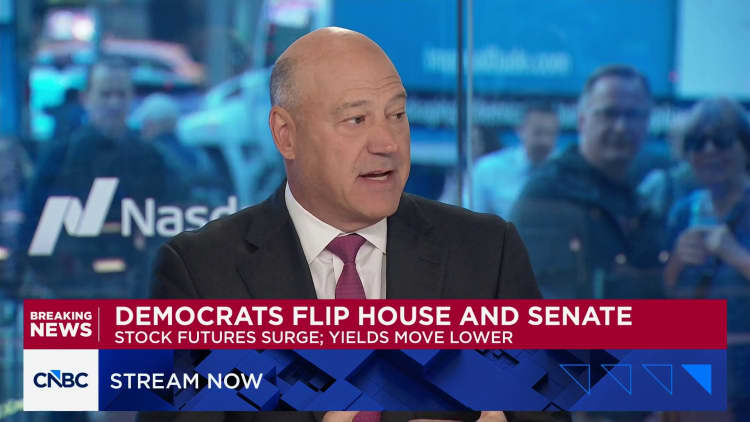
Gary Cohn, who served as director of the National Economic Council during Trump’s first term, said Wednesday that he sees room for movement on trade issues.
“There’s becoming a more universal view of what rates are and what’s good,” Cohn said in a CNBC interview. “Protecting US workers and protecting manufacturing, protecting jobs in the United States, especially from China, more than anything, is good and has been good policy.”
While Cohn notes that “the border between Canada and Mexico and the United States is probably not very good for policy,” he thinks “there is a compromise that can be made where we actually have tariffs that are put into the legislative system and become law.
Address affordability
Democrats will also look to roll back spending cuts to SNAP food stamp benefits and Medicaid that were approved by the Republican-controlled Congress in the One Big Beautiful Bill Act, Morgan Stanley analysts said in a client note. But other policies that Democrats oppose will be harder to reverse.
“We think policy uncertainty since the start of President Trump’s second term has been tied to executive action, not legislative action,” the firm said. “Policy on tariffs, geopolitics, trade, … deregulation, and export controls will all remain in place, meaning we should expect a certain level of policy uncertainty to continue.”
High levels of government debt and budget deficits will also remain.
The national debt is now $40.5 trillion, more than $4 trillion since Trump took office in January 2025. Net interest on the debt will total $1.05 trillion in fiscal 2026, higher than spending in any other category except Social Security and Medicare.
The US ended the year with a deficit of just $2 trillion, or about 6.1% of GDP. Morgan Stanley expects those levels to hold despite some Democratic officials preaching fiscal discipline.
House Minority Leader Hakeem Jeffries, DN.Y., speaks at an election night watch party in Washington, DC, after Democrats won the House, November 3, 2026.
Tom Williams CQ-Roll Phone, Inc. | Getty Images
While there are concerns that the change in power could lead to standoffs over the debt ceiling, “Democrats are likely to influence. [an impasse] to win policy concessions,” Goldman Sachs chief economist Jan Hatzius said in a note.
“It’s not clear what Democrats will seek, but limiting the war with Iran, repealing tariffs, reversing spending cuts, and expanding health benefits appear to be high on their priority list,” he said.
Despite various headwinds and political uncertainty, most Wall Street expects growth in the economy to continue – if not without hiccups and lingering problems about the cost of living.
“My guess is that economic expansion will continue, with trend growth above 2½ percent,” said Joseph Brusuelas, chief economist at RSM.
Brusuelas also sees an opportunity to “reset” the trade agreement between the US, Mexico and Canada after a year and a half of tension from Trump’s tariffs and retaliation.
“We only have a 15% chance of a recession in the next 12 months,” he said. “The election results are not important to these estimates.”