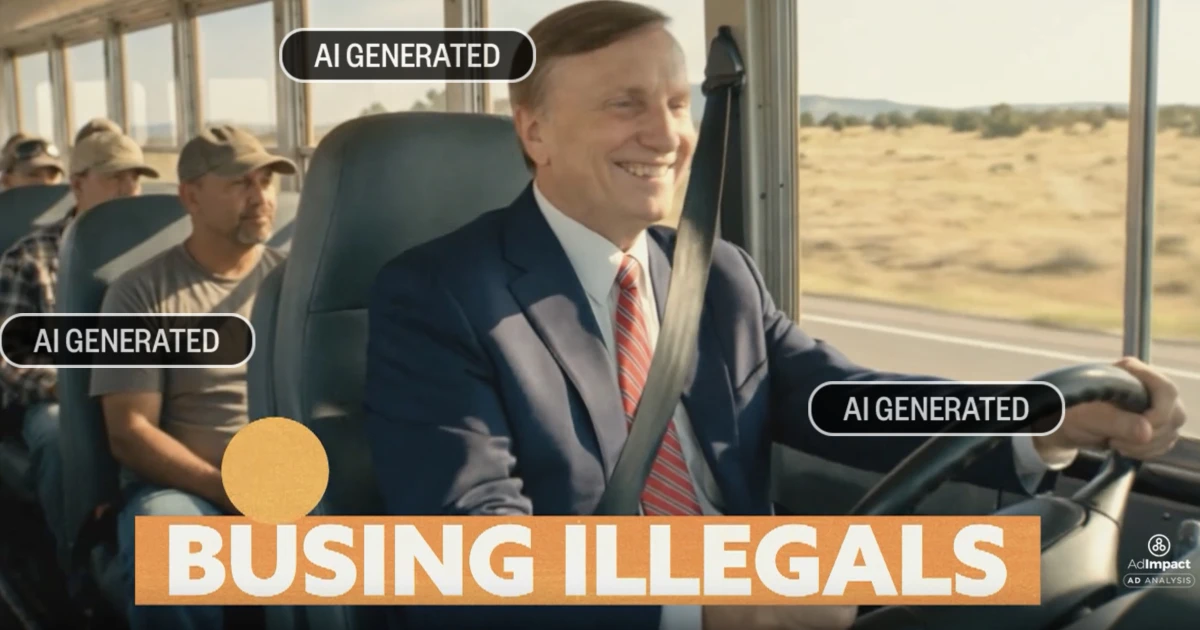
South Carolina Lieutenant Governor Pamela Everett appeared distressed as she took a lie detector test in a darkened room when it caught fire. Evette told Noticias Telemundo that although the film clarified that the “drama” in the political ad was generated by artificial intelligence, some voters still asked her whether what they saw was real.
At first, Everett said she thought, “This is ridiculous, right? Like, no one is going to believe this?” Later, when she traveled to the state during her campaign to be the Republican gubernatorial candidate (she lost the race in June to Attorney General Alan Wilson), she said she encountered some voters who were confused about the authenticity of the video.
“On the campaign trail, people would ask me, like, ‘Oh my gosh, are they really going to make you take a polygraph test?'” Avitt said. She then had to explain to them that this never happened and that it was false advertising generated by artificial intelligence.
“So you almost think it’s a joke and you laugh at it until you realize there’s a group of people out there who can’t tell the difference,” she said, “and then start questioning whether what they’re saying is true.”
Evette isn’t the only one whose image has been manipulated ahead of the midterm elections. The Wesleyan Media Project, a group of experts that tracks political propaganda in campaigns, identified at least 220 ads created or enhanced by candidates or political action committees using artificial intelligence this election cycle. They cost just under $137 million.
This is a significant leap forward from the less than $50,000 invested in artificial intelligence during the 2024 presidential election. As of May this year, spending on these AI ads has reached $20 million.
“We definitely saw growth in artificial intelligence advertising this summer,” Travis Ridout, a professor at Washington State University and one of the program directors, told Noticias Telemundo. “A lot of it has to do with the heated primary.”
South Carolina’s lieutenant governor saw two videos of himself generated by artificial intelligence or deepfakes, But she also shared a message that incorrectly described her opponent, Alan Wilson, as rejecting a call from President Donald Trump. According to Evette, her campaign used artificial intelligence after her ad went viral. “But we said, ‘This ad was generated by artificial intelligence,'” she said.
The video targeting Evette was allegedly paid for by the PAC; the photo released targeting her opponent was funded by the lieutenant governor’s campaign. A request for comment sent to Wilson was not immediately responded to.
In response to Noticias Telemundo’s inquiries on social media, nearly 40 people said they had seen political ads generated using artificial intelligence. Some people admit they have trouble telling them apart.
“It could be deceptive; in that case, voters could make a decision based on a lie,” Ridout said. “I think that’s most concerning from a democratic standpoint.”
Ridout said in the absence of federal laws regulating them, the responsibility falls on local governments. He estimates that about 30 states have some type of rules or requirements for artificial intelligence in political campaigns.
Of the 220 ads analyzed by the Wesleyan Media Project, only 27% revealed that they used artificial intelligence tools.
The possibilities are “infinite”
Ridout suggested that candidates with smaller campaign budgets rely on artificial intelligence to compete with their rivals.
“I thought it was here to stay. I didn’t know it was going to go away,” Everett said. She noted that events are “extremely expensive” and that artificial intelligence reduces many recording and editing costs.
The tools could also “free up” more creativity in political advertising, Ridout said, “which wouldn’t be the worst thing in the world.”
The possibilities are nearly endless, he said, including sarcasm. In the ads he analyzed, he saw candidates emerging from the swamp to fistfight with Trump or appearing alongside physicist Albert Einstein, who died in 1955.
“I do worry about the lasting impact of these images, even though people know they may not be true,” Ridout said. He noted that these images could stick in their minds as they vote, and could even create a wave of misinformation that could spark violence.
Artificial intelligence could “redefine” modern political movements, experts from the non-profit Brennan Center for Justice have analyzed the technology’s potential impact on democracy.
Mekela Panditharatne, legal counsel and director of the Center’s Elections and Government Program, said that without disclosure, “the use of generative AI in political advertising has the potential to distort perceptions of candidates, creating a flattering impression of the candidate or a negative impression of the opponent.”
During the Minnesota primary, a deepfake photo circulated showing Lt. Gov. Peggy Flanagan, the Democratic candidate for U.S. Senate, smiling amid a huge amount of money.
A spokesman for her office said that while it didn’t stop them from winning the primary, the impact of the AI-generated footage was alarming. “There is already too much distrust in our politics, and voters deserve to know what is real and what is not,” the spokesman said.
Minnesota is one of the states with AI regulations; in 2023, its legislature passed a ban on its use to influence elections with bipartisan support. The artificial intelligence ad targeting Flanagan has sparked debate over whether it is illegal or protected by the First Amendment.
Flanagan’s spokesman said artificial intelligence “should never be used to manipulate voters.”
Transparency issue
At least two federal bills regulating artificial intelligence politics are awaiting discussion and approval by lawmakers.
One seeks to ensure that ads prominently display the use of artificial intelligence tools; another seeks to ban the technology from “generating substances.” Deceptive content in political advertising that falsely depicts federal candidates to influence federal elections. “
Pandita Ratni of the Brennan Center said that despite local regulations, some candidates still violate them.
“I don’t think these laws are as strong of a deterrent as we hoped they would be,” she said, noting the need for a universal federal standard.
When designing any law, lawmakers consider the First Amendment, which protects rights such as freedom of speech, religion, and the press.