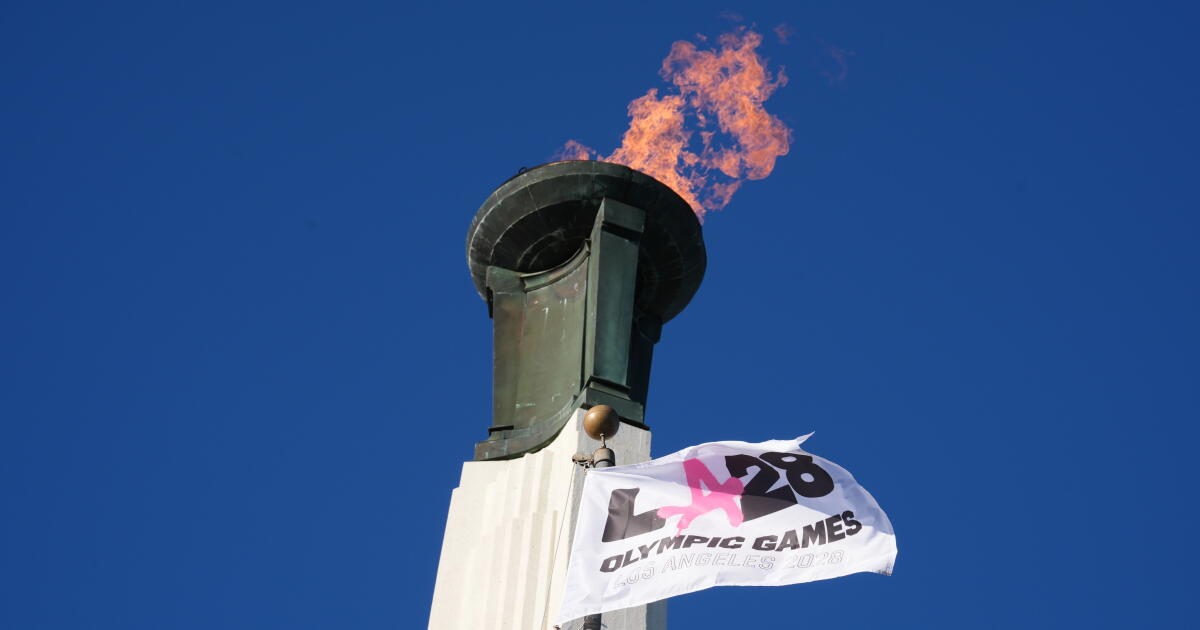
Gov. Gavin Newsom is forming a “strike force” of state workers to help reduce bureaucratic delays and pave the way for the 2028 Summer Olympics and Paralympics in Los Angeles.
Newsom plans to sign an executive order on Friday creating a new executive director position for the Olympic and Paralympic Delivery and Coordination Strike Force and appointing one of his senior advisers, Jamie Callahan, to lead the organization.
Callahan will work to ensure that more than a dozen state agencies and departments work with local governments in Los Angeles and surrounding cities and leaders of LA28, the private nonprofit responsible for hosting the Olympics and Paralympics at an estimated cost of $7.2 billion.
“California knows how to play a role on the world stage,” Newsom said in a statement, adding that Los Angeles Mayor Karen Bass and LA28 CEO Reynold Hoover had begun coordinating. The governor said the strike force will “ensure California is ready to host a world-class event that reflects the best of our state.”
California institutions have committed to playing an important role in sporting events.
The California Office of Emergency Services was tapped to coordinate an influx of police officers from across the state and across the western United States to protect athletes, officials and up to 2 million fans expected to descend on Southern California in the summer of 2028. (Ultimate authority for security matters rests with the U.S. Secret Service.)
The California Department of Transportation has agreed to improve highways and freeways and conduct a public relations campaign to try to convince tourists and locals to get off the bus to ensure athletes and officials get to the event on time.
In making the announcement, the governor’s office touted state funding previously approved for the Summer Games. That includes more than $100 million to upgrade and modernize Exposition Park, home to the Los Angeles Memorial Coliseum. Last summer, another $257 million was set aside to create and enhance “mobility hubs” that connect pedestrians, cyclists and bus and train passengers.
Officials at L.A. Metro, the county’s large transportation agency, have been lobbying hard to get more funding from the state. They requested a total of $379 million in the most recent legislative session and expressed frustration at receiving only $20 million.
Projects not advanced by the Legislature this year include $138 million for cloud-based computing systems, traffic cameras and video connections to help expand and integrate regional transportation management systems; and $65 million to install emergency tracks so light rail trains can be rerouted if they malfunction.
Emergency runways are of particular concern as passenger numbers are expected to double during the Olympics. Metro also didn’t get $23 million for additional improvements to transit hubs, including seating, shade structures, Wi-Fi, restrooms, hydration stations, vending machines and concessions.
The governor’s office said the team created by Newsom will “look for opportunities to streamline permitting and improve communication between agencies and support the region’s efforts to expand workforce and economic opportunities.”
Newsom praised Callahan as a perfect fit for the new position, saying he has advised California governors for more than 15 years and helped pave the way for previous major events, including last summer’s FIFA World Cup.