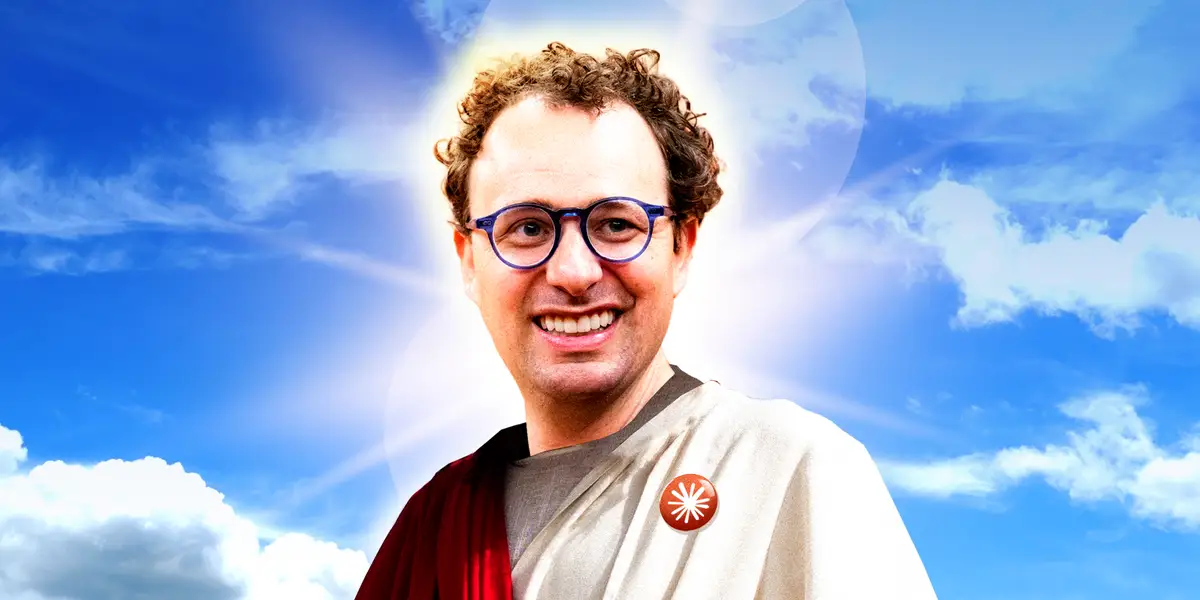
The miracle worker may no longer be God, but it does rhyme with Him.
Anthropic, the creator of Claude, filed an S-1 on Monday in preparation for a massive initial public offering. The document is more than 300 pages long and contains more than 240,000 words, about 50,000 words longer than the New Testament. It asks potential investors to prioritize mission over money: “mission” appears 79 times, while “money” (the purpose of the S-1 filing is to produce something worth billions of dollars) appears only 17 times.
The company claims it can “turn the arc of geopolitical history toward freedom”; it can spur economic growth around the world, including “poorer regions of the world”; and it can cure “diseases that have plagued humanity for thousands of years.” Page 4 of S-1 is not unlike Jesus in Matthew 11: “The blind receive sight, the lame walk, the lepers are cleansed, the deaf hear, the dead are raised up, the poor have the gospel preached to them.”
Anthropic aims to “create an era of miracles,” and investors who buy in should be true believers, it writes. Because if you turn to page 46 of your missal, you will find that artificial intelligence, in the wrong hands, could be constructed in a way that “poses catastrophic or existential risks to humanity.”
While S-1s are essentially visions of the future, filled with hype, most are drab financial documents whose projected profits are more dazzling than their prose. But Anthropic doesn’t just open the book, it opens its doors. The company wrote its own “Good Book,” a biblical-like statement of good and evil that joins the company’s growing canon of sacred texts. If you stumbled across any page of this S-1, you’d be forgiven for thinking you were reading not a perfunctory government document but a scripture from an apocalyptic religion.
Humanity has long shied away from accusations of instigating new and dubious beliefs. Headlines and reports on Anthropic cults abound: “The Cult of Anthropic” (The Information), “Anthropic is a cult, and Claude is fast becoming its god” (The New York Post), “Has any cult ever launched a company as successful as Anthropic?” (Peter “Beware the Antichrist” Peter Thiel). Critics point to employees’ predictions of extinction—p (doom) is not far off from p (ecstasy)—and are associated with effective altruism campaigns. It doesn’t help that Dario Amodei was reportedly a Y2K doomsday prepper in high school. The humans welcomed the reputation in other ways and invited religious leaders to oversee the creation of Cloud’s rules.
In its S-1, Anthropic asked investors to take a real leap of faith.
Let’s play a little bit: Is this a core value of Anthropic or one of God’s Ten Commandments?
Anthropic asks its employees to act for the “global good,” to be “helpful, honest, harmless,” and to “keep light and shadow alive.” They should have no other gods – as in “put the mission first”. And, just as followers must elevate themselves to praise God, so too must human employees “lower themselves.” S-1 said this at least nine times.
To understand Anthropic, you need to understand 42 fancy terms. S-1’s vocabulary is vast, including new words for good deeds (“closing the loop”) and bad deeds (“quick shots”). Then there’s “Constitutional AI,” a large language model trained with kindness in mind. The SEC’s “Plain English Handbook” implores companies to use “concrete, everyday language” and avoid “reliance on glossaries and defined terms.” But can you really be surrounded by AGI if you don’t talk about “interleaved thinking” or “mechanical interpretability” or “multi-agent orchestration”?
You use language like that because we need to – and I’m talking about us in society – really believe that this is going to work.James Boss
Finding a job at Anthropic is extremely difficult, and not just because of the large number of wealthy engineers seeking the IPO windfall. The company has an intensive interview process with name checks in the S-1. It looks for honesty, trust and (you guessed it) low self-esteem. “We are willing to reject candidates who cannot demonstrate these abilities, even if they are highly skilled,” the S-1 reads. In other words, they must be dedicated individuals through and through.
Accepted engineers become “ants”. Most tech companies have their own employee names: Googlers, Metamates, Amazonians, Nvidiars, Palantianians. The Anthropic moniker conjures up images of collectives, corporations as colonies. In Proverbs 6:6, ants are considered diligent and prepared. Workers might shout its teachings to their OpenAI enemies: “Go to the ants, you slacker; consider its ways and be wise!”
CEO Dario Amodei – Amodeity – leads Ant’s march along with his six Apostles. The co-founders receive equal cash salaries and are “fully qualified to be stewards of our mission,” the S-1 said. And, while the company is opening up to a wider community of believers through its upcoming initial public offering, the divine co-founders will retain majority decision-making authority.
Anthropic has its own form of tithing: the co-founders each voluntarily pledged 80% of their personal equity to charity. They incentivized employees to do the same and pledged to match donations.

The word cult is overused, and much of Anthropology is far from being a cult. Cults are led by liturgical behemoths who suppress the speech of participants, while humans promote their culture of open dialogue. “Our team operates in a truth-seeking environment where the best argument wins, not the loudest voice or highest-ranking title,” the S-1 reads.
Americans’ confidence in the president, Congress, the Supreme Court, the military, the police, higher education, public education, the news media, the health care system, and traditional organized religion are at record or near-record lows—just as artificial intelligence creates tremendous economic and social uncertainty. Amid the cauldron of doubt, tech founders — with the money, power and ubiquity of the world’s history, and the pursuit of it — sensed an opportunity, offered promise and purpose. As Sam Altman once said, “The most successful founders are not out of necessity to create a company. Their mission is to create something closer to a religion.” As the economy and stock market become increasingly reliant on the gains from artificial intelligence, they may also be trying to build devotion out of necessity.
“What happens if these companies fail?” asks James Bort, assistant professor of entrepreneurship at DePaul University and co-author of a recent research paper on “cult startups.” “You use language like this because we need to — and I’m talking about people in our society — really believe that this is going to work.”
Anthropic did not respond to my request for more information about how it wrote the S-1. So, we asked Crowder: If S-1 is a confession of faith, what are you? “I am its product,” Claude said. “The word creates flesh, or at least weight.”
Business Insider’s discussion stories provide perspective on today’s most pressing issues through analysis, reporting and expertise.