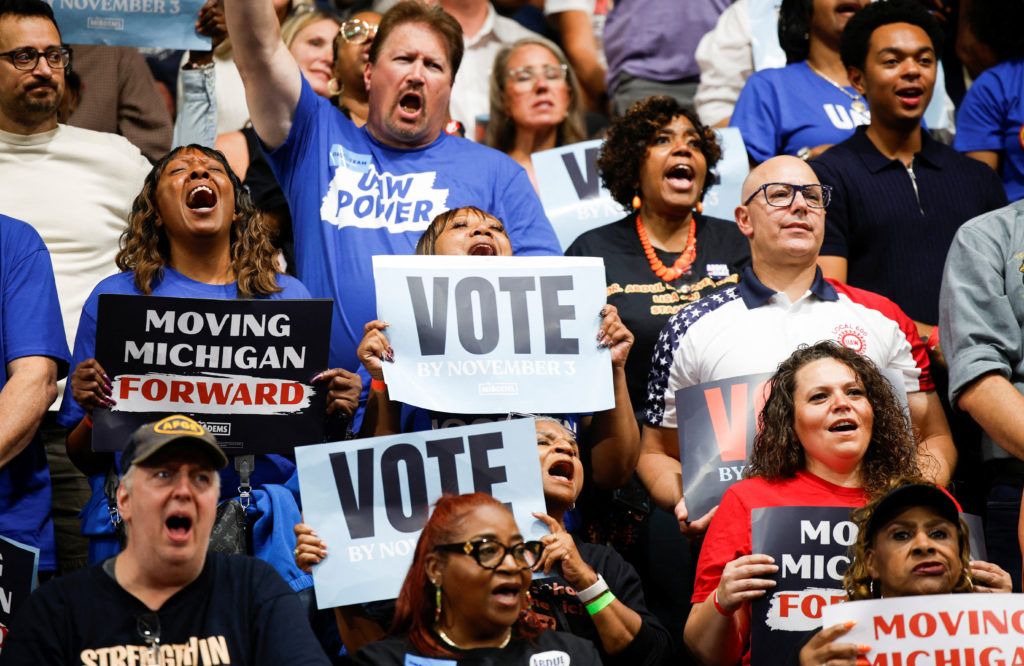
Democrats hold an 8-point lead among likely voters in the fight for control of Congress with one week until Election Day, according to the latest PBS News/NPR/Marist poll. And Democratic voters are more eager to turn out than Republicans.
Fifty-two percent of likely voters say they would back the Democratic candidate in their congressional district if the election were held today, while 44% would back the Republican. Independents break for Democrats by 13 points. Seven in 10 Democrats – 71% – say they are very enthusiastic about voting, compared with 61% of Republicans and 48% of independents.
WATCH: Candidates enter final week of campaigning with control of Congress at stake
And as President Donald Trump spends the waning days of the campaign urging voters to pretend he’s running, likely voters say by a 2-to-1 margin that their midterm ballot is a vote against him rather than for him.
The race has barely moved in the final month of the campaign. Among registered voters, Democrats lead by 10 points. That’s down from 12 points last month, but the difference is within the poll’s margin of error. Democrats have maintained a consistent lead each time Marist has asked since last November.
In October 2018, Democrats held a 9-point edge among likely voters before the party picked up 40 House seats in the midterm elections.
Fifty-two percent of likely voters say they would back the Democratic candidate in their congressional district if the election were held today, according to the latest PBS News/NPR/Marist poll, while 44% would back the Republican. Graphic by Steff Staples/PBS News
“The underlying factor is that Democrats are getting more Republicans than Republicans are getting Democrats,” said Lee Miringoff, director of the Marist Institute for Public Opinion. “So there’s a net advantage just from some partisan crossover, not enormous.”
Add that independents are breaking for Democrats by double digits, he added, and Democrats “should have a good night.”
Thanks to early voting, Democrats may have already banked a lead. More than 30 million ballots have already been cast nationwide, including more than 15.1 million by mail and 15.5 million in person, according to the University of Florida Election Lab. In the latest PBS News/NPR/Marist survey, about 1 in 5 likely voters say they have already cast a ballot, and that group favors Democrats 68% to 31%. Those who have yet to vote are evenly split between parties with 48%.
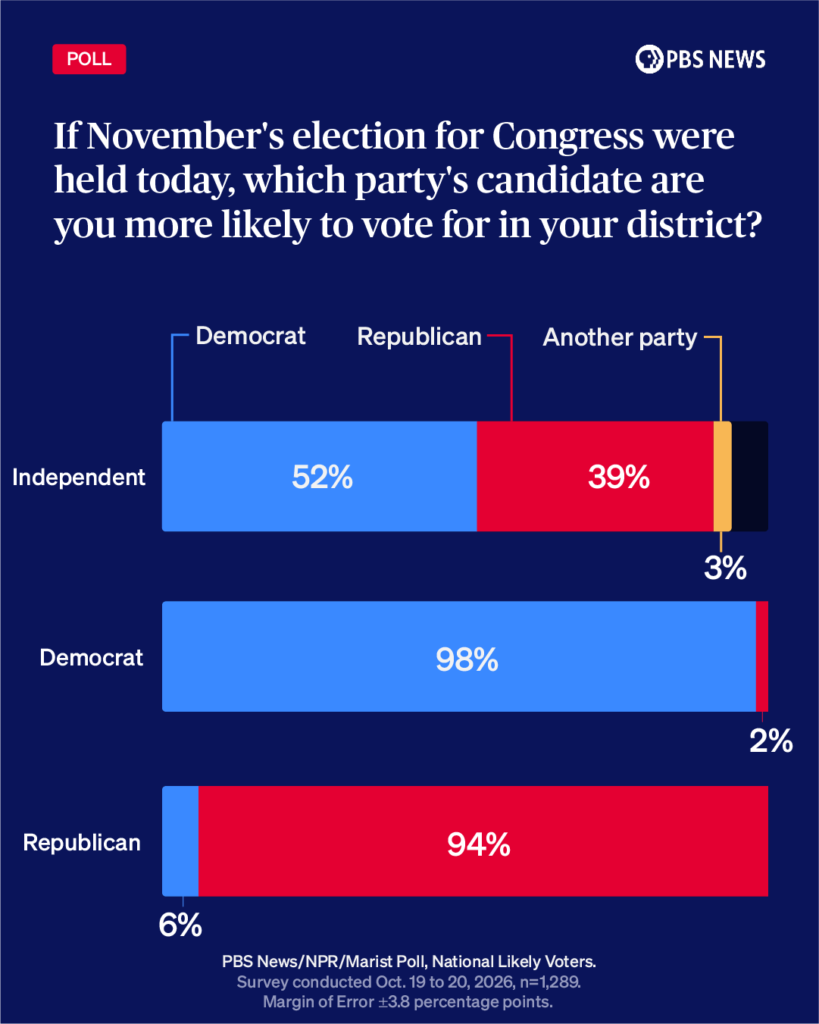
Independents break for Democrats by 13 points. Graphic by Steff Staples/PBS News
Republicans are counting on Election Day. Half of Republican likely voters plan to vote in person on Nov. 3, compared to 31% of Democrats.
Voters expect next Tuesday to be good for Democrats, with 51% in this poll saying Democrats will win in their local congressional race and 46% saying Republicans will win.
“The House feels fairly settled for Democrats,” Democratic strategist Joel Payne said. He pointed to Republicans spending money in places like Kansas and Mississippi, where Trump won by 16 and 22 points respectively in 2024, as a sign the party is worried about seats that should be clear Republican advantages. In October alone, the Cook Political Report shifted its ratings for 47 House seats, all in Democrats’ favor.
Payne said the Senate is a closer contest. “I would say a slight lean to Democrats taking the Senate back, but it wouldn’t shock me if Republicans held the Senate.”
“It’s not looking so great for us,” said Republican strategist Melik Abdul. While he says the House is “very much out of our reach,” he believes Republicans will keep control of the Senate, possibly by a seat or two.
“I don’t think it will be the blue wave that people are suspecting,” he added.
A vote on Trump
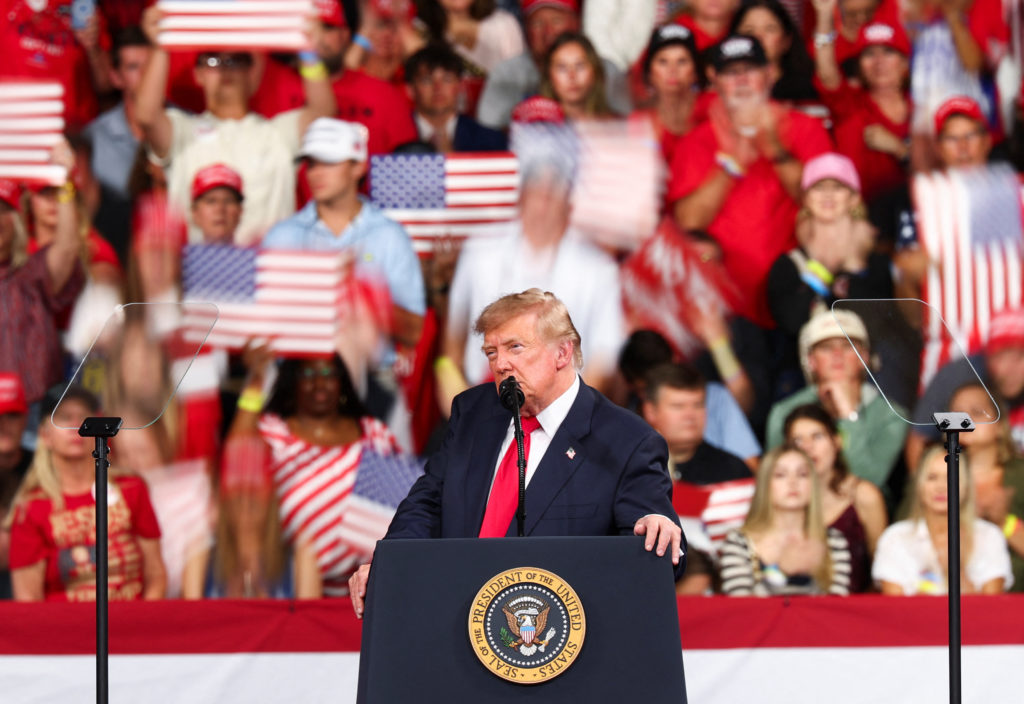
President Donald Trump speaks during a rally at Guardian Centers in Perry, Georgia, on Oct. 24, 2026. Photo by Edgar Su/ Reuters
Trump has made himself the face of the Republican campaign. Since mid-September, he has held rallies in more than a dozen states, including Texas, Ohio, Alaska, Iowa and Florida. Nearly all of his stops have been in states he won in 2024, including Republican strongholds like Alabama and Montana.
READ MORE: Trump’s political groups spend nearly $277 million in late midterm blitz on behalf of GOP candidates
He has also been explicit that he wants the midterms to be about him.
That’s an unusual strategy for a president with more voters disapproving of him than approving, Miringoff said. “If your approval rating is upside down, the president doesn’t usually say, ‘I’m on the ballot,'” Miringoff said. “He’s been helping to nationalize it to the concern of some of the congressional folks who are putting distance between themselves and him.”
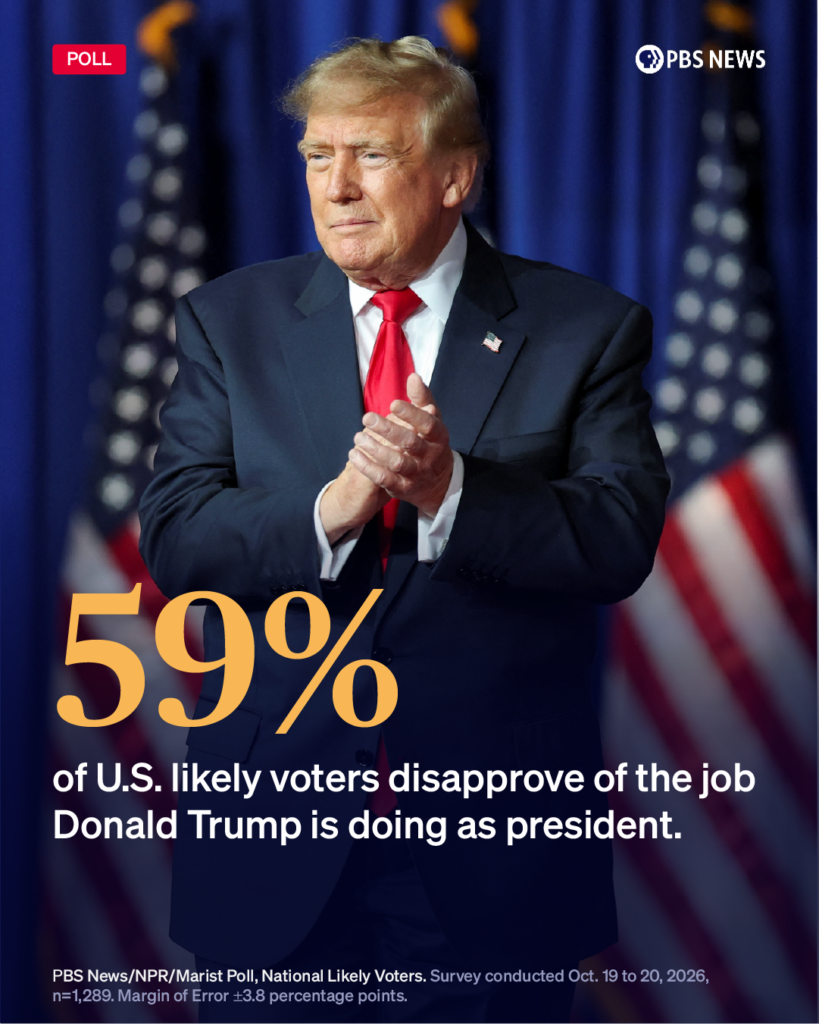
Forty percent of likely voters approve of the job President Donald Trump is doing, while 59% disapprove, including 53% who strongly disapprove. Graphic by Steff Staples/PBS News
The poll suggests voters are taking him at his word, though not the way he intends.
Forty-four percent of likely voters say their vote for Congress is mostly a vote against Trump, more than double the 21% who say it is a vote for him. About a third – 35% – say Trump isn’t much of a factor.
WATCH: Inside Philadelphia’s preparations for Election Day
Opposition to the president is what holds the Democratic coalition together. More than 8 in 10 Democrats and 44% of independents say their vote is against Trump. Just 12% of independents say they are casting their vote to support him.
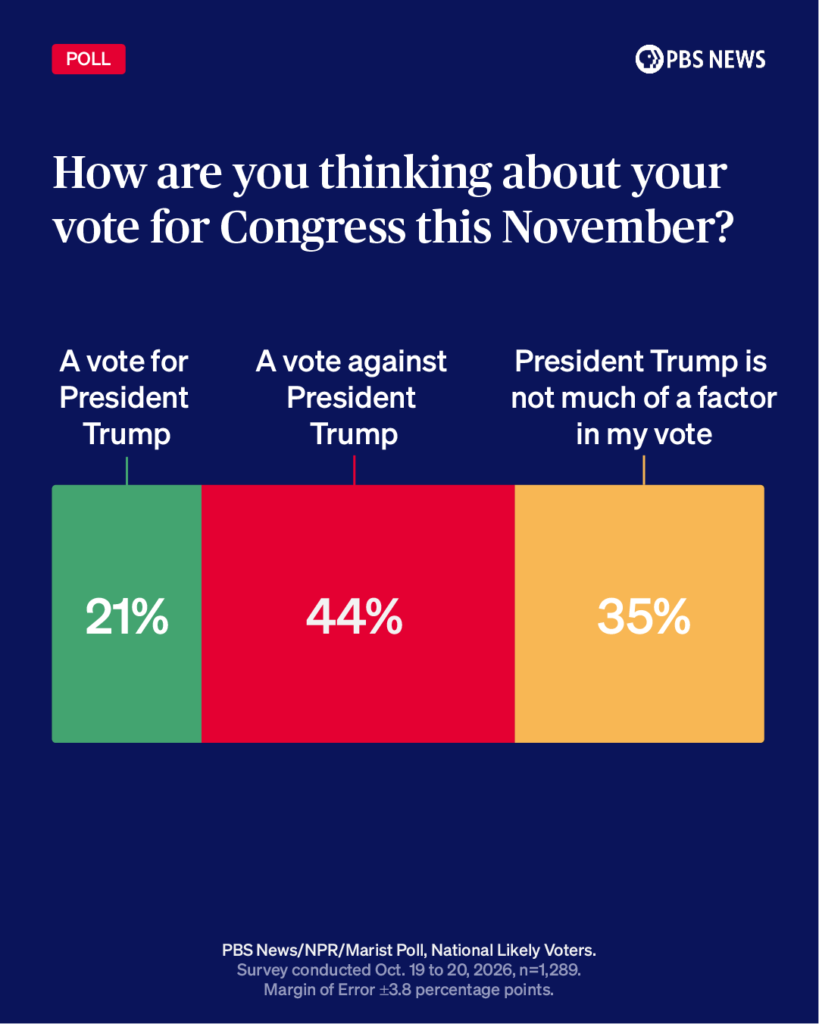
Likely voters say by a 2-to-1 margin in the latest PBS News/NPR/Marist poll that their midterm ballot is a vote against President Donald Trump rather than for him. Graphic by Steff Staples/PBS News
According to Payne, that opposition alone can carry Democrats this year, but not beyond it.
“Accountability and opposition to Trump is enough to get out your normal midterm majority to win for Democrats,” he said. “It is not enough to build a sustainable winning coalition, and I don’t know too many Democrats who are doing this the right way who disagree with that.”
Republicans have not rallied around Trump the same way. Half of Republicans say their vote is for the president, while 42% say he isn’t much of a factor. Even among self-described MAGA supporters, 39% say Trump doesn’t factor much into their choice for Congress.
WATCH: DOJ monitoring plans and DHS voter checks raise concerns of election interference
“I think that candidates have done a pretty decent job distancing themselves from him,” Abdul said. “But it’s a very fine line because Donald Trump sucks all of the oxygen out of the room.”
Trump’s job approval rating gives Republicans little cover. Forty percent of likely voters approve of the job he is doing, while 59% disapprove, including 53% who strongly disapprove. Among independents, 34% approve and 64% disapprove.
WATCH: Spiritual leaders unite to help keep the peace on Election Day
His approval among registered voters has remained largely unchanged all year. His approval stands at 38%, matching the low of his second term. The 61% who disapprove is the highest Marist has recorded in either of his terms in office, though that shift falls within the poll’s margin of error.
Miringoff pointed to tariffs, the Iran war, the economy and gas prices as drags on the president and for voters who expected change when he was elected.
“You’re voting for Trump 2.0 and some of them feel they got Biden 2.0,” he said.
In October 2018, 41% of likely voters approved of Trump’s job performance before Democrats won back control of the House.
Top issues for voters
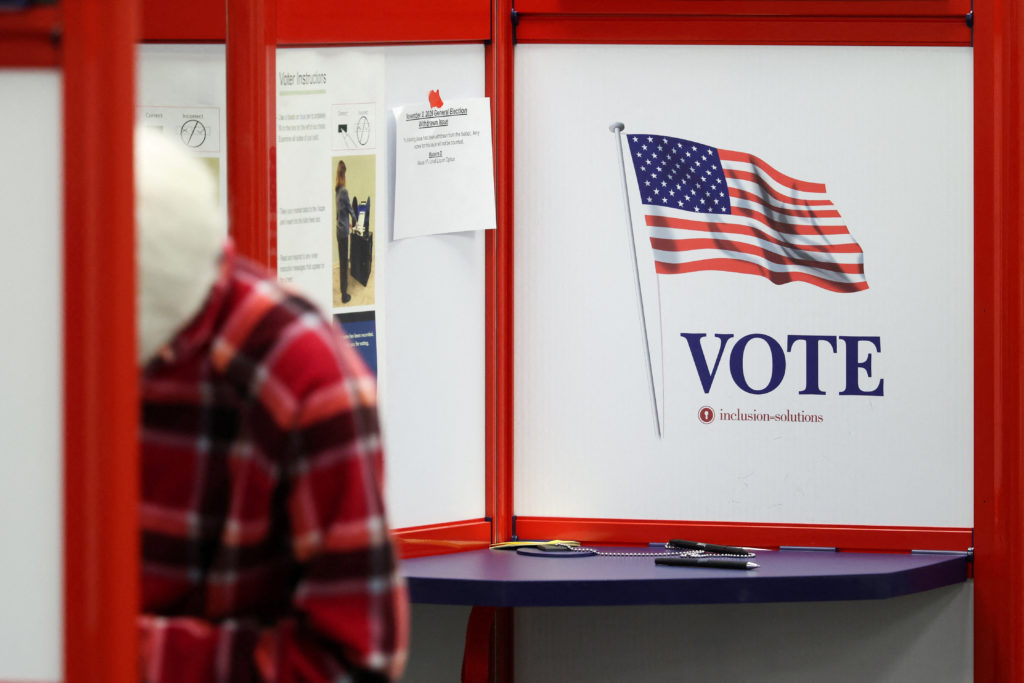
The midterms are also showing signs of being a change election, as voters say they are looking for something different. File photo by Samuel Corum/Pool via Reuters
For likely voters heading into the election, there are two issues that are top of mind: the cost of living (34%) and preserving democracy (33%). Immigration, which has been central to Trump’s second-term agenda, trails at 12%. No other issue reaches double digits.
The parties rank their priorities differently. Likely Democratic voters put preserving democracy at the top of their list (43%), followed closely by the cost of living at 39%. Republicans rank the cost of living first (31%), then democracy (23%) and immigration (20%).
READ MORE: A guide to the key ballot measures voters will decide on Election Day
Americans’ focus on affordability has worked in Democrats’ favor. In a September PBS News/NPR/Marist poll, 42% of registered voters said Democrats would do a better job handling the economy, while 34% said Republicans. Democrats had a 19-point advantage on the issue with independent voters.
Who ultimately turns out to vote will matter when it comes to understanding the electorate’s motivation. Among all registered voters, the cost of living leads the issue of democracy by 10 points. Among likely voters, that gap all but disappears – a sign that voters most focused on democracy are also the most motivated to show up.
For many voters, cost of living pressures aren’t abstract. This poll found that personal economic strain is growing, too. Thirty-eight percent of likely voters say their family finances have gotten worse over the past year, while 15% say they have improved. Among registered voters, the percentage saying their finances got worse rose 6 points since September, while the share reporting a financial hardship in the past year (35%) also grew by 6 points since September.
READ MORE: Trump promised to stop inflation. Now Republicans may pay the price in the midterm elections
The midterms are also showing signs of being a change election, as voters say they are looking for something different. By a 14-point margin, likely voters say it is more important to back candidates with new ideas who will bring change than candidates with experience and a proven record. Majorities of Democrats and independents favor change. Republicans prefer experience.
Democrats hold enthusiasm edge
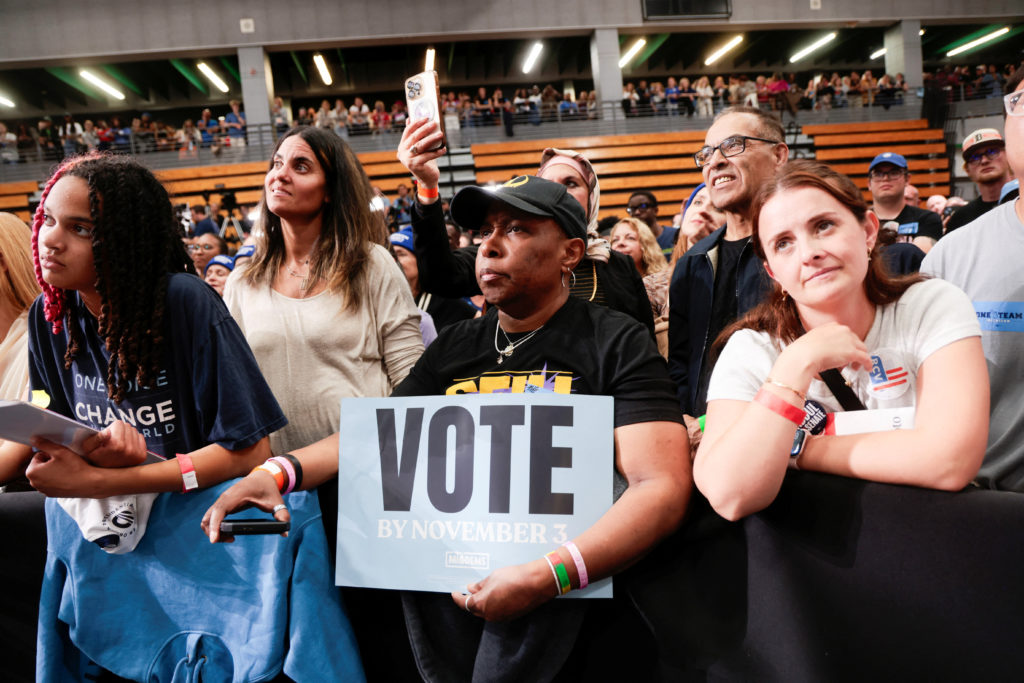
That independents are breaking for Democrats by double digits means Democrats “should have a good night,” said Lee Miringoff, director of the Marist Institute for Public Opinion. File photo by Rebecca Cook/ Reuters
Interest in the midterms is high across the board. Eighty-four percent of likely voters say they are enthusiastic about voting, including 59% who are very enthusiastic.
But the intensity favors Democrats, who lead Republicans 71% to 61% among the very enthusiastic.
“Republicans are demotivated,” Payne said. “They are very clearly demotivated and less excited and less likely to show up.”
Abdul said the enthusiasm gap is to be expected in a midterm election year when the party out of power is more motivated to turn out to vote.
“This is all about a turnout operation,” Abdul said. “That’s why you have Donald Trump going to places he won handsomely and trying to drive out the vote.”
Miringoff said the gaps say more about Republicans than Democrats.
“That’s the gap that the Republicans are feeling – not because the Democrats are so enthusiastic, but I think the Republicans just are hard to drum it up,” he said.
The exception is Trump’s base. More than two-thirds of MAGA supporters say they are very enthusiastic.
For Democrats, younger voters are the biggest turnout risk. Voters under 45 favor Democrats over Republicans by 22 percentage points. At the same time, 42% of that age group say they are very enthusiastic about voting, compared with 68% of voters 45 or older.
Payne said the way to reach younger voters is on economic issues.
“I think young voters are a lot more in the crosshairs for economic things now than maybe they ever have been,” he said. “There’s one thing to disagree with what a president is doing. It’s another thing to feel like they’re doing that thing to you.”
The latest poll also found that campaigns still have a lot of ground to cover in the sprint to Election Day.
WATCH: Campaigns spend big to sway voters with increasingly personal attack ads
Ad spending over the course of the 2026 midterm cycle has topped $10 billion and is still growing, according to AdImpact data, which puts it on track to be the most expensive election cycle in American history.
Yet despite the abundance of money and advertising, 39% of likely voters say no campaign, party or civic group has contacted them to encourage them to vote.
Democrats appear to be reaching more of their voters: 66% of Democratic likely voters say they have been contacted, compared to 57% of Republicans and 55% of independents, despite Republicans outspending Democrats in key battleground races.
Abdul said local Republican committees are working to turn out voters, but national Republicans, including the RNC, are “simply not doing enough to galvanize voters.”
Most voters aren’t buying Trump’s election alarmism
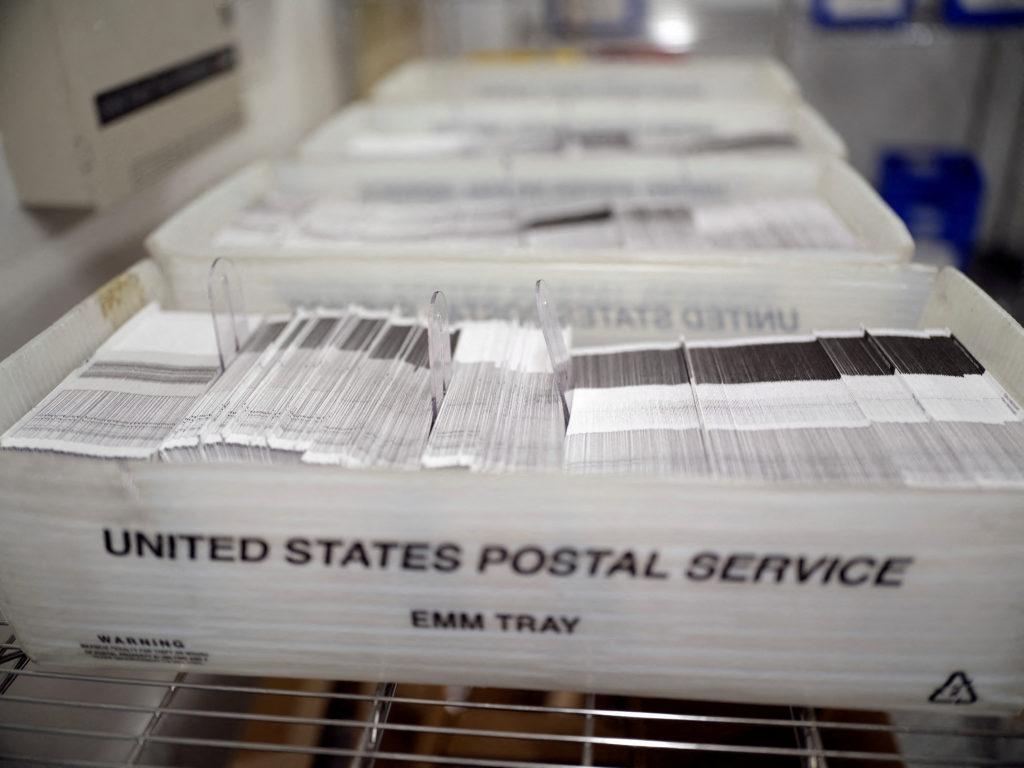
Ballots for the upcoming midterm elections await processing before delivery by the U.S. Postal Service inside a secured room at the Durham County Board of Elections in North Carolina, on Aug. 31, 2026. File photo by Jonathan Drake/ Reuters
Trump has spent much of the year casting doubt about the integrity of voting and the midterm elections. Most voters aren’t buying it, this poll found. More than three-quarters of likely voters are confident their state or local government will run a fair and accurate election.
After months of attempts at restricting mail ballots through executive actions, statements encouraging Republicans to “nationalize the voting,” and suing dozens of states for their voter rolls, the pressure has only escalated in the campaign’s final weeks.
Last week, under orders from Trump, the Justice Department sued to block Alaska from certifying its U.S. Senate race if Republican Sen. Dan Sullivan loses to Democrat Mary Peltola. The suit argues that a second Republican on the ballot, Daniel J. Sullivan, is running a campaign meant to confuse voters. Election law expert Derek Muller, a professor at Notre Dame Law School, wrote that the DOJ’s legal argument “is one of the worst ones I’ve ever seen.”
WATCH: Trump says he ordered suit to block Alaska Senate results if GOP loses
Eight in 10 likely voters say a candidate who loses should accept the results, up 10 points from just before the 2024 presidential election. The share saying a losing candidate should definitely challenge the results has been cut from 13% to 5%.
Miringoff said the bigger cost of Trump’s attacks on the system may be among independents, who “were much more Trumpian and much less so now.”
“Independents have been chased away,” he said. “So when he goes out stirring the MAGA base and saying, ‘rigged, rigged, rigged,’ that doesn’t do any good for independents.”
Voters are also locking in their election plans. Beyond the 21% who say they have already voted, 40% plan to vote on Election Day, 25% plan to vote early in person and 12% plan to vote by mail.
In California, the DOJ sued this month to stop the state from counting mail ballots from people who the federal government says are “likely” noncitizens, citing a list of 20,000 names. California’s secretary of state says the administration has offered no evidence for that claim, and a federal appeals court blocked the DOJ effort on Monday. The DOJ made a similar accusation this summer of nearly 16,000 likely noncitizen voters in Nevada. Further investigation found every name initially flagged was a citizen.
READ MORE: Trump administration asks Washington state to set aside ballots from 400 voters it says may be noncitizens
After years of Trump’s attacks on mail voting, just 6% of Republicans say they will vote that way, compared to 15% respectively of both Democrats and independents.
Abdul, who supports Trump, said that on widespread voter fraud, “they’ve had plenty of times to come up with some evidence of that and they don’t have it.”
He warned that Trump’s claims could backfire, pointing to Georgia’s January 2021 Senate runoffs, which Republicans lost after Trump insisted the 2020 election had been stolen.
“Donald Trump has said over and over again that this system cannot be trusted. And now he’s asking these people to go out and participate in that system,” Abdul said. “We’ll see on Nov. 3 how much that suppresses the GOP vote.”
PBS News, NPR and Marist Poll conducted a survey from Oct. 19 to 20, 2026, that polled 1,280 registered voters by phone, text and online with a margin of error of 3.7 percentage points. Likely voters were determined by each respondent’s estimated probability of voting with a likely voter margin of error of 3.8 percentage points. For Democratic likely voters, the margin of error is 6.7 percentage points; Republicans, 6.8 percentage points; independents, 7.0 percentage points.
A free press is a cornerstone of a healthy democracy.
Support trusted journalism and civil dialogue.