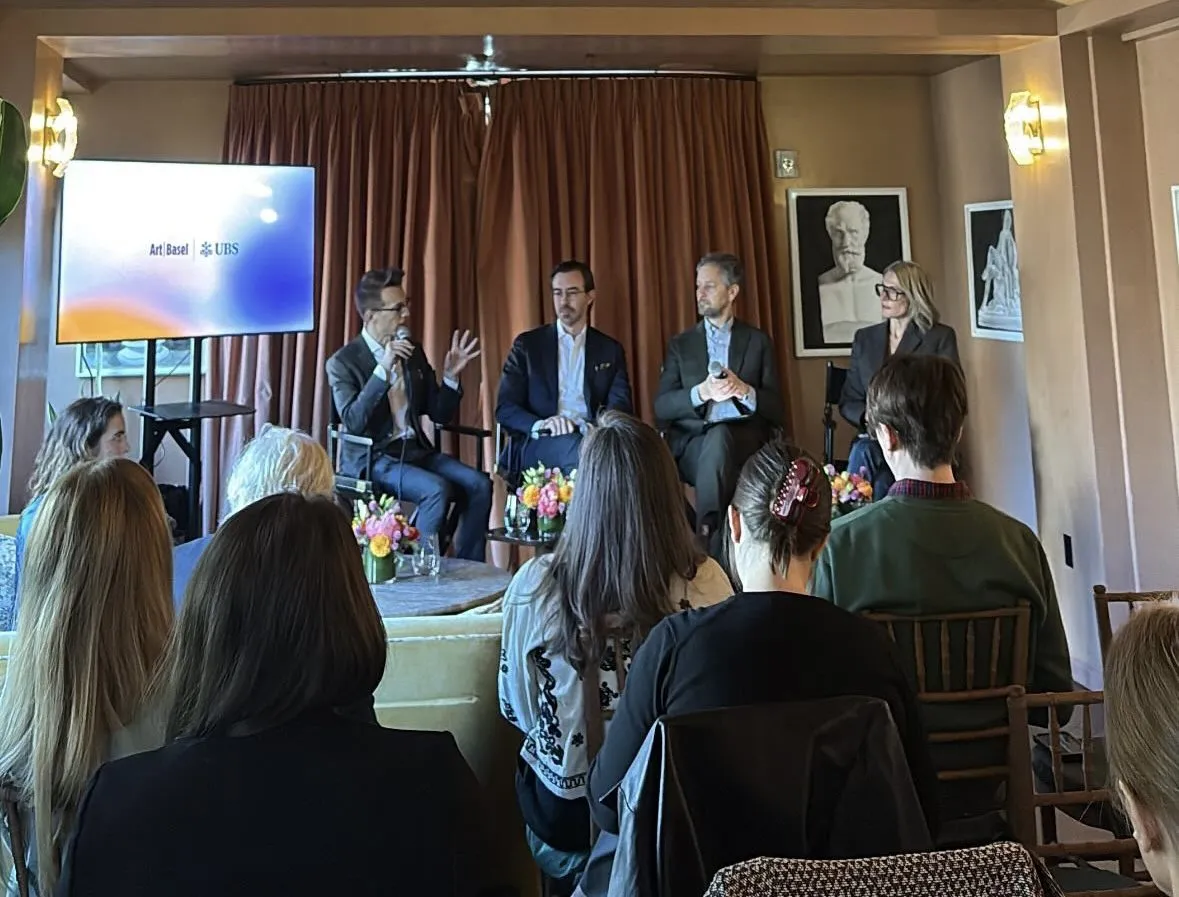
If the most visible effect of the Great Wealth Transfer on the art world so far has been the parade of major 20th-Century collections hitting the block and lifting the very top of the market, the Art Basel and UBS survey on global collecting, released today (Oct. 8) after a preview at the Ned NoMad earlier this week, reveals deeper changes underway as a younger collector base emerges with a very different set of behaviors and preferences.
More than $83 trillion is expected to pass between generations over the next 20 to 25 years, yet according to the report, Gen Z collectors already rank among the art market’s top spenders, reporting the highest activity across categories and market tiers, with wide-ranging habits that span painting and sculpture, digital art and luxury collectibles.
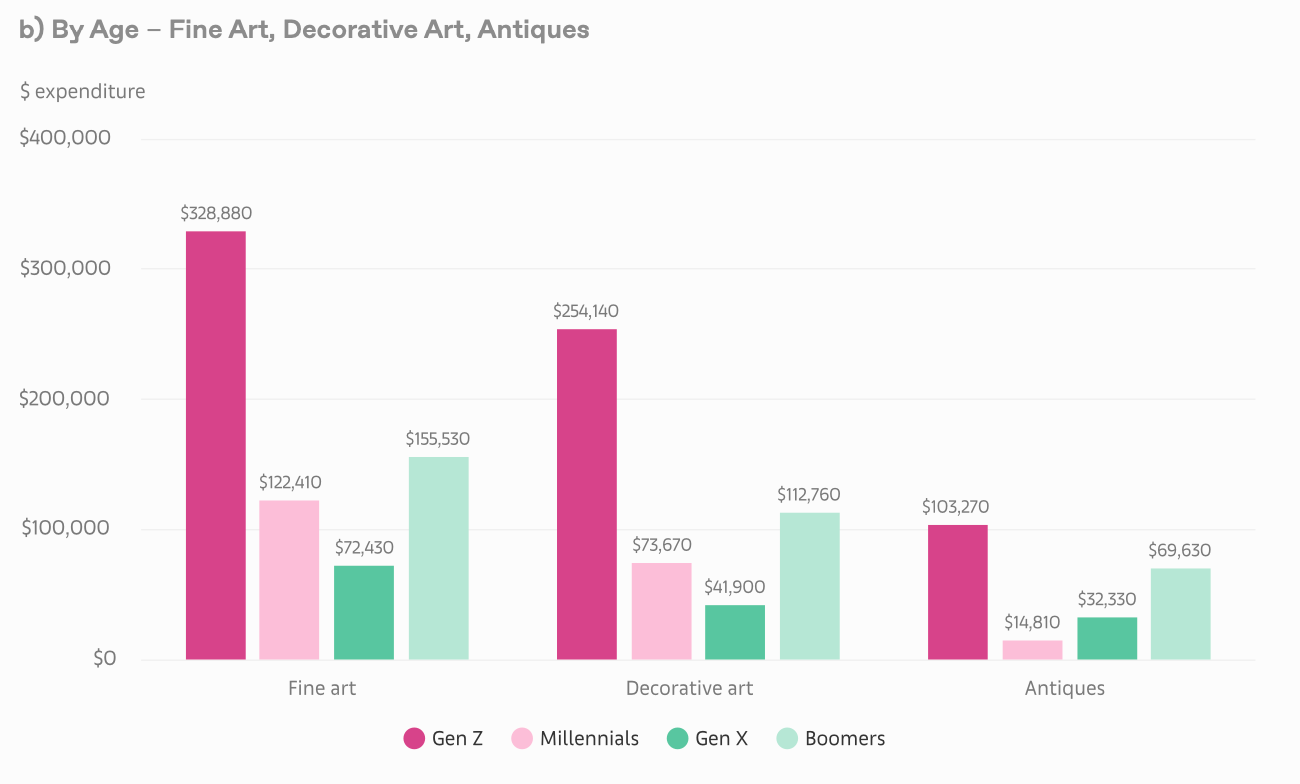
While the average fine art expenditure among high-net-worth individuals (HNWIs) rose to $124,265 in 2025, up 13 percent from 2024, the Gen Z average was $347,460, up 19 percent. In a sign of renewed confidence, average expenditure in the first half of 2026 alone exceeded the full-year 2025 figure, with Gen Z spending more than double their older peers. Activity across all ages was concentrated at lower levels, with 77 percent of HNWIs keeping their total fine art spending in the first half of 2026 below $50,000 and 84 percent below $100,000, yet Gen Z stood out among those who had spent more than $1 million on fine art in the same period, versus 3 percent of collectors overall. Quality, not only volume, drives their collecting. Younger collectors remain the most open to discovery, with 56 percent of Gen Z buying work by an unfamiliar artist versus 36 percent of Boomers, but the share of all collectors who reported buying a newly discovered artist’s work fell to 45 percent in 2026, the lowest level in five years.
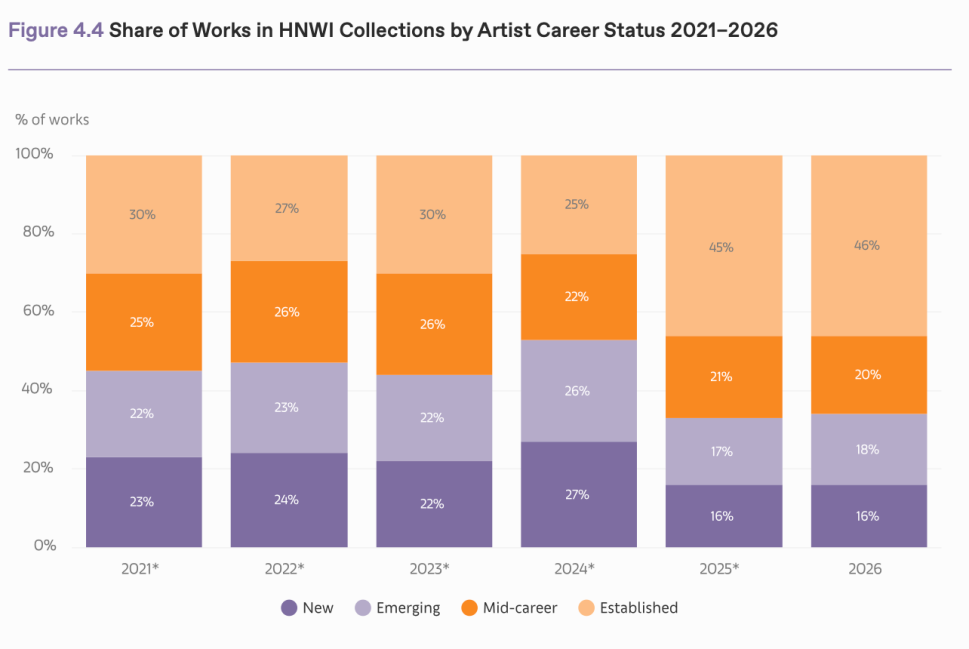
Across generations, tastes have shifted toward established names with solid, institutionally backed CVs. Established or top-tier artists, those with a strong secondary market at auction or in galleries and selling regularly above $100,000, accounted for 46 percent of the works in collections, up one percentage point from 2025 and up from a low of 25 percent in 2024. Another 20 percent were by mid-career artists who have shown in galleries or museums for more than 10 years, 18 percent by emerging artists with representation and 16 percent by newly emerging, unrepresented artists.
Even as a younger demographic moves the market, traditional mediums remain the most popular: 76 percent of buyers purchased paintings, which accounted for 31 percent of total fine art expenditure, while sculpture was the second-largest area of spending, at 15 percent. Works on paper, digital art and new media each accounted for about 9-10 percent of total expenditure.
This generation also loves to move across categories in search of unique objects that contribute to individual storytelling and distinction. The survey confirmed that uniqueness and rarity were the aspects of ownership HNWIs valued most (43 percent), and that they mattered more to younger collectors (48 percent of Gen Z versus 38 percent of Boomers).
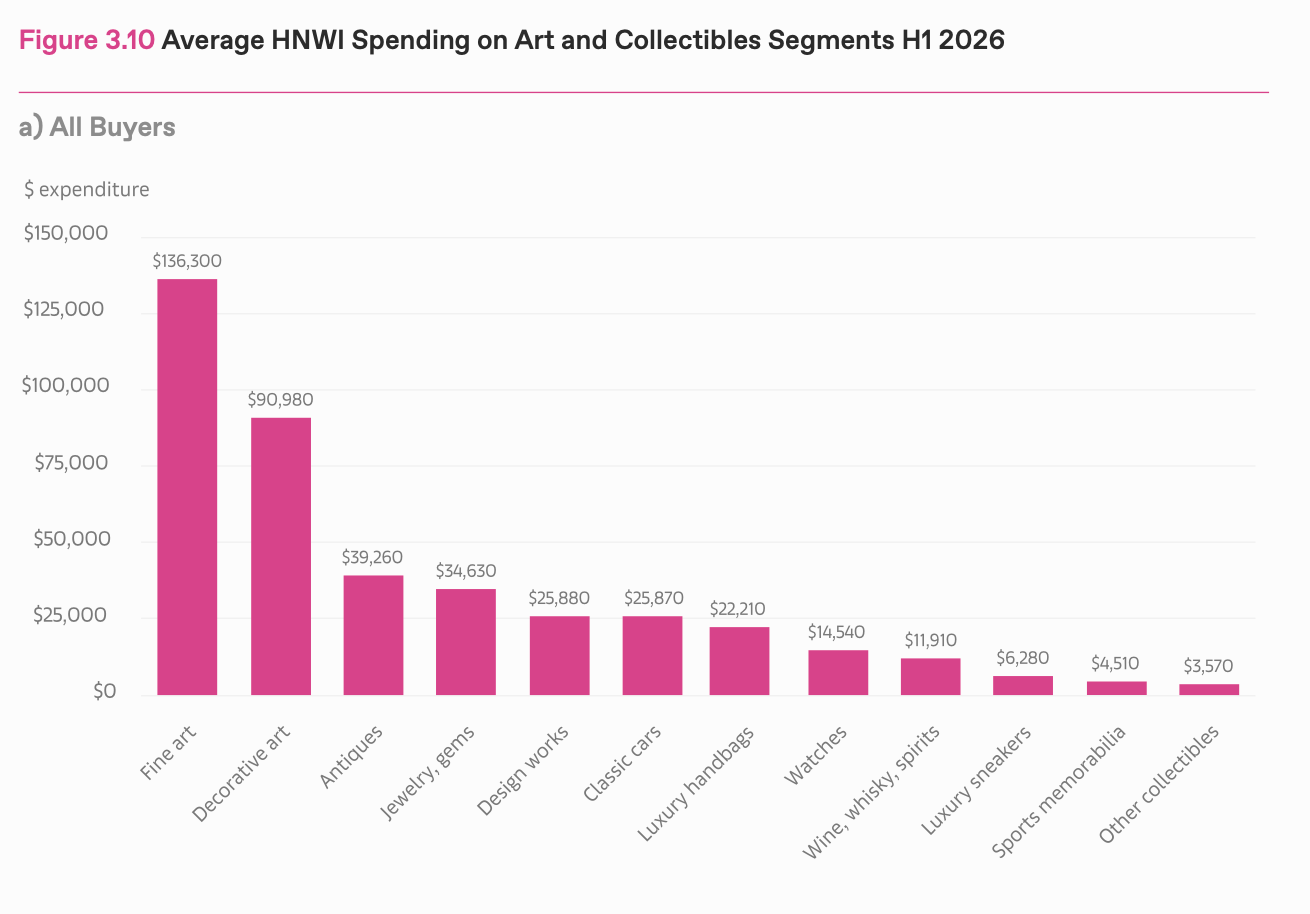
Outside fine and decorative art, the most popular collectibles ranked by participation were antiques (30 percent), jewelry and gems (19 percent), watches (18 percent) and luxury handbags (14 percent), although these categories do not serve as the entry point to art collecting that has often been assumed. Gen Z’s average jewelry and gems expenditure reached $151,310, more than five times that of Gen X. And 42 percent of Gen Z bought in at least two of these categories in the first half of 2026, compared with under a quarter of Millennials and Gen X.
What has changed with the new generations is their behavior and priorities, which often amount to a return to the old values the art ecosystem once ran on: although younger collectors are digital natives, they still prize the quality of in-person exchanges, experiences and relationships.
Despite the multitude of channels available, most transactions still occur through galleries and dealers, with 87 percent of HNWIs buying from a dealer, either directly (75 percent) or at an art fair (62 percent). Dealers also capture the largest share of total spending: 27 percent through direct sales, rising to 46 percent when art fairs (10 percent) and online sales (9 percent) are included.
That appetite for in-person engagement extends beyond transactions. HNWIs expected to attend an average of 44 art events in 2026, down slightly from 46 in 2025 but still above the pre-pandemic average of 41 in 2019. Women reported attending about 20 percent more events than men, while Boomers were the most active generation and Millennials the least. Even those who entered the market through online channels and social media are increasingly drawn to physical events, attending an average of 52, perhaps because those experiences still feel new and exciting.
Gen Z is also better informed and more active in research, given the many channels at their disposal: while 72 percent of respondents undertook moderate or significant research before buying, the figure rises to 80 percent among Gen Z buyers. Digital sources remain the most popular for advice, led by online publications and press (27 percent) and apps or A.I. tools (22 percent, up from 4 percent in 2024). Social media also played a role, with 32 percent citing Instagram or X/Twitter, particularly Gen Z and women. Collectors are broadly optimistic about A.I., especially for artwork discovery (67 percent), personalized recommendations (66 percent), provenance and authenticity checks (65 percent) and pricing and valuation analysis (64 percent).
Against the backdrop of the much-discussed strain on the traditional gallery model and the growing fluidity of roles across the ecosystem, the share of collectors buying directly from artists rose again this year, up six percentage points to 69 percent. This included purchases from studios (48 percent), commissioned works (40 percent) and works bought via Instagram (38 percent).
The trend also reflects a broader desire, particularly among younger collectors and patrons, to play a more active role in the ecosystem, supporting an artist’s work and career well beyond ownership. As recent reports and our own interviews have shown, collecting is expanding into more sustained forms of patronage, with buyers funding production, research and opportunities while becoming more directly involved in the communities and institutions they support.
That shift is visible in their plans. While 23 percent of HNWIs intend to donate works to museums or charities over the next 12 months—rising to 30 percent in the U.S. and 27 percent in France—another 28 percent plan to support artists through prizes, mentorships or residencies. A further 26 percent intend to establish a foundation or private museum, now the most popular philanthropic measure among Gen Z collectors, at 29 percent.
The narrative of art as a financial asset and investment tool, by contrast, has almost completely faded among younger buyers. They remain aware, however, of its potential as financial leverage, particularly when it frees up liquidity to buy more art (53 percent) or to cover maintenance and storage costs (50 percent). Some 19 percent intend to use artworks as loan collateral in the next 12 months (30 percent in the U.S.), while around 20 percent report having borrowed against their art (45 percent in the U.S.), more than three-quarters of them securing over $1 million and 15 percent more than $25 million.
Geographically, the largest shares of new collectors, those collecting for five years or less, were in the U.S. (41 percent) and the U.K. (32 percent), while Japan (7 percent), France (10 percent), mainland China and Germany (both 12 percent) had more established collector bases. Japan also had the highest share of long-term collectors, with 14 percent collecting for more than 20 years, double the 7 percent average across all markets.
The push-pull between community and privacy
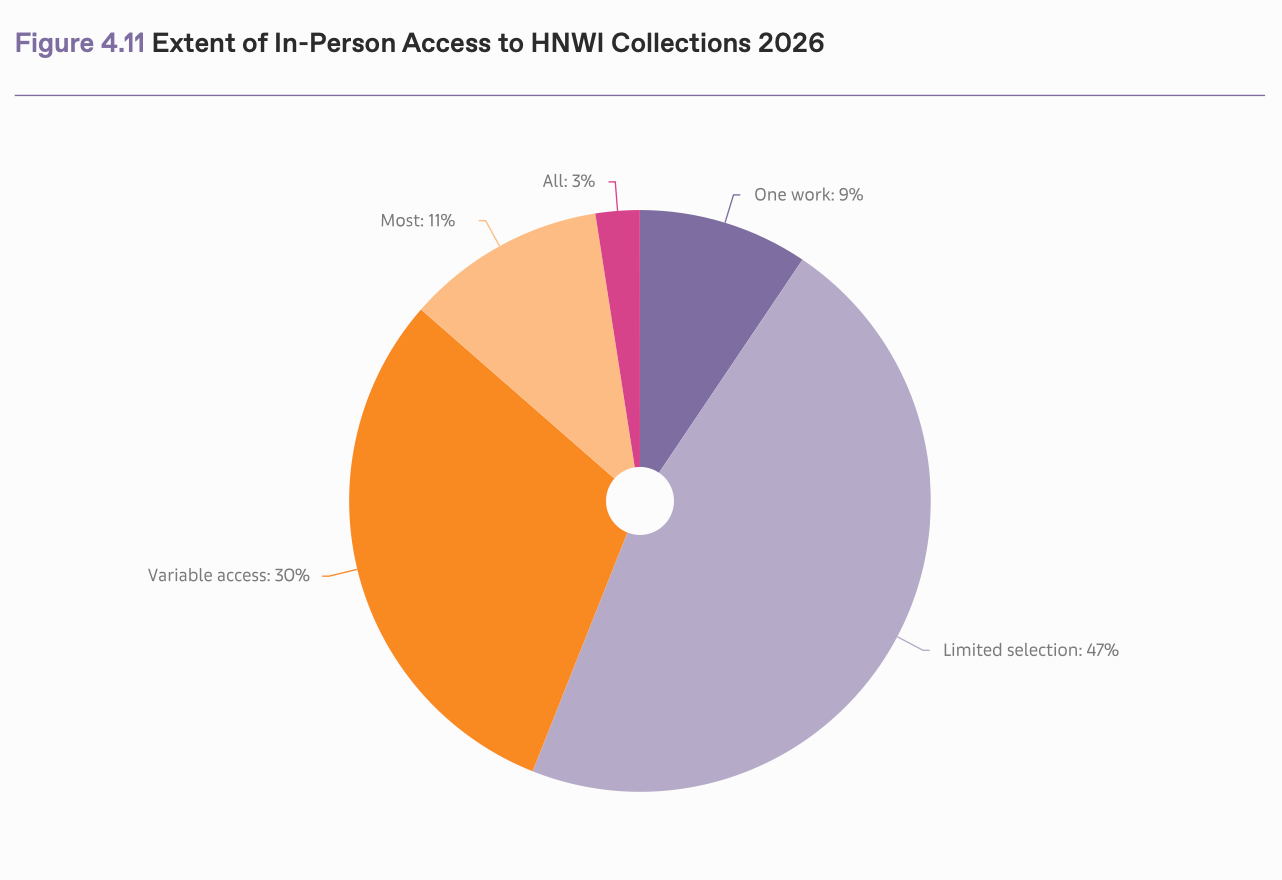
Another surprising finding is that younger collectors, particularly Gen Z, are far more private about their holdings. This is part of a broader trend: 22 percent of HNWIs have restricted access to their collections over the past 12 months, 15 percent limiting it to their immediate household and 7 percent to close friends and family. Gen Z cares most about privacy, with 39 percent restricting in-person viewing of their collections to their households or close family and friends, almost twice the share of any other generation. They are also now the most private online, with 36 percent keeping content within private circles and 42 percent relying on restricted or invitation-only group sharing.
If previous reports revealed a desire to share their collections and collecting journeys, these collectors want to do so only within the peer communities they have selected and cultivated, not with everyone. As other reports confirm, peer-to-peer mentorship and personal networks remain important entry points and ongoing compasses for next-generation collectors. Family influence remains the most common route into collecting for HNWIs (28 percent of respondents and 40 percent of Gen Z), but others found their way in through later experiences: visits to museums, galleries and fairs were the second most common starting point (22 percent), followed by financial interest (14 percent), friends or peers (13 percent), online discovery (13 percent) and work or studies (10 percent).
As Art Basel CEO Noah Horowitz emphasized during the panel, the art world and its market remain an essentially people-driven ecosystem: “Everybody needs a friend, a family member, some inspirational person that drags them along and gets them into a gallery, into a museum, at a dinner where you just meet awesome and inspiring people, and you kind of catch it. That’s pretty fundamental.”
Rather than privacy for its own sake, the shift reflects how differently social reputation operates today compared with the age of the great American patrons now exiting the scene. Another finding that the report’s author, cultural economist Clare McAndrew, emphasized during the panel is an overall decline in collectors’ need to signal reputation or social status publicly through ownership. Only 10 percent said they sought broad recognition for buying art or for being known as collectors. Most preferred to keep their collections relatively private: 30 percent favored complete anonymity when lending to a museum, while 47 percent wanted only limited recognition. Just 17 percent sought full public acknowledgment when lending or donating works to an institution.
If that trajectory continues, even the long-standing museum convention of naming galleries after donors and their families may feel out of step—it’s a practice that has at times proved awkward when institutions distance themselves from benefactors whose reputations have soured.
Women and collecting: another perspective
As every expert at the New York presentation highlighted, an estimated 70-75 percent of the historic Great Wealth Transfer is projected to flow to women, driven primarily by longer life expectancy and horizontal spousal inheritance. Women’s share of billionaire wealth has risen steadily, from 5 percent in 1996 to 10 percent in 2005 and 13 percent in 2026, and is expected to keep growing as these demographic trends and wealth transfers gain momentum. There are regional variations as well: women hold a greater share of billionaire wealth in Oceania (20 percent), South America (18 percent) and Europe (17 percent) than in North America (13 percent), Asia (10 percent) and the Middle East and Africa (9 percent).
The key point, according to the report and consistent with similar studies, is that women approach collecting very differently, acting more on instinct and intuition, supporting more women artists and thinking longer term. The survey found that women collect more broadly and boldly than men, with higher participation across every medium, category and price tier. They proved less risk-averse in practice and more inclined to support emerging voices, which accounted for 36 percent of women’s collections versus 33 percent of men’s. Photography and digital art are also more popular in women’s collections than in men’s.
As for other collectibles, men outspent women on antiques, jewelry and gems, watches, wine, whisky and spirits and sports memorabilia, while women spent more on design, classic cars and luxury collectible handbags and sneakers. The biggest change in taste, however, is that women are actively collecting to close the gender gap. While works by male artists still outnumber those by female artists in HNWIs’ collections (56 percent versus 44 percent), women’s collections held a higher share of works by female artists (46 percent).
There is still considerable ground to cover. Works by women remained a minority in collections in every region, ranging from 40 percent in Hong Kong to 47 percent in Germany. The largest gains came in the U.K., up four percentage points to 46 percent, and Brazil, up three points to 43 percent, while the sharpest declines were in Hong Kong, down five points to 40 percent, and the U.S., down three points to 45 percent.
As Matthew Newton, head of Art Advisory Americas at UBS, pointed out, women collectors are also more inclined to think in terms of stewardship and legacy, particularly after inheriting a collection. “Most of my conversations around those generational topics are with women collectors who are thinking about what is going to be the impact of this collection long term, and how their family is going to activate this collection over time,” Newton said.
Horowitz confirmed that the change is visible at Art Basel, both in who attends the fairs and in who makes acquisition decisions, with women’s participation in events now outpacing men’s by double digits: “We have seen the change: there are more females, they are younger, they are more self-made, and what we’re seeing in data here is that they also have a high proclivity to spend. They’re spending wide.”
These demographic changes carry more weight because the generational transfer is unfolding through a more conversational, collaborative decision-making process. As Christl Novakovic, head of UBS Global Wealth Management EMEA, notes in the foreword of the report, shifting family dynamics and a new level of information and preparation have led women and younger family members to take a more prominent role in discussing and planning the future of their family’s wealth.
It is worth remembering, as McAndrew herself noted during the presentation, that the survey reflects a very narrow pool of 3,100 respondents with disposable household financial assets exceeding $1 million in 2026, excluding real estate and assets held in private businesses. “They have to have that million themselves. That’s not their family wealth; it’s their own personal wealth. And then they have to have spent a certain amount in the market for the last couple of years,” she clarified.
The sample is thus drawn from the world’s millionaires, a small group that makes up less than 2 percent of the adult population but controls a growing share of global wealth (48 percent, according to UBS estimates for 2026). A key criterion for including Gen Z respondents was that the wealth was already in their hands, not merely set to be passed on, and that they had full control over its use.
From art fair to experience platform
Beyond the report’s nearly 300 pages, one of the most interesting takeaways from the presentation was how explicit Horowitz was in describing how Art Basel is adapting to the behaviors and priorities of the new generation leading the market. Across several of his remarks, he emphasized engagement, storytelling and a fully curated experience for this audience, framed increasingly in terms of hospitality rather than trade, and often in collaboration with other industries. The message was that Art Basel is adapting to today’s experience economy, evolving from an art fair into an experience platform that offers different levels of access and engagement.
“We have to meet audiences in a more proactive and thoughtful and, frankly, more human and humble way,” Horowitz said, openly acknowledging that the mystique and snobbish detachment that long defined the art business no longer work. “… the market needs to move and evolve as an ecosystem. The through line is that anybody in the art market needs to be people-first. It is a people-first business. Everybody has to be more proactive and intentional about what they do and how they do it.”
Art Basel is accordingly reshaping itself from a primarily transactional fair into a broader, year-round experience ecosystem. Horowitz described how it has been remapping its VIP and audience touchpoints through artist studio visits, artist-led tours, major-project programming, digital initiatives, editorial content and platforms such as its awards program, while becoming more deliberate about hospitality as audience expectations rise in step with those set by sports, luxury and other cultural events.
“As hospitality has raised this bar, we need to adapt our platform to beat that,” Horowitz argued. “Ultimately, this is to try to put our galleries and their artists in the best place possible to get in front of existing clients, but also attract these and newer clients that are increasingly coming to fairs and treat these events as touchpoints for discovery and for acquisitions.”
Beyond the fairs themselves, Art Basel is developing slower, more intimate moments of engagement within what Horowitz described as “Art Basel IP and brand”—such as its Aspen programming in collectors’ homes—and working with partners on activations in private residences, salons and host cities, all of which feed into what he calls the larger “fair-week experience.”
“It’s all in keeping with looking at the fairs not just as transactional moments within the halls of the fair, but at the overarching fair-week experience and what happens in the cities on an overarching basis, which is extraordinarily compelling and allows us to tell stories and ultimately advance markets for artists in more complex but ultimately more thought-provoking ways,” Horowitz said at one point.
If this is the profile of the new art audience, the fair can no longer be understood as a few days of concentrated transactions. It must operate as a people-first platform that sustains discovery, storytelling and connection between the peak moments of the calendar. This matters especially for Gen Z and younger collectors, he suggested, who seek meaningful, bespoke experiences in which buying art is only one part of a broader cultural journey, making hospitality, digital guidance and access to artists and local scenes central to how Art Basel now builds audiences: “As an industry, we need to figure out how to fill that interstitial space, how to create value moments, and ways to build artists’ brand reputations and ultimately create meaningful moments of connectivity for these wide-ranging, art-loving audiences to the great galleries and the great artists of our generation.”
In this sense, Horowitz positioned the fair not as a simple trade floor but as a branding and marketing launchpad that helps galleries reach new audiences, taking on the role of the “media business” that new buyers and the experience economy increasingly demand. It marks a significant shift in narrative, strategy and the dynamics of value creation, one that can encourage genuine investment in the arts at different levels and among different stakeholders, even beyond collecting.