
I graduated from college in 1982. Social Security was broken at the time, with promised payments exceeding income. Since the system was “fixed” in 1983, the trajectory has been clear to me. I will pay into the system of all working life, first to support those who have retired or soon to retire in the 1980s, but also to build a “trust fund” that will help to finance benefits for those who retire in the early 2000s. However, by the time I reach retirement age, even though I’ve already paid for it, Social Security will be broken again, with promised payments exceeding future earnings by about $29 trillion over the next 75 years, according to actuaries.
In a just and virtuous universe, politicians would be caught in the crossfire over how they would prefer to solve this problem—because a lack of answers means, under current law, a 22% cut to all Social Security benefits starting around 2032. Public promises that benefits will not be cut are not enough. The question is the actual combination of tax increases or benefit cuts that politicians will support.
Mark Duggan attempted to open this conversation in “Social Security Reform in an Era of Fiscal Deficits,” which he presented as the 18th Annual Feldstein Lecture at the National Bureau of Economic Research last July (Journalist: NBER, 2026, Number 3, video available).
Some of Duggan’s talk has an undertone of frustration, as Social Security’s impending bankruptcy has been obvious to anyone who has been paying attention for decades now. A relatively small change, which was made a few decades ago, will now be the solution that will keep the program going for decades. For example, Duggan points out that the biggest step taken in 1983 was to gradually increase the date for full retirement benefits, from age 65 to 67. (Other steps in 1983 included accelerating some of the scheduled payroll tax increases and implementing Social Security benefits for high earners.) in 1983. The full retirement age could have been nudged back further, or other steps taken, in the last few decades. But in this area, broad bipartisan compromise is one of abandonment.
Here are some snapshots from Duggan’s talk. This figure shows the annual deficit and surplus for Social Security over time. You can see the annual deficit leading up to the 1983 reforms, then the annual surplus when the trust fund was built, the annual deficit as the trust fund was drawn down, and the deficit to come.
If we start from the baseline that existing Social Security recipients should not have their current benefits reduced, then the question is how to fill the gap. Duggan discussed some possibilities in his talk; here, I will only list some of them, with a sense of tradeoffs.
The government can use general tax revenues to fill the gap. However, total US government debt relative to GDP has risen to historically high levels, leaving no tax revenue to spare. Also, this policy means changing the core definition of Social Security from a contributory system, where benefits are based on payroll taxes paid, to a system partially funded by general tax revenues.
While an outright cut in benefits appears politically impossible, there are a number of measures that have the effect of cutting benefits. For example, the full retirement age can be pushed back a year or two. The formula for calculating Social Security benefits, which involves looking at your highest 35-year earnings and then applying the formula, can be adjusted. The annual inflation adjustment for Social Security benefits can be tweaked. As Duggan points out, public pension payments in the US tend to be higher than in other countries.
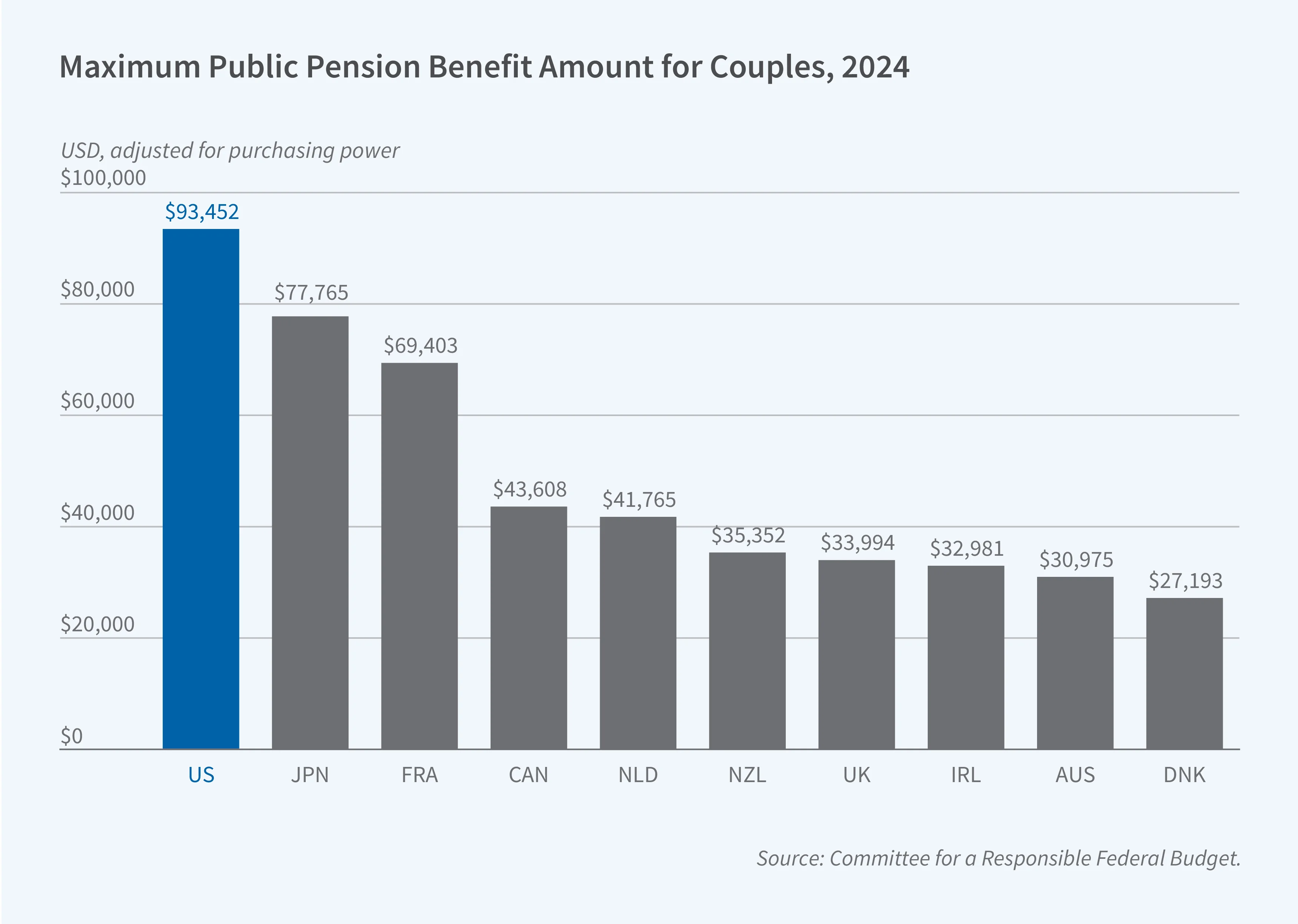
On the tax side, the 12.4 payroll tax rate for Social Security (half is charged directly to workers, the other half is indirectly charged to workers through employers) has not risen since 1990. Duggan noted that Social Security actuaries estimate that the rise to 17.3% will keep the program solvent until 2100. implemented in Medicare in 1994. While this would eliminate a fraction of the funding gap (which is considered a “pure tax” that does not increase Social Security benefits), it would push the marginal tax rate over 60 percent for many high-income individuals in states with relatively high state tax rate increases and thus would reduce the tax rate in the state of California and thus would reduce the tax rate of other states’ individual income taxes.”
It’s not hard, sitting at the desk, to fiddle with some combination of these options and figure out a plan I can live with. But Duggan notes a fundamental problem: “The current Social Security structure is not designed to deal with the economic effects of significant changes such as declining fertility, rising life expectancy, declining immigration, rising income inequality, and a declining share of labor income.”
The arithmetic of Social Security reform is unforgivable. If I had to guess, the first refuge of politicians is to appoint a commission. Failing that, the second refuge is to use general tax revenue. Along the way, I fear that the possibility of redesigning the form of Social Security will be lost. After all, when Social Security was enacted in 1935, the U.S. economy was very different. Private pensions are rare, and 401k and IRA contributory retirement accounts don’t exist yet. Perhaps the next revision should, like the 1983 reform, not make changes for those aged 46 and older, but for all the people of the United States should start a phase in the next few decades of the public / private pension system, where the public system will provide universal benefits but at a low level to ensure that no elderly person experiences the highest poverty.