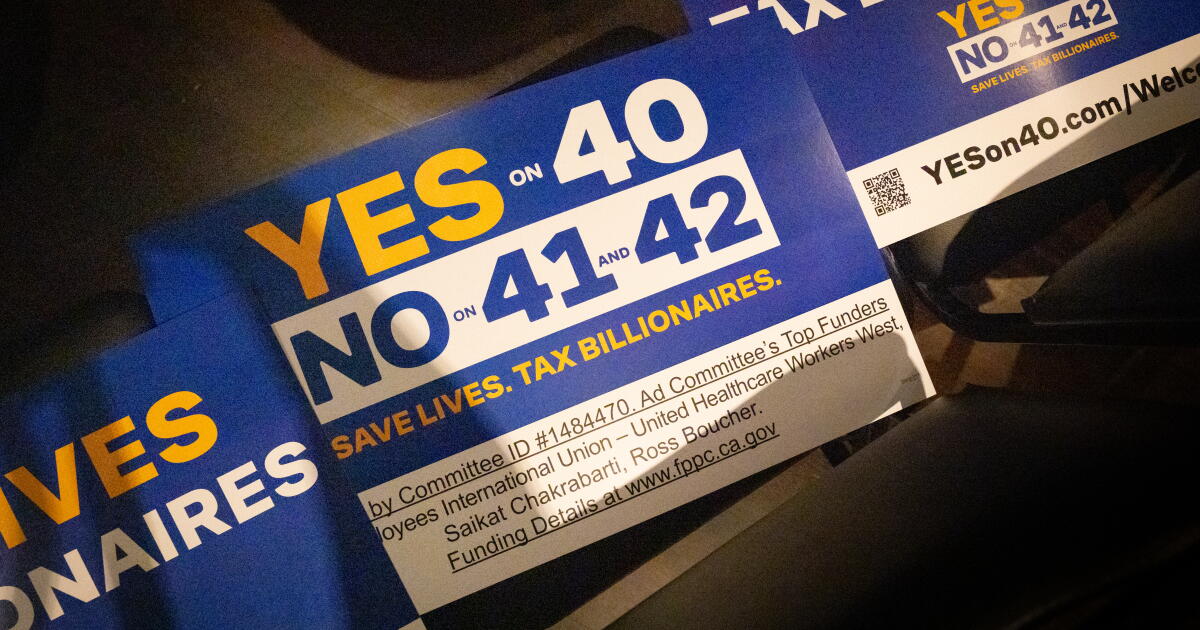
The fate of a controversial ballot measure to impose new taxes on California’s billionaires, a measure proposed as a lifeline for the poor and criticized as a threat to the state’s fragile economy, appeared to be lost in early election results Tuesday night.
California voters also rejected another controversial measure, Proposition 39, which would have required voters to show identification at the polls and required election officials to verify that all registered voters are U.S. citizens.
The billionaire tax, known as Proposition 40, would impose a one-time 5% tax on billionaires’ assets to raise about $100 billion to help millions of Californians destined to lose health insurance due to federal funding cuts. Two separate ballot measures, Proposition 41 and Proposition 42, aim to eliminate the wealth tax, but the results remained too close Tuesday night.
While supporters of the billionaire tax made no concessions late Tuesday, they acknowledged they faced a tough spot in the campaign with the huge spending stacked against them and warned people would die if the measure failed.
“If we don’t succeed in passing Proposition 40 tonight, if Sacramento fails to provide real solutions to the health care crisis incited by the President of the United States, [federal government]this bill actually lets billionaires pay their fair share, and then California’s health care workers are going to be back on the ballot in 2028 to right the damage and overcome all the lies and deceit and the completely outrageous campaign that we’ve seen,” said Dave Regan, president of SEIU-United Healthcare Workers West, which drafted the proposal.
Voters rejected the Republican-led Proposition 39 at a time when distrust in the integrity of the nation’s election process is growing and voter alarm is heightened by President Trump’s baseless claims that the 2020 election was stolen and his false claims that large numbers of undocumented immigrants, especially in California, are affecting the election.
On Monday, the Supreme Court rejected an emergency appeal by Trump’s lawyers to set aside 20,000 ballots in the state that the White House said may have been cast by non-citizens.
The proposals are among 14 state ballot measures California’s 23.3 million registered voters will be asked to decide on Tuesday, in addition to congressional, statewide and local elections.
The billionaire tax was proposed in response to legislation signed by Trump last year that could cause millions of Californians to lose their Medi-Cal coverage, rural hospitals to close and other health services to be cut unless new sources of funding are found. The proposal would retroactively apply to billionaires who lived in California as of Jan. 1, prompting some to preemptively move out of the state. Ninety percent of the revenue will be used to fund health care programs, with the remainder going to education programs and food assistance.
Proposition 40 is divisive among Democratic leaders because they worry about the impact it will have on the unstable budget of a state that relies heavily on the wealthy. Gov. Gavin Newsom opposes the measure, while state Democrats support it.
Efforts for and against the tax and two ballot measures aimed at repealing it nearly broke state campaign finance records. As of Tuesday, about $425 million had been donated to the three hybrid ballot measures.
The vast majority of the funding was provided by California billionaires, including some of the state’s most powerful tech moguls, who oppose wealth taxes. The campaign centers on three intertwined ballot initiatives: Proposition 40 and Propositions 41 and 42, both of which would weaken Proposition 40 through a series of strategic changes to state tax laws and new spending limits.
Neither man has explicitly said that the billionaire tax would be eliminated if Proposition 40 passes and any of the countermeasures gets more votes.
Proposition 41, which trailed slightly late Tuesday, seeks to cut wasteful government spending and require an audit of new special taxes. But it would also prohibit new taxes that would be exempt from state spending limits. Proposition 42, which is slightly ahead of the curve, seeks to protect state lawmakers from daily taxes on California residents’ retirement funds, personal savings and home equity.
In polls ahead of Election Day, voters appeared to be dividing between the billionaire tax proposal and Proposition 3, which was set to pass Tuesday night. It would make permanent a temporary tax increase for wealthy Californians, primarily used to fund education. The tax would increase state income taxes by 1% to 3% for single filers making more than $360,000, joint filers making more than $721,000 and heads of household making more than $490,000. Voters approved the tax in 2012 and extended it in 2016, but it is expected to expire in 2031.
Voters cast ballots on several other proposals related to local taxes, public financing of political campaigns, a landmark environmental law, housing, the state recall process, the ability of state legislators to divert taxpayer dollars into a state “rainy day” fund, funding for immunology and immunotherapy and restrictions on how community health clinics spend their money:
Several ballot measures were decided Tuesday night:
- Proposition 1 proposed issuing $11.25 billion in bonds to promote affordable housing and was approved by voters.
- Proposition 2, approved by voters, would give state lawmakers more flexibility in state spending by exempting certain tax revenues from state spending limits, allowing them to put them into a “rainy day” fund.
- Voters approved Proposition 37, which would create a down payment assistance program to help middle-class Californians buy homes.
- Proposition 44, which would have required some medical centers to spend 90% of their revenue on patient care rather than overhead and executive compensation, failed.
Among those who are still too close to judge:
- Proposition 4, which would allow state and local candidates to receive public campaign funds if they show broad support and agree to spending limits.
- Proposition 5 is a constitutional amendment that would change the state’s recall process, limiting it to a question of whether to remove an elected official and no longer include the cadre of candidates who wish to replace the politician.
- Proposition 38 would issue $8.4 billion in bonds to support the immunology and immunotherapy fields.
- Proposition 43 would prohibit local governments from imposing special taxes unless two-thirds of voters support it. Current law requires a simple majority vote.
- Proposition 45 would amend the California Environmental Quality Act to accelerate certain housing, water, energy, transportation and other projects deemed critical.