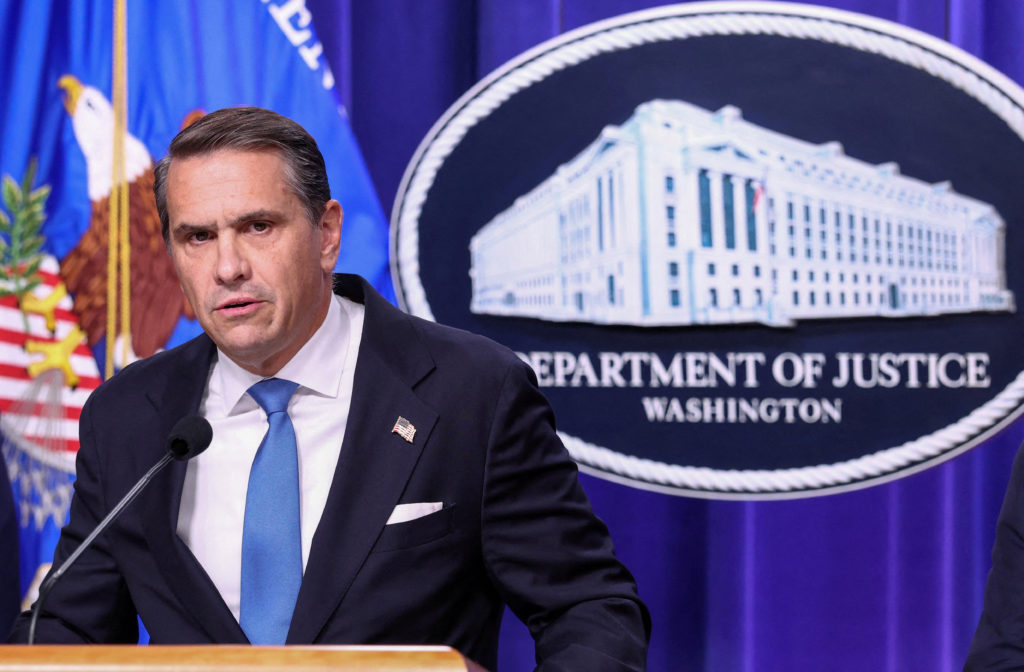
WASHINGTON (AP) — With a crucial and contentious midterm election approaching next week, President Donald Trump’s Justice Department has been busy pursuing a series of headline-grabbing actions and cases that defense attorneys, Democrats and other critics say are no coincidence and are politically charged in timing and targeting.
Read more: Trump administration indicts former FBI Director James Comey for third time
This month alone, the Justice Department has intensified its investigation into Democratic Rep. Ilhan Omar, searching her home; filing criminal charges against two former FBI officials accusing them of falsely downplaying their knowledge of an investigation involving Hunter Biden; unveiling a new attempt to prosecute former FBI Director James Comey; and trying unsuccessfully to prosecute a former White House aide who made 2020 drama over Trump’s successful but dramatic comments.
On top of that, there are lawsuits in Alaska and California related to next week’s vote.
The moves are notable not only for their timing but also because they largely target Trump’s outspoken critics or issues that anger the Republican base.
The Justice Department has also adopted an unusual tactic to hone in on charges, bypassing a grand jury and filing what is essentially a placeholder case against Comey and former FBI officials in the heavily Democratic nation’s capital — something prosecutors have repeatedly struggled to indict over the past year.
Read more: Branch says Trump doesn’t want to interfere with Alaska’s election results by suing Senate race
“Never in the modern history of the Department of Justice has there been such a blatant disregard for time-honored norms and protocols in conceiving or conducting politically sensitive investigations,” said David Laufman, who served as a senior Justice Department official in both Democratic and Republican administrations and helped oversee the Hillary Clinton email investigation.
The Justice Department said in a statement that this was “following the facts and the law, not anyone’s political timeline.”
The Justice Department has historically tried to avoid taking major action before elections
There is a long-accepted practice among law enforcement agencies to avoid taking overt investigative actions against candidates in the weeks before an election or taking other overt steps that might be viewed as an attempt to influence political outcomes.
It’s such a fundamental principle that successive attorneys general issue department-wide memos during election cycles reminding employees not to take investigative actions designed to help or hinder any particular candidate.
In response to questions about recent investigative actions, the Justice Department said in a statement that avoiding public action within 60 days of an election is an informal practice, not a written rule. The department said the approach was intended to prohibit prosecutors from timing their actions to influence the election.
“Standards are the purpose, not the proximity to Election Day. Department policy does not require departments to cease ongoing work during election season,” the department said.
The approach was famously tested in 2016, when then-FBI Director Comey told Congress 11 days before Election Day that the bureau was revisiting its investigation into Democratic nominee Hillary Clinton’s handling of classified information in light of newly discovered emails. Comey said he felt he chose the least damaging option, but his decision-making was harshly criticized by Democrats and the Justice Department’s inspector general.
Attorney General Todd Branch has made no secret of his view that the Justice Department does not exist independently of the White House and insists he is no different from his predecessors in serving the president. He denied that the department’s investigative decisions were political. Even before this month, however, the Justice Department had launched multiple investigations into the president’s opponents.
They include an investigation in Florida that Trump allies hope will prove right-wing theories that former law enforcement and intelligence officials who have spied on the president for a decade are conspiring against him.
The investigation is showing signs of wavering amid massive staff turnover and delays. In recent weeks, investigators have postponed scheduled grand jury testimony from multiple witnesses who discussed the ongoing probe, according to multiple people familiar with the matter who spoke on condition of anonymity to discuss the matter.
A “little sideshow on top of the sideshow”
In one of the most politically subtle moves this month, federal agents raided the home of Omar, one of the president’s most outspoken critics in Congress. She will be on the ballot for reelection Tuesday to represent Minnesota’s 5th District. Federal agents seized Omar’s cellphone during the search and issued more than a dozen subpoenas to a grand jury, including some of her relatives, as investigators looked into issues related to her immigration documents.
Branch defended the timing of the search, which was approved by a federal judge. “I can tell you unequivocally that the decision to seek a search warrant had nothing to do with what happened in November,” he told reporters last week.
The Justice Department later charged two former FBI officials with making false statements to Congress about their knowledge of a laptop it said belonged to former President Joe Biden’s son Hunter. The case emerged from an investigation that began immediately after Trump’s July speech on election security and was ordered by FBI Director Kash Patel, according to Tuesday’s testimony from an FBI agent leading the investigation.
The Justice Department charged the two former officers through complaints rather than grand jury indictments — a move the magistrate judge overseeing the case called unusual. Then, when prosecutors tried to add another charge by filing a new criminal complaint in a court filing, they failed to get the necessary judicial approval to prove probable cause existed, leaving the judge stunned.
“It was all sideshow on top of sideshow,” U.S. Magistrate Judge Zia Faruqui told prosecutors.
On Monday, newly released court documents in a separate case showed that prosecutors are trying to bring the third criminal case against Comey since Trump returned to the White House, accusing him of leaking classified information a decade ago. With the statute of limitations set to expire earlier this month, prosecutors have used an unusual legal tactic to try to extend the time they have to seek a grand jury indictment.
Comey’s legal team called the bill legally invalid and politically motivated and urged a judge to throw it out. The judge is scheduled to hear arguments Friday.
Asked about the latest case against the former FBI director, Trump said this week he knew nothing about it. But the president added, “He’s a dirty cop, James Comey.”
Comey, for his part, didn’t seem surprised. “Well, they’re back again,” he said in a video statement on Monday. “It would almost be funny if this wasn’t such an egregious abuse by the Department of Justice – we can’t be insensitive to this. I haven’t changed anything; I’m still innocent, I’m still not afraid of these people – and I still believe in the independent federal judiciary.”
A free press is the cornerstone of a healthy democracy.
Support trustworthy journalism and civil dialogue.