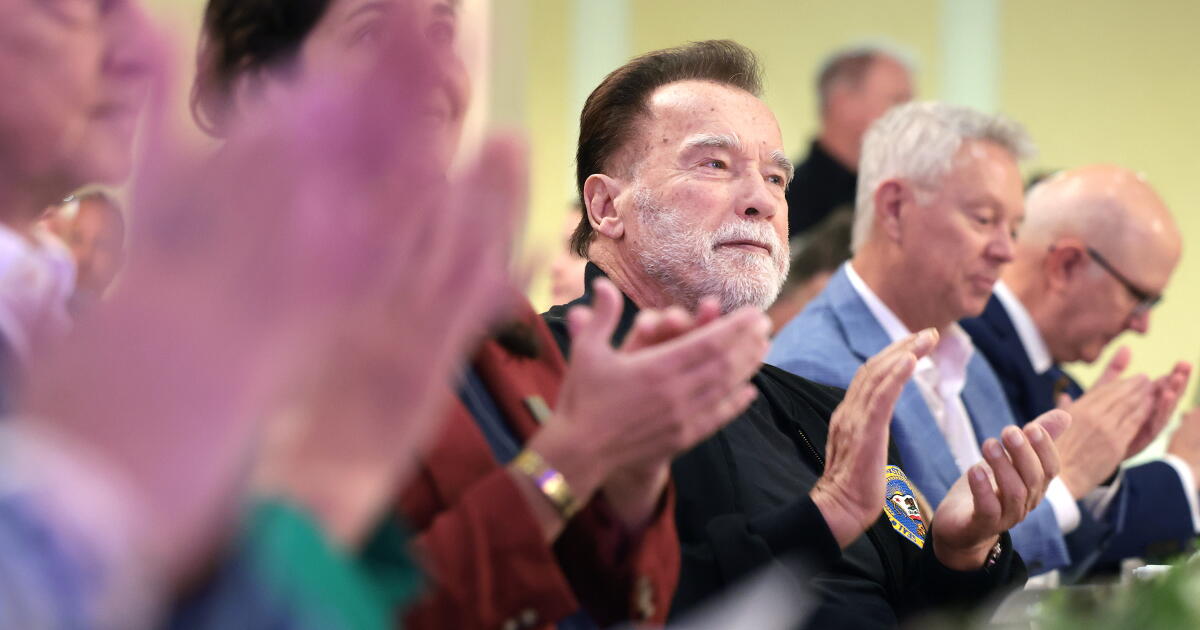
Dozens of California’s most influential lawmakers, environmentalists and policy experts gathered in Los Angeles this month to mark the 20th anniversary of the landmark Global Warming Solutions Act, which put the state on a science-driven path to combat climate change.
Two decades after the passage of the nation-leading law, California is not yet on track to meet its future goals, new data shows.
-
Share via
The passage of Assembly Bill 32 in 2006 launched an unprecedented initiative: a statewide mandate to inventory and curb greenhouse gas emissions. It paved the way for the creation of California’s signature carbon market program, Cap and Invest.
It also called for restoring emissions to 1990 levels by 2020 — a goal California achieved six years early. Annual emissions in 1990 were approximately 431 million tons of carbon dioxide equivalent.
But tougher changes are always ahead, including the next goal: reducing emissions to 40% below 1990 levels by 2030.
California is only about halfway there, with annual emissions set to drop about 4% to 346 million tons by 2024, according to the state’s latest report Greenhouse Gas Emissions Inventoryreleased in September. (Emissions data are released with a two-year lag).
On this basis, California must reduce carbon emissions by an additional 86 million tons by 2030. At the current pace, that means California won’t meet its 2030 goal until 2034, according to an analysis by the nonprofit Next 10. The organization releases an annual report on the state’s progress.

The 2045 target – to reduce emissions to 85% below 1990 levels – is even further off track. The group found that deep cuts of about 8.8% per year will be needed starting in 2030, more than double the current pace.
State officials say the job may be particularly challenging in the current political climate, and that’s not yet reflected in the data.
Over the past two years, the Trump administration has ended federal subsidies for electric vehicles, rolled back strict emissions rules and challenged California’s ambitious electric vehicle sales goals, which were effectively Ban on sales of new gasoline-powered cars 2035.
“The state has made great progress and is on a positive trajectory, with the latest inventory showing a nearly 4% decline in emissions across the state,” California Air Resources Board spokesperson Lindsay Buckley said in an email. “But federal interference in California’s efforts to reduce transportation emissions could derail that momentum, as transportation remains the state’s largest climate and air polluter.”
Emissions reduction efforts have not yet completely stopped.
Next 10 founder F. Noel Perry said the 3.9% cut in 2024 is an improvement from the 3% cut in 2023, “so we are moving in the right direction.” He said 2024 represents the largest annual reduction outside of the pandemic and recession years of 2020 and 2008, when energy use, transportation and economic activity were low.
Stephanie Leonard, Next 10 research director, said emissions reductions in 2024 are also well above the 1.2% annual average from 2006 to 2016, primarily due to lower emissions from clean transportation, clean electricity and households as the state adds more electric vehicles and appliances and more electricity comes from renewable sources like wind and solar. Major investments in battery storage, and new state laws lBalanced plug-in solarshould also help drive action.
Leonard said the next goal will require greater progress in transportation, which still accounts for the largest share of California emissions, and the industrial and commercial sectors including factories, refineries, office buildings, shopping malls, schools and hospitals.
“We do have about 2.8 million [zero emission vehicles] Now on the road, that’s great, but we need more, we need more people taking public transit,” she said.
Buckley said regulators are considering additional actions to reduce transportation emissions and “make sure we stay on track with science and health goals.” That could include tougher regulations or new incentives targeting pollution from cars, trucks and other transportation sources.
She said the California Air Resources Board will further assess the impact of federal drawdowns on the state’s climate goals as part of next year’s scoping planning process.

Tom Steyer, center, reaches out to greet former Gov. Arnold Schwarzenegger during a luncheon at the Fairmont Miramar Hotel in Santa Monica.
(Christina House/Los Angeles Times)
In Los Angeles, recent gubernatorial candidate and clean energy investor Tom Steyer told The Times that the president’s actions will almost certainly affect the state’s trajectory.
“We’ve moved from government subsidies for new clean green technologies to massive government subsidies for fossil fuels,” said Steyer, who spent $5 million to help defeat Fossil fuel-funded ballot initiative Overturned AB 32 in 2010.
But there are affordability issues, including the need for expensive infrastructure upgrades to support the clean energy transition and the fact that most residents in the state still rely on natural gas for their homes and gasoline for their cars.
“We need to figure out how to have a balance on substance so that over time you can achieve your goals and objectives and not be too aggressive and leave people behind,” said former California Assembly Speaker Fabian Núñez, who co-authored AB 32 in 2006 with former state Sen. Fran Pavley.
“We still need to continue to be aggressive in fighting climate change … but how we get there and who we help or hurt in the process is very important,” Nunez said.

Susan Kennedy (left) moderates a panel discussion at a luncheon commemorating the 20th anniversary of AB 32.
(Christina House/Los Angeles Times)
Susan Kennedy, former chairman of the California Public Utilities Commission and chief of staff to the then-governor. Arnold Schwarzenegger said affordability “may be the biggest obstacle to reaching the next level.”
Kennedy said the state’s grid operator has said it needs $62 billion in transmission upgrades over the next 10 years to meet mandated climate goals, and another $50 billion is needed for water infrastructure upgrades and other emergency needs.
“It’s very necessary today to treat this as an emergency – how to make these investments over the next 10 years – otherwise we won’t get to the next level,” she said.
State officials stressed that despite significant cuts in emissions, California’s economy continues to grow, with gross domestic product up 40% since the passage of AB 32. Gov. Gavin Newsom said at a recent economic conference in Long Beach that this was contrary to the “hysteria of the oil lobby” when Schwarzenegger signed the bill.
“we are [world’s] In ’06 we were the eighth largest economy, today we’re the fourth largest economy,” Newsom said. “We have no rivals. We are dramatically changing the way energy is produced and consumed. ”
He noted that bipartisanship was key to the passage of AB 32, and Schwarzenegger recalled how environmentalists and business leaders celebrated after the bill passed.
Schwarzenegger said California must not be intimidated by external threats or the daunting challenges ahead. While there will be no legal consequences for falling short of the state’s next goal, it will require more cuts and aggressive action in later years to make up for it.
“Getting something and accomplishing something are the same thing,” Schwarzenegger said. “It’s another thing to stick with it.”
California remains at the forefront of states in reducing greenhouse gas emissions, but the nation as a whole is lagging behind. A shocking United Nations report released on Wednesday said U.S. emissions rose last year in large part due to President Trump’s policies – including withdrawing from the Paris climate accord and a backlash against subsidizing coal power – while all other members of the 20 major economies reduced carbon pollution or at least slowed growth.
The report says that by 2100, world temperatures will rise 4.7 degrees above pre-industrial levels, far exceeding the 2.7-degree target set by most world countries in the 2015 Paris Climate Convention.