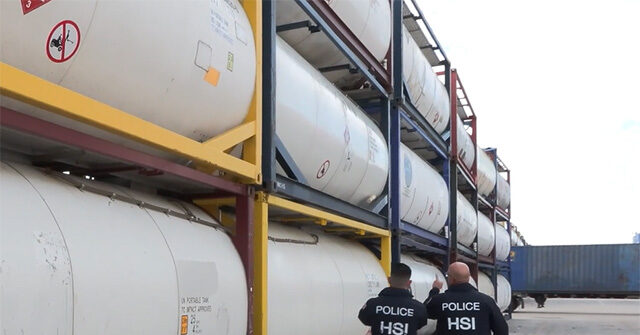
Multiple federal agencies announced Wednesday that they had seized 90 shipments of fuel intended to be illegally shipped from the United States to a sanctioned corporate entity in Cuba.
The shipment, which reportedly contains mostly diesel fuel and is worth $2.8 million, is expected to be received by Cuban energy company ENETEC SA. The company was sanctioned by the U.S. government for funding the illegal communist regime that controlled the country. Federal agencies said the seized shipments were on their way out of Florida and Texas.
The seizure shows that U.S. authorities believe that the Cuban regime, desperate for oil products, is apparently seeking them in the U.S. despite a long-standing so-called “embargo” that limits business with the Castro family dynasty. Cuba has faced severe fuel shortages this year since the arrest of Venezuelan dictator Nicolás Maduro in January. Maduro has provided Cuba with free or heavily discounted fuel for years in exchange for political and military support.
Cuba in particular needs access to diesel and other petroleum products because its decrepit power grid cannot meet the country’s electricity needs. Due to more than half a century of socialist mismanagement, Cuba can barely maintain its power grid, and what’s left is regularly failing. The wealthy, tourists, and the communist elite became accustomed to receiving electricity from private generators. If those generators run out of fuel, power outages can affect luxury hotels and other properties frequented by foreigners. This year, the grid has been down frequently, five times in August alone.
According to a press release issued by U.S. Immigration and Customs Enforcement (ICE) on Wednesday, multiple agencies, including Customs and Border Protection (CBP), “had information indicating that the Cuban government was using ENETEC SA to receive illegal exports of fuel from the United States,” leading them to take action to seize the shipment.
“A total of 71 shipments containing approximately 496,000 gallons of biodiesel were seized at the Port of Everglades, and 19 additional shipments containing approximately 119,000 gallons of biodiesel are currently being seized at the Port of Houston,” ICE said.
Special Agent in Charge Jose R. Figueroa of Miami’s Homeland Security Investigations (HSI), one of the participating agencies, said in a statement that the seizure “underscores Miami’s HSI’s commitment to preventing the illegal export of fuel and other goods to Cuba through sanctioned entities or deceptive commercial networks” and that authorities will continue to monitor and interdict such activity.
The agencies also released video of cargo seizures in Florida, where large numbers of tankers were impounded and lined up for inspection on land.
Independent media outlet Cubanet reported that authorities have opened a case against ENETEC SA, a Cuban company sanctioned on July 13 for providing supplies to the Castro regime. It is considered a Cuban state-owned enterprise, and Cuba.com describes it as “dedicated to the import, export and commercialization of combustibles.”
While direct shipments to Cuban state companies violate sanctions, Cuba.com observes that since Cuba is a repressive communist dictatorship, the non-existent “Cuban private sector” actually seeks to import U.S. petroleum products after the collapse of once-reliable Venezuelan supplies. According to reports, these goods have avoided “embargo” review through a loophole in U.S. policy that does not prevent companies from “supporting the Cuban people.”
On Thursday, Cuban Foreign Minister Bruno Rodriguez appeared to respond to the seizure in a social media post, declaring that the U.S. government “lacks the practical and moral authority to determine what is legal under international law and the law of free commerce.”
“Its measures are illegal not only against Cuba, but also against the rest of the international community,” Rodriguez declared. This claim is false, as any other country can — and many, including the United States’ European allies — do do business with Cuba. As far as its restrictions are concerned, it is a response to Cuba’s poor economic conditions and lack of respect for human rights. One notable example is the large Spanish hotel group Melía, which had dozens of hotels in Cuba for decades but closed its operations in Cuba this year in response to the island’s unsustainable economic climate.
Rodriguez then ranted that the United States “also has no right to impose a naval blockade or an energy blockade.”
President Donald Trump’s administration has frequently dismissed the Cuban regime’s accusations that Cuba’s energy woes are related to the United States or the “embargo.” On May 20, after announcing a series of new sanctions against the Cuban regime in response to its serious human rights violations, Secretary of State Marco Rubio gave a speech explaining that Cuba’s power struggle has nothing to do with any U.S. policy.
“You are forced to survive without electricity 22 hours a day not because of the US oil ‘blockade,'” he clarified. “As you know, and you know it better than anyone, you have been suffering from blackouts for years. The real reason you have no power, fuel or food is because those who control your country have looted billions of dollars that have not been used to help the people.”
Follow Francis Martel Facebook and twitter.