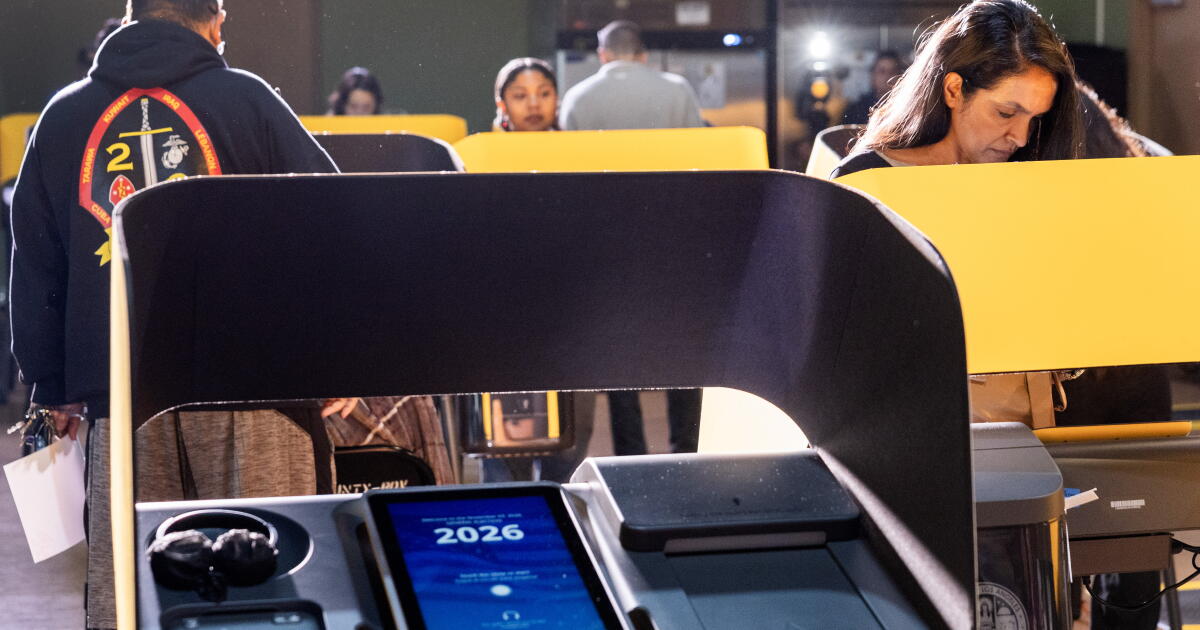
The Justice Department dispatched a last-minute swarm of election monitors to Los Angeles on Tuesday morning, hours after losing the latest legal tug-of-war over 20,000 disputed ballots in California.
In two rulings late Monday night, the Ninth Circuit Court of Appeals issued and then quickly reversed a ruling that allowed the Trump administration to sue election workers who handled disputed ballots even if their request to segregate them was rejected by the Supreme Court.
Then, as Election Day dawned, the Justice Department announced it would send “1,000 election monitors and observers” across the United States in what it called “the largest oversight effort in the Department of Justice’s history.”
Dozens of jurisdictions, including Los Angeles, New York, Chicago and Detroit, have fielded monitors under the auspices of the Voting Rights Act of 1965, legislation that President Trump has tirelessly pushed through both administrations.
A Justice Department spokesman said federal monitors “will be at polling locations” but that the department would not “disclose precinct details.”
The move was widely seen as an intimidation tactic.
“They are not doing this to ensure a free and fair election,” said Eric J. Segall, a Georgia State University law professor and Supreme Court expert. “They are doing this for nakedly partisan reasons and the federal government should not be allowed to do this.”
California officials were quick to push back.
“We will have our observers on the ground watching your monitors closely to ensure the integrity of a free, fair, safe, secure, accurate and reliable election in California,” Bonta vowed on social media as the altercation escalated early Tuesday morning.
The Justice Department said it would also dispatch monitors to San Diego, Sacramento and Alameda counties in the San Francisco Bay Area.
The sudden influx of election monitors and the dramatic U-turn by the appeals court are the latest dramatic twists in the Golden State’s protracted midterm tussle with the federal government — a battle that has captured national attention amid growing concerns about election interference by the Trump administration.
“On the eve of Election Day, the defendants insist that they must be free to use prosecutorial power to do what they cannot do by seeking an injunction from this court and the Supreme Court,” Ninth Circuit Chief Judge Mary Helen Murguia wrote in her dissent to the preliminary 2-1 ruling just after 8 p.m. Monday night.
“The district court properly sought to prevent defendants from using false threats of prosecution to intimidate election workers into abandoning lawful state election procedures,” Murguia wrote.
By 11pm, the decision had been overturned, with the court setting aside its previous ruling while it reviewed the case with a larger full panel.
It’s the latest legal blow in the administration’s months-long effort to retract ballots it says may have been issued to non-citizens, while publicly threatening to sue election workers who processed the ballots as its efforts were rebuffed in court.
Last week, the Justice Department issued criminal grand jury subpoenas to election workers in Los Angeles, seeking a trove of data related to efforts to comply with its demands.
Unions and voting rights groups filed suit in federal court, saying the actions amounted to “a coordinated campaign of intimidation, threats and coercion” of public servants to block legitimate votes.
On Friday, after the Ninth Circuit ruled in favor of California in a ballot recovery case, U.S. District Judge Trina Thompson in San Francisco issued a tough order blocking the Justice Department from pursuing criminal charges against election workers or requiring voters to be removed from the rolls.
“In the lead-up to the election, senior DOJ and DHS officials engaged in a campaign to intimidate, threaten, and coerce state and local officials and employees involved in administering the ongoing 2026 midterm elections,” Thompson wrote.
“Although defendants claim their actions were intended to prevent non-citizens from illegally voting, their actions could have the effect of interfering with the administration of the election and disenfranchising lawful voters,” the judge wrote.
Then, on Monday afternoon, just minutes after being asked to consider the issue, the Supreme Court returned an unsigned decision in California’s favor, appearing to rule out, at least briefly, further efforts to halt the vote count.
“This latest decision should put an end to the administration’s attempts to disrupt California’s elections through emergency court orders,” California lawyers said, Gen. Rob Bonta said Monday in response to the Supreme Court’s ruling.
But that’s not the case.
Instead, the latest decision from the Ninth Circuit sparked a flurry of confusion and speculation just hours before voting began in the nation’s most populous state.
After the court ruling, Siegel and others said the Trump administration’s move to deploy election monitors was part of a troubling pattern. The law professor worries the Supreme Court could weaponize remaining parts of the Voting Rights Act to benefit the president and his party.
“So far, they’re saying we’re going to chop off the legs [the Act] So as not to help the Democrats, but the next iteration will be to use the Voting Rights Act to help the Republicans,” he said.