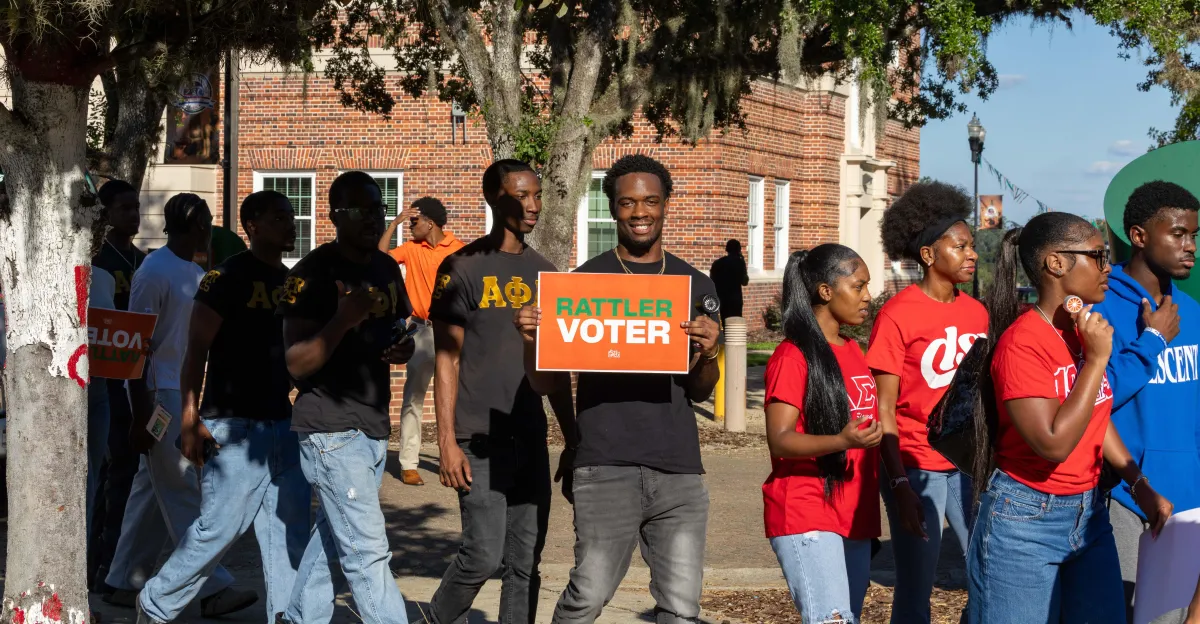
If there’s a Democratic wave in next week’s midterm elections, one of the biggest reasons will be young voters.
While voters of all ages have become dissatisfied with President Donald Trump and the Republican Party since his victory in 2024, polls show the decline has been particularly pronounced among young people who supported him in surprising numbers two years ago. The election results sparked endless discussions about the “climate shift” among Generation Z, and whether young voters are turning against “woke” progressives, radicalized by “manosphere” podcasts and TikTok algorithms, or lashing out at Biden-era gerontocracy.
But come November, things look very different. A Pew Research Center poll released earlier this month found that only 49% of 19- to 34-year-olds who voted for Trump over Kamala Harris approved of his job performance as president. (By comparison, about 75% of Trump 2024 voters age 50 and older still support him.)
The Pew Research Center also found earlier this year that young people’s partisan identification has shifted—or, rather, recovered.
In 2022 and 2023, Democrats hold a 17-point advantage among adults ages 18-29 — 55% of whom say they are Democratic or lean Democratic, while only 38% say they are Republican or lean Republican.
In 2024, that gap has narrowed, with Republicans actually leading slightly, at 47% to Democrats’ 46%. But now, in 2026, Democrats are set to regain a 16-point advantage, capturing 54% of young voters compared to 38% for Republicans.
It’s not just that fewer young people call themselves Republicans. Those who still support Republicans also say they are less likely to vote this year.
According to a Harvard Youth Poll released last week, 50% of Democrats ages 18-29 said they would definitely vote, but only 34% of Republicans in that age group said the same. That’s a 16-point partisan gap; the poll is the largest of the recent midterm cycle.
In a sense, the core reason for all this is not surprising. Like older voters, younger voters say their top concerns include the cost of living, government corruption, overseas wars and health care costs.
But the volatility — and the sense of betrayal and disillusionment among former Trump supporters — has been particularly acute among young people, raising questions about how their experiences and views particularly shape their politics.
To answer this question, I spoke with advocates and political consultants who focus on young voters. Here are the origins and limits of what they believe is the coming youth earthquake.
How to treat Generation Z “Trump regretters”
Rachel Janfaza, founder of The Up and Up, a strategy firm focused on Gen Z, told me that we should think of the young people who will vote for Trump in 2024 as three distinct groups.
First, she said, are the “hardcore young people who still support the president, just like the older MAGA people.” They supported him in 2024 and still support him now.
Second, she said, young people are “very keen to ride the America First train” but “are unhappy with Trump basically being part of the establishment, whether it’s building the White House ballroom, or the Epstein dossier, or starting new wars”—and therefore stay away from him.
These young people are much less likely to switch to the Democratic Party, but many of them may be disillusioned and too lazy to vote this year.
The third, she said, is “a large group of young people, primarily young people, who have never been die-hard MAGA, but they are voting for Trump in 2024 because they are frustrated with the whole political conversation.”
“They are frustrated with their economic situation; they are tired of political correctness and the pendulum swinging too far in the ‘woke’ direction,” Janfaza continued. These people now feel “politically homeless,” she said.
Tina Tang of Navigator Research, a Democratic-aligned firm, conducted multiple focus groups with young people who now regret voting for Trump. She told me that many “Trump regretters” said they initially hoped he would bring change to the entire political system and deliver on his promises for the economy and jobs.
“Young voters are particularly worried about jobs right now,” Tang said. “That’s actually one of the biggest frustrations we’re hearing from young voters this time: frustration with the job market. We heard a lot about how he promised a lot of things; he promised the economy would get better, costs would come down, there would be more jobs.”
Young people are pragmatists. They have lost faith in the system because they believe it is not working.
Several of the people I interviewed also urged caution about the common perception that young people tend to be strongly progressive or liberal, a long-held assumption that has led many observers to be blindsided by their shift to the Republican Party in 2024.
In fact, a Harvard Youth Poll released this week found that 25% of 18- to 29-year-olds consider themselves liberal, 23% consider themselves conservative, and about 46% consider themselves somewhere in between.
Santiago Mayer, founder of Voters of Tomorrow, a progressive youth-centered organization, told me that while Gen Z voters tend to have liberal values and policy views, they typically don’t define politics in ideological terms: “I think that for a lot of things that many of us would consider progressive, to them they’re common sense, and they don’t necessarily analyze those issues through a political lens.”
In fact, Mayer said that while the politicians who appeal most to young voters may differ in their ideologies, “what they all have in common is that they’re very pragmatic, very down-to-earth. They’re talking about how to improve today’s situation and how to actually create material, tangible change in the lives of young people.”
Navigator Research’s Tang agreed, telling me that young people “definitely remain skeptical of both sides.” She added: “What we hear a lot from young people is: they want to see results.”
The results they aspire to are first and foremost economic and cost of living. Jane Faza told me that experts have long held a misconception that young voters are obsessed with identity and culture wars—but she believes that was never true and is even less true now.
“Right now, climate and abortion are not even on the top of what young people say they care about,” Janfazah said. “That doesn’t mean they don’t care about these issues, it’s just that economic issues are of much greater concern.”
In fact, she believes that some young voters’ “flirtation with socialism” is actually more about policies like affordable housing, affordable health care and affordable education, and the promise of disrupting the status quo. “That’s really what young people are craving.”
Key to young people’s worldview is their increasing pessimism about the status quo. A surprising finding from the Harvard Youth Poll is that when asked whether they expected themselves to be better off or worse off financially than their parents by the time they reached their age, more people said worse – a first for the poll.
“I think you can see in the numbers that there’s a level of nihilism among young voters,” Mayer said. “They’re basically giving the Democrats another chance. But I’m afraid this is our last chance to get them to believe in democracy.”
And, he worries, if Democrats don’t actually improve their lives, “they’ll be gone forever.”