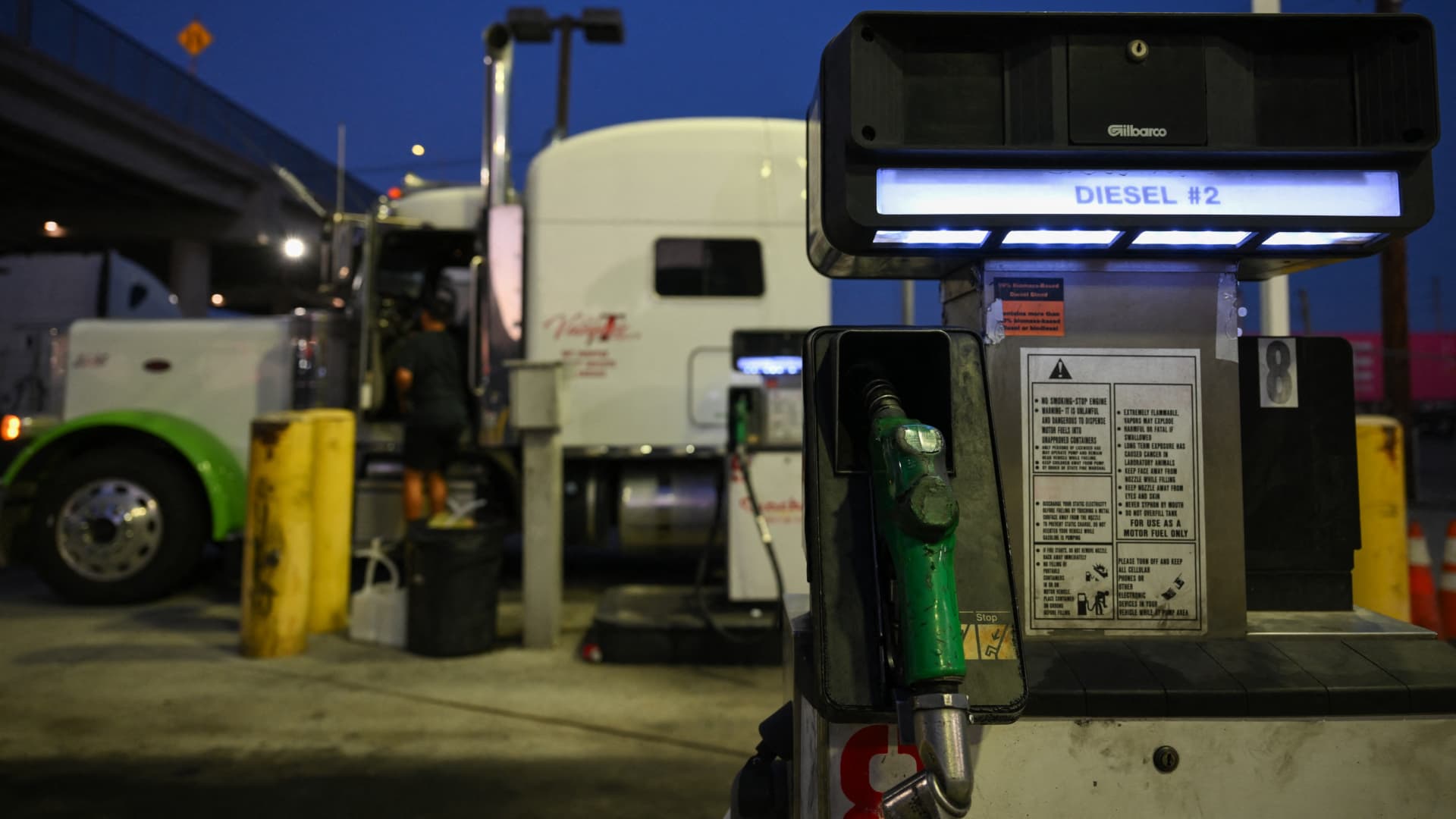
A driver pumps diesel fuel at a truck stop in Miami, Florida on September 11, 2026. The price of diesel fuel in the US topped $6 per gallon for the first time.
Joe Raedle Getty Images
Diesel prices may have to remain high until 2027 as refinery constraints contend with recovering consumption from the government and companies rebuild depleted inventories, according to Goldman Sachs.
“We need to keep product prices high enough to see some demand damage next year,” Nikhil Bhandari, Goldman’s head of Asia-Pacific natural resources research told CNBC’s “Squawk Box Asia” Monday.
The bank sees high diesel prices as necessary to prevent demand from recovering from overstretched refineries.
Goldman predicts the global spread of crack diesel and jet fuel – a premium refined product of crude oil – will average above $40 a barrel in 2027, more than double the usual level of around $20.
This is despite the bank expecting Brent crude to stabilize at around $80 a barrel as new crude flowing through the Strait of Hormuz gradually normalizes.
“If there is a rebound in demand next year, we think the global refining system should reach the highest level of utilization seen in the last two decades,” Bhandari said.
Baden Moore, resource and energy research analyst at broker CLSA, said that the new weakness does not necessarily represent a permanent loss of demand.
“Underlying demand for oil products remains intact,” Moore said in an email to CNBC, adding that buyers have rebalanced the market through inventory management, reserve drawdowns, consumption reductions and refinery optimization.
Replenishment of global inventory while meeting demand could take up to two years, he added.
Under pressure
Recovering demand for refined products could also collide with a strained refinery network, Goldman said.
The bank expects 2026 to be another year of “negative refining capacity growth,” as refining capacity outside China is expected to contract by about 300,000 barrels per day.
Goldman estimates that product inventories could end 2026 below the lowest daily supply level recorded since 2015, according to the global Refining Super Cycle report published on September 21.
Meanwhile, about 2 million barrels per day of Middle East refining capacity remain offline, Bhandari said, while damaged Russian facilities have further limited diesel supplies.
U.S. refineries that have been running at higher rates to compensate for reduced capacity will also have to experience deferred maintenance that will temporarily slow refineries, he said.
The recovery in Gulf crude oil exports is not expected to increase the availability of refined products, as shipments of diesel, gasoline and jet fuel remain limited.
Bhandari’s comments came after the Group of Seven countries agreed on Friday to release 100 million barrels of crude oil and refined products over four months, including a “substantial release of diesel ahead” in the first 20 days.
The announcement sent European oil futures down 5.75%.
But experts are not optimistic that the additional supply will improve the availability of refined products and temper prices in the long term.
Emergency reserves “might buy us a winter,” but cannot fix long-term supplies, Saudi Aramco CEO Amin Nasser said on Monday.
“Emergency releases only address liquidity issues, not underlying stock issues,” CLSA’s Moore said. The release buys time, but means that inventory is used rather than rebuilt, making restocking a long-term source of demand.
Bernard Aw, chief economist for Asia-Pacific at Coface agreed, adding that the impact of the release was “temporary rather than structural,” in an emailed statement to CNBC.