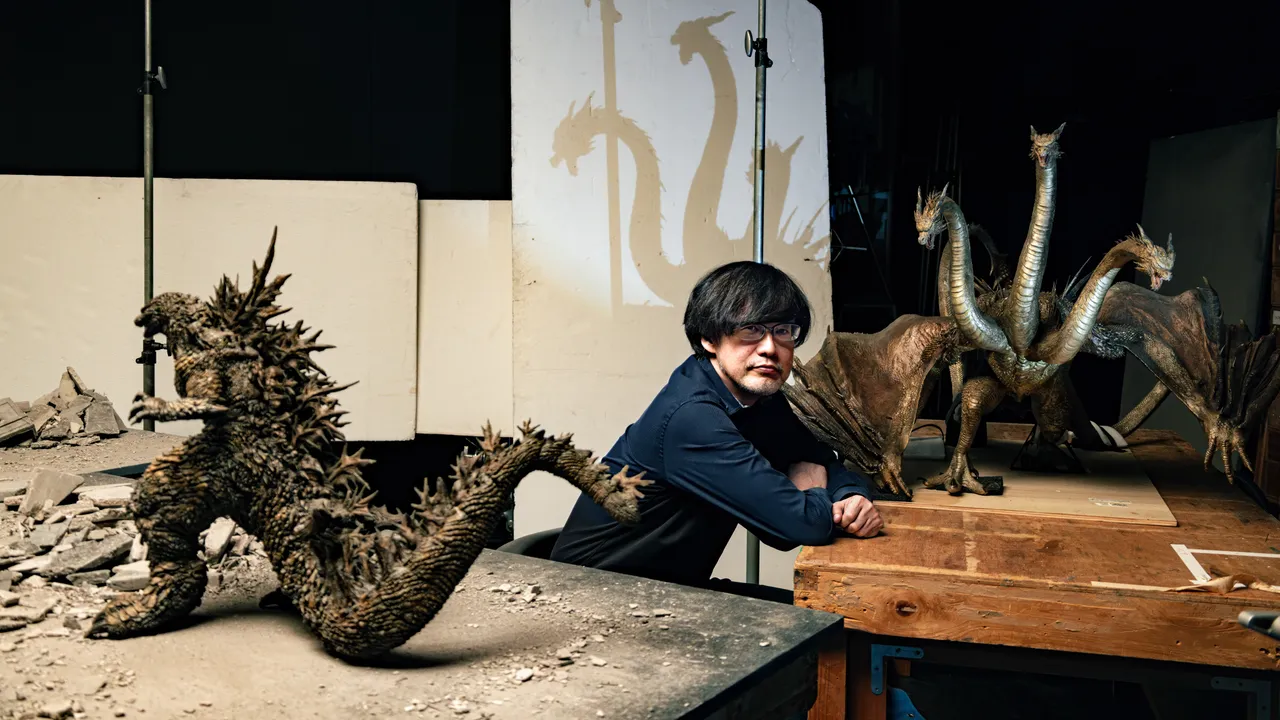
The scene they filmed involved a plot to draw Godzilla’s attention to the flying invader Ghidorah in order to stop the latter from destroying the city. The effort was spearheaded in part by Kenji Noda, the bespectacled scientist who led the attempt to subdue Godzilla in the previous film. Human characters are about to suffer a concussive explosion from Godzilla’s fiery breath – actors must act out the effects of the explosion, which will then be added digitally alongside Godzilla himself.
Roland Emmerich was the first director to make Godzilla entirely using CGI rather than actors in suits, which he did in the 1998 Hollywood reboot of the film. Anno and Higuchi’s Shin Godzilla was the first Japanese production to do this. Yamasaki told me that he “never considered” having the actors wear suits. “The interesting thing about a suit is that the person inside it can express himself through it,” he said. “Godzilla moves right in front of you, on set, in the camera — that’s another advantage. But I wanted to do something more complex.” He explains that digital effects allow for many tricks that are impossible with a physical suit, such as subtly changing the proportions of a monster’s head or feet to accentuate its size, or precisely calibrating the ripples and currents around an underwater creature.
In the studio, Yamazaki strode across the Styrofoam carved into rubble toward the bell tower, then climbed a ladder to survey the scene. A crew member handed him a tablet. Yamazaki could see a view of the room on the screen, superimposed with a carefully rendered model of 1949 Tokyo. He can point to any part of the studio and see the virtual city and where Godzilla will appear in it, as if he were playing a giant version of Pokémon Go. Yamasaki told me that the use of augmented reality was a key part of how he set up the eyelines and camera angles.
Yamasaki’s production process did involve a physical version of Godzilla: On the far wall, a stagehand held up a long pole with a colorful printout of the monster’s face attached to one end. Yamazaki loudly made adjustments—higher, lower, a little to the left—until it matched the position of the CGI Godzilla on the screen. The actors caught their eye, and Yamazaki returned to his chair. Crews turned on spotlights to simulate the glare of an explosion. Then the wind turbine roared to life. Behind the bell tower, the actors ducked for cover as wind and dust washed over them, flattening their hair and sending newspapers flying.
Yamasaki is a precise filmmaker. His cast and crew are often frequent collaborators, and he has a keen sense of budget. As a result, his shooting efficiency is unusually high. This lean approach has attracted significant attention abroad; Hollywood studios reportedly spent $160 million on 2014’s Godzilla. In contrast, according to hollywood reporterthe cost of “Godzilla Minus One” was “only $15 million.” Neither Yamazaki nor Toho would confirm the figure, but in a 2024 interview with Japan House Los Angeles, he explained, “I’ve learned strategies to save.”
In American visual effects, a single shot is usually the job of many specialists – “riggers” who build the digital skeleton of the model, “gaffers” who handle the lighting and animators. Their work takes place in so-called pipelines, where a delay from one specialist or a supervisor’s displeasure can ripple throughout the production line. “In my company, one person handles multiple tasks,” Yamazaki continued. “Maybe just one or two people can finish a shot. No need to wait for other people to finish, no need to blame other people.”
I asked Yamasaki if the Oscar meant he had a bigger budget this time around. He smiled—as he often did, looking like a child who had just received a coveted toy. To some extent, he did. On set, I would often see him waving his hands to imitate the head of a snake-like monster, or making an explosion sound, while watching the camera feed on the monitor.
“A little,” he admitted.