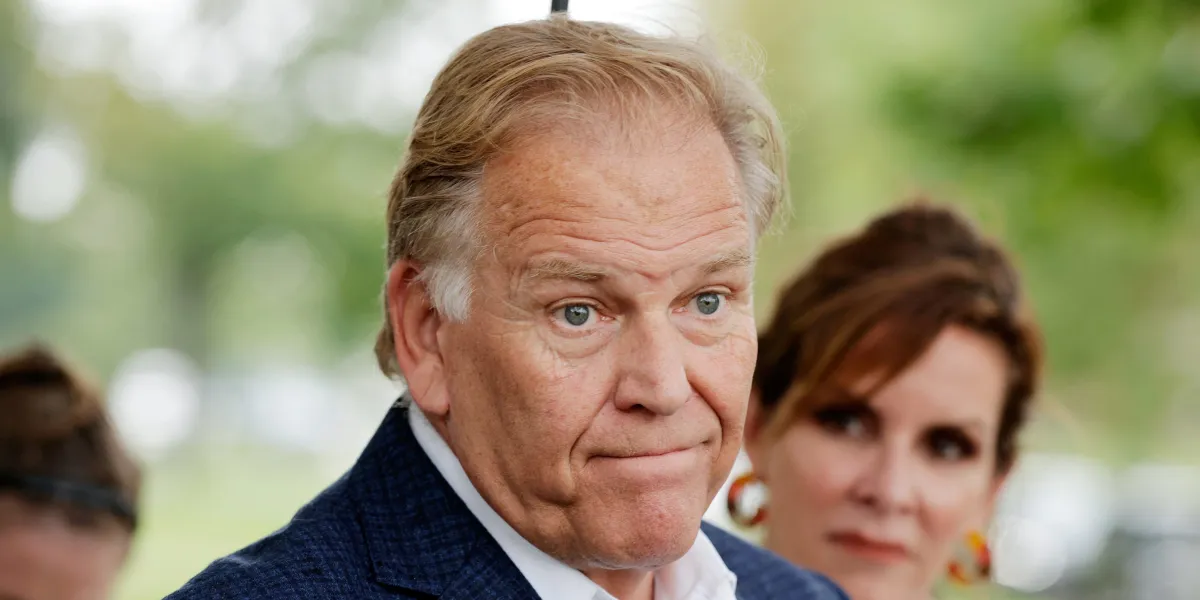
Astronomical fuel prices The U.S.-Israel war in Iran has Mike Rogers getting increasingly emotional.
The Republican candidate for Michigan Senate spent more than $40,000 to pay the bill for a private jet last month, according to campaign finance records reviewed by The Intercept. The five-figure ticket was part of more than $100,000 worth of campaign cash Rogers spent on luxury travel last quarter, much of it on private jet travel.
As economic woes impact Michigan’s Senate race, Rodger’s opponent, Democratic candidate Abdul-Sayed, a former public health official, has repeatedly attacked Republicans for their ties to corporate and billionaire donors. Rogers, who represented Michigan’s 8th District in the House from 2001 to 2015, often advocated in Congress for lawmakers to accept gifts and other benefits from restricted nonprofits. He helped defeat a 2006 bill that would have cracked down on lobbying by former members of Congress and banned certain privately funded travel.
For Jeffrey Hauser, a critic of corporate political influence, Rogers’ newly revealed campaign spending on luxury services could serve as a warning to Michigan voters about the crisis in a struggling economy.
“It seems like Mike Rogers has developed a real taste for good things,” said Hauser, director of the Revolving Door Project, which does not endorse any candidates in the Michigan race. “That means he may want to continue to curry favor with and be courted by the economic elite, which bodes badly for working-class Michiganders because they want their senator to have some understanding of their lives and identify with their interests.”
In September, the Rogers campaign paid JL Jets $93,152 for at least five separate private charter flights, including a $40,000 deal. Around the same time, the campaign also poured another $500 into luxury chauffeur company Blacklane. From July to September, Rogers’ campaign paid Blacklane an additional $4,527 for luxury car services, including $2,078 for driver fees on Aug. 17. The campaign spent $683 on two limousine trips in August and September.
The campaign requires extensive travel, and El-Sayed’s campaign finance records show total travel expenses were higher — about $330,000 last quarter, according to public documents. But the funds were spent on commercial flights on Delta and American Airlines, Hertz car rentals, gas, Uber and Lyft rides and hotel stays.
El-Sayed has an even busier campaign schedule as he faces off against Rep. Haley Stevens in the Democratic primary, while Rogers has been considered the Republican nominee from early in the campaign. El-Sayed’s campaign said he held more than 500 events before the August primary, while Rogers adopted a more relaxed schedule during the general election cycle.
In a statement to The Intercept, Rogers’ spokesperson pointed to El-Sayed’s meal and travel expenses during the campaign, as well as a series of high-profile donations his father-in-law made to super PACs supporting the campaign.
“Abdel-Sayed reimbursed himself $90,000, and his father-in-law (a senior adviser to CAIR) gave his SuperPAC $300,000,” said Abby Ronson, a Rogers campaign spokesperson. “If the Intercept was looking for the FEC story, I would look closely at Abdul.” The Saied campaign did not immediately respond to a request for comment.
If elected, Rogers wouldn’t be the only U.S. senator to spend significant sums on private jets. He seems to compete with whoever spends the most money. Only Sen. Mike Rounds and Democratic Sen. Kirsten Gillibrand spent more on private flights than Rogers did last quarter, and they did so over the course of a year and a half, as public scrutiny forced politicians away from charter flights, Axios reported.
The Rogers campaign did book some flights through airlines such as Frontier and Southwest, spending about $29,000 on 10 flights, but luxury transportation accounted for the vast majority of the campaign’s travel spending last quarter.
Rogers’ hotel expenses included $2,000 for a stay at The Breakers, a luxury oceanfront hotel in Palm Beach, Florida; another $1,295 at the Grand Traverse Resort and Spa in Michigan; and $200 for a stay at the five-star Palazzo Hotel at the Venetian Resort in Las Vegas. In addition to travel expenses, the campaign paid deputy campaign manager Tyler Henningsen $2,165 in late September for car repairs at a BMW dealership in Bloomfield Hills, one of Michigan’s wealthiest areas. Henningsen did not immediately respond to The Intercept’s request for comment, but a Rogers spokesman said the car was used for campaign purposes.
Luxury transportation accounted for the vast majority of the Rogers campaign’s travel spending last season.
Campaign finance rules state that spending on travel and vehicle expenses is allowed as long as it is strictly for campaign purposes. It is generally illegal to use campaign funds for personal travel; if a person uses campaign funds for mixed personal and campaign travel, they must repay the campaign expenses within 30 days. If a campaign pays for a car, the car can only be used on the campaign trail.
Rogers has significant personal investments in real estate, artificial intelligence and cybersecurity. His Senate campaign has received strong support from billionaire Apollo Global Management CEO Mark Rowan, the DeVos family and business leaders such as Elon Musk. Since Rogers pledged to “protect” the world’s richest man from congressional oversight, Musk has poured more than $6 million into the campaign through his super PAC, America’s Political Action Committee.
On the debate stage, El-Sayed took aim at Rogers’ Florida home and his two “yachts,” trying to portray the former congressman as someone who is out of touch with everyday working Michiganders. Public records show Rogers owned two 32-foot and 39-foot boats in Maryland, but he reportedly sold one of them. According to news outlet Michigan Bridge, Rogers is trying to sell his Florida home and live in Michigan full-time.
During his time in Congress, Rogers served as chairman of the House Intelligence Committee and was a leading supporter of the Patriot Act, pushing for expanded domestic spying powers. In 2013 and 2014, toward the end of his term in Congress, he and his wife, Kristy, attended two weekend retreats at The Cloister, a five-star resort in Sea Island, Georgia, funded by the American Enterprise Institute, a right-wing think tank. At the 2014 forum, which CBS News described as “a private, off-the-record gathering of conservative leaders and wealthy donors,” Rogers spoke on “cybersecurity and national security issues” as a panelist in his capacity as chairman of the House Intelligence Committee, disclosure forms show.
In addition to Rogers, the 2014 event featured prominent conservatives as speakers, such as then-House Majority Leader Rep. Eric Cantor, R-Va.; Iraq War architect Karl Rove; then-Sen. Marco Rubio, R-Fla.; New York Times columnist David Brooks; Gene Sperling, then-chairman of the National Economic Council; and Keith Alexander, director of the National Security Agency under Presidents George W. Bush and Barack Obama. Also in attendance were Betsy DeVos, education secretary in Donald Trump’s first term, and former Amway CEO Dick DeVos, who has since funded Rogers’ current campaign and several past campaigns.
Weeks after conservatives retreated, Alexander resigned as NSA director in the shadow of Edward Snowden’s revelations about the U.S. government’s role in a global spy network. That same year, Alexander founded cybersecurity company IronNet and hired Rogers in 2015 after he decided not to run for re-election. He was later promoted to the board of directors of IronNet, which is now bankrupt, and received more than $700,000 in payments and held $250,000 to $500,000 worth of stock in the company, according to financial disclosure forms.
“Politicians spend a lot of time dealing with the ultra-rich, either because they want to raise money from them, or because they consult on economic issues, or both,” Hauser said. “As a result, they start to develop expensive tastes.”