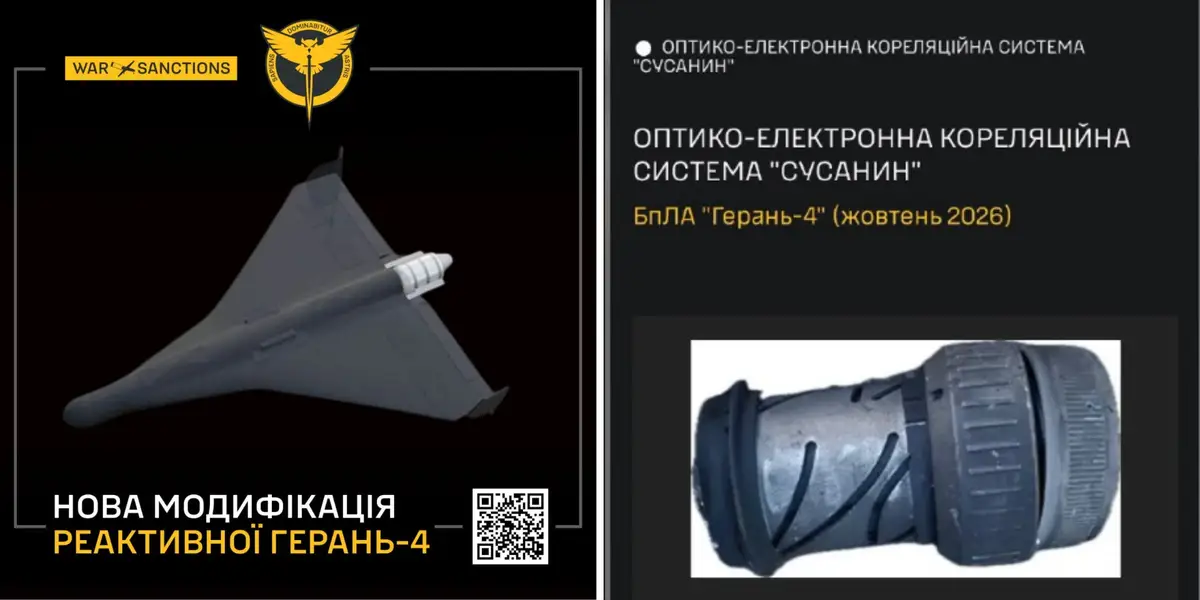
Last week, Ukraine’s Defense Intelligence Service appealed for information about newly discovered equipment in Russia’s latest killer drones.
“Susanin” is a small cylinder with a camera attached to it, an optical system that allows Russia’s long-range drones to navigate the skies of Ukraine without relying on satellites or radio signals.
If deployed on a large scale by Moscow, the modules would pose a major new challenge for Kyiv, allowing Russian unidirectional drones to bypass jamming – a key pillar of Ukraine’s air defense network.
The Kremlin has installed them on turbojet Geran-4 and Geran-5 K5 aircraft, which fly at speeds of 280 mph or faster, and which Russia has increasingly used this year, according to the intelligence service (GUR). These drones are already difficult for Ukraine to destroy by force because their speed exceeds that of typical Ukrainian interceptor drones.
Susanin works by storing images of Ukraine’s terrain on a drone, then using a downward-facing camera to observe the ground while flying and comparing the instant feedback with the pre-saved images. Through these comparisons, the drone can independently determine its location and how to reach its target.
“Even Google Earth imagery is sufficient for basic positioning,” Serhii “Flash” Beskrestnov, a prominent drone analyst with ties to the Ukrainian military, wrote on Sunday.
Beskrestnov warned that Russia may continue to actively develop the Susanin system for its drones next year.
“Our enemies already use such systems on small Molniya, V2U and Lancet drones,” he added.
Cruise missile technology on drones
The technology is similar to that used by some cruise missiles to reach their targets in jammed environments. For example, the Tomahawk missile has what analysts call “Digital Scene Matching Zone Correlation,” which takes photos of landmarks beneath the missile and compares them to satellite imagery stored on the missile.
High-end Russian cruise missiles such as the Kh-101 use a Russian version of this technology called Otblesk-U. But the Kh-101 has an estimated unit price of $2.4 million, and its long-range drones cost a fraction of that: the delta-winged Geran-4 is estimated to cost $50,000 to $70,000 each, while the Geran-5 is believed to cost around $100,000 to $115,000.
The ground near the Epicenter retail center is littered with the remains of a drone after a Russian Geran-4 attack on Kharkiv. Polina Kulish/Gwara Media/Global Pictures of Ukraine via Getty Images
Russia is producing these drones much faster, launching more than 3,500 jet attack drones into Ukraine in September alone.
Kyrylo Liukov, head of the unmanned technology department at the Serhiy Prytula Charitable Foundation, told Business Insider that Russia is “very likely” to expand its use of navigation systems such as Susanin.
“Russia is already using this navigation system for medium-depth strike operations,” Liukov said, adding that the system’s deployment on Geran-4 and Geran-5 has been increasing recently.
Still, Liukov said these systems have their limitations. Susanin is only useful against pre-programmed drone attacks and cannot help drones find moving Ukrainian armored vehicles or mobile missile launchers.
“In other words, these are mainly planned static targets,” said Lyukov, whose organization raises funds for Ukraine’s military and drone manufacturers.
But the prearranged flights fit perfectly into Moscow’s strategy with Jerans, launching them in large numbers to overwhelm Ukraine’s air defenses and wreak havoc on its cities.
The battle with Susanin
Lyukov said that if Russian turbojet drones used the Susanin system, Ukraine’s only current response would be to use force.
Ukraine’s options in this area remain limited, with its military still in the early stages of introducing advanced interceptor drones capable of capturing turbojet Jerans. Another approach is to launch rare and expensive anti-aircraft missiles, which are usually reserved for Russia’s more capable cruise or ballistic missiles.
Lyukov said one possible solution that Ukraine might eventually explore is to obscure the Susanin’s cameras. He said the Ukrainian terrain captured by the camera could also be obscured by clouds, rain or fog.
“For high-quality route identification using Susanin, flight altitude relative to speed is required in order to use captured images as well as favorable weather conditions for precise positioning,” Liukov said.